What Are the Key Green Finance Trends for 2026?

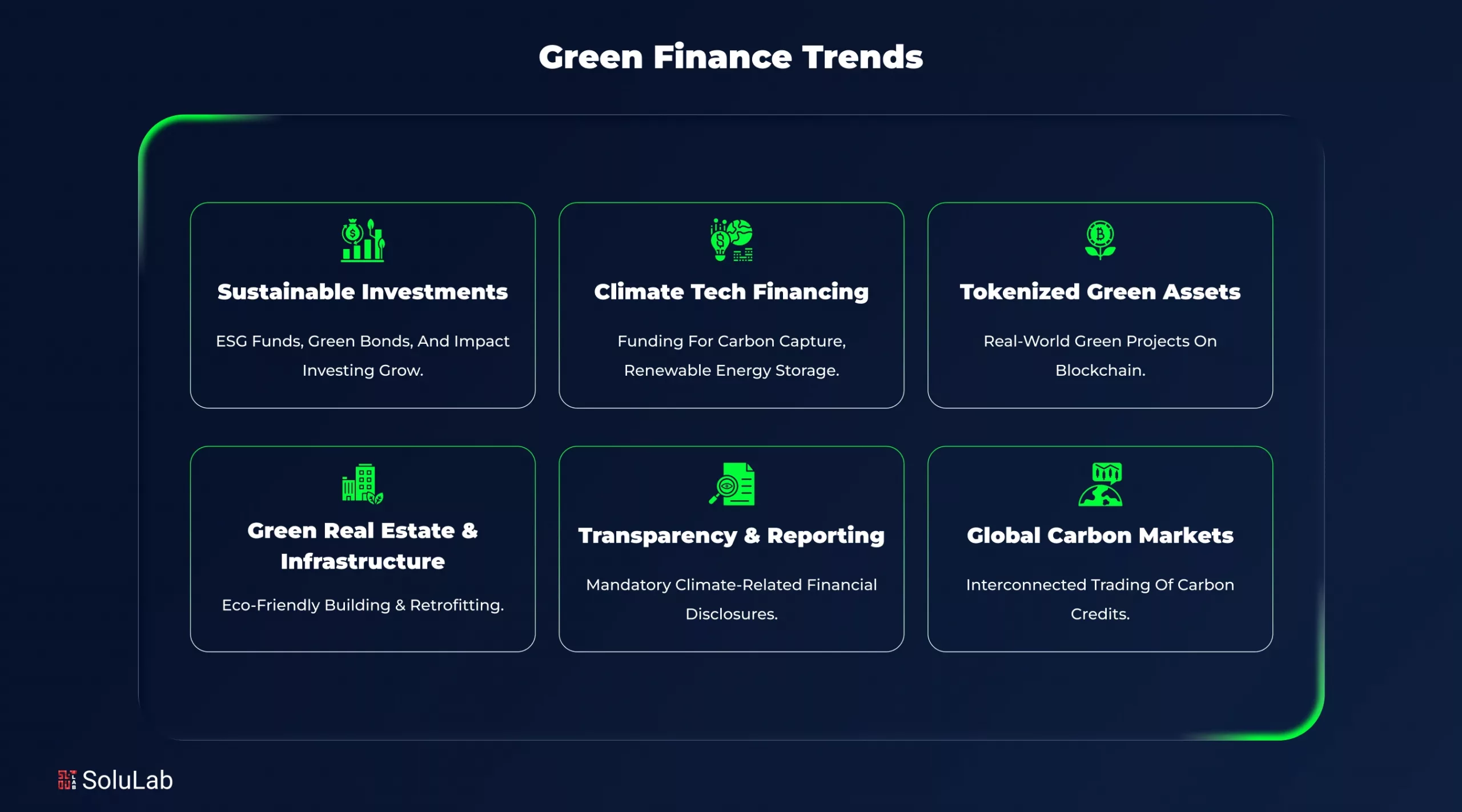
key Green Finance Trends

What if every dollar you invested could help fight climate change and grow your wealth?
That’s exactly the promise of green finance, a rapidly expanding movement reshaping global financial systems. As the world races toward net-zero targets, investors, governments, and corporations are turning to sustainable funding models that strike a balance between profit and purpose.

By 2026, green finance is no longer a niche concept; it’s becoming the foundation of responsible economic growth. From AI-powered ESG assessments to tokenized carbon credits and climate-linked bonds, technology and policy reforms are driving a new era of eco-conscious investment.

In this blog, we’ll explore the key green finance trends for 2026, the innovations, frameworks, and opportunities that are redefining how money moves toward a sustainable future.

Why 2026 Is a Pivotal Year for Green Finance?

The year 2026 marks a critical turning point for global finance systems as sustainability shifts from being an optional strategy to a core financial priority. The momentum toward green finance, which supports environmentally responsible investments, is accelerating due to several key global and regional developments.

1. Stricter Global ESG Regulations

Governments and financial regulators across the EU, UAE, and Asia-Pacific are enforcing tighter ESG (Environmental, Social, and Governance) compliance standards. By 2026, major economies are expected to align their corporate disclosure norms with IFRS Sustainability Standards, making transparent sustainability reporting mandatory for both public and private institutions.

2. Post-COP28 Commitments Coming into Effect

The outcomes of COP28 are translating into actionable finance targets in 2026. Countries are channeling more funds into renewable energy, climate adaptation, and carbon neutrality projects, creating massive opportunities for green bonds, sustainability-linked loans, and climate-focused fintech innovations.

3. Technology and Finance Converge

With the AI integration, blockchain, and data analytics, financial institutions are developing smarter, traceable, and verifiable sustainability models. By 2026, these technologies will be standard tools for measuring carbon impact, assessing ESG risks, and tokenizing green assets for greater transparency.

4. Investor Behavior Is Changing Fast

Institutional and retail investors are demanding ethical and climate-conscious portfolios. This shift is pushing banks, asset managers, and fintech startups to embed sustainability into their products. As a result, green investing is becoming a mainstream growth driver rather than a niche segment.

5. Transition from Pledges to Measurable Impact

Unlike the previous decade, where green finance often revolved around voluntary goals, 2026 focuses on accountability and impact measurement. The emphasis is on quantifying results, carbon reduction achieved, biodiversity preserved, and energy efficiency improved, turning sustainability into a tangible financial metric.

Top Green Finance Trends Shaping 2026 Ahead

Trend #1. Tokenized Green Bonds & Blockchain Transparency

Businesses are using blockchain technology to issue digital green bonds. This creates tamper-proof records and faster secondary trading, key benefits for investors and regulators. This innovation is driving major trends in green finance and reducing transaction costs for institutional players. For businesses, it’s a practical way to raise capital while proving sustainability commitments.

For example, over $10 billion in tokenized bonds have already been issued globally by mid-2025. Settlement costs are reduced by up to 80% through smart contract automation, and major institutions like BlackRock and Abrdn are actively exploring blockchain-based issuance.

A standout case is Hitachi’s 10 billion yen ($69 million) digital green bond issued in 2023, which featured real-time ESG metrics streaming to investors and instant settlement capabilities.

Trend #2. AI-Driven ESG Scoring

Artificial Intelligence can scan huge ESG (Environmental, Social, Governance) data sets in real time and deliver accurate risk reports. Companies that adopt AI will stay ahead of the top green finance trends and build stronger trust with investors. 

Leading platforms include:

  • Persefoni for end-to-end emissions tracking
  • Sylvera for AI-powered carbon credit ratings
  • Planet Labs for satellite-based forest carbon monitoring using machine learning

Collectively, the top 15 SMEs in AI-driven carbon management have raised over $160 million, with Planet Labs alone securing $95 million in Series C funding.

For enterprises, AI tools make compliance easier and help identify profitable, climate-friendly investments.

Trend #3. Carbon Credit Marketplaces

Voluntary carbon markets are expanding quickly, making them a highlight of the latest trends in sustainable finance. Digital MRV (measurement, reporting, verification) tools let businesses buy, sell, and retire carbon credits. This is central to any sustainable green finance strategy and gives companies a new way to offset emissions or create new revenue streams.

Platforms like Xange combine satellite data, blockchain, and AI to offer fully transparent carbon credit systems that meet the highest ESG standards for monitoring and verification.

Trend #4. Embedded Green Finance

New fintech APIs now add “green by default” features directly into enterprise software. With these integrations, clients can automate compliance, track ESG goals, and launch new services faster. This is becoming one of the most important green and sustainable finance opportunities for software providers and financial institutions alike.

Real-world example includes Tide UK, whose business banking app shows the carbon footprint per transaction.

CTA1

Technology Enablers for Sustainable Finance

For modern enterprises aiming to lead in green finance trends, the right technology stack is critical. Modern infrastructure is the backbone of green, sustainable finance and drives measurable impact. Here are the key enablers explained in straightforward terms:

1. Cloud & Edge Computing

  • Provides real-time carbon tracking and energy-use monitoring across multiple facilities or trading desks.
  • Scales easily so global green finance companies can process ESG data without latency or heavy on-prem costs.
  • Microsoft Azure Cosmos DB supports containerized, climate-resilient financial apps.

2. Smart Contracts on Blockchain

  • Automate compliance for ESG-linked loans, green bonds, and carbon credit trades.
  • Reduce manual audits and human error, vital for sustainable and green finance projects where transparency builds investor trust.

3. API-First Platforms

  • Offer seamless integration with banking systems, trading engines, and third-party ESG data sources.
  • Enable quick rollout of new sustainable finance trends such as tokenized green bonds or carbon-offset marketplaces.

By combining these elements, scalable cloud infrastructure, blockchain-based smart contracts, and flexible APIs, enterprises can implement green and sustainable finance solutions that are both cost-effective and audit-ready. 

Opportunities for Enterprises & Financial Institutions

Companies that act early on green finance trends 2025 and the broader green finance trends shaping 2026 can win investor trust, meet stricter regulations, and stand out in a crowded market. Acting now provides three key advantages:

New Revenue Streams: 

Offer ESG-as-a-service, launch white-label carbon marketplaces, or create platforms for sustainable and green finance trading. These solutions attract climate-focused investors and corporate clients seeking measurable impact.

  • Lower Capital Costs: Early adoption of sustainable finance trends makes it easier to qualify for sustainability-linked loans and green bonds, reducing borrowing costs while meeting compliance standards.
  • Brand Leadership: Companies that integrate green and sustainable finance solutions signal long-term commitment to ESG goals and can secure premium partnerships with banks, asset managers, and large green finance companies. Companies like UPS and SIDBI in India demonstrate how sustainability drives premium partnerships.

While established green finance companies set the pace, agile mid-market firms can leapfrog them by partnering with technology agencies that specialize in blockchain, AI, and API development.

How to Implement Green Finance Solutions in 2026?
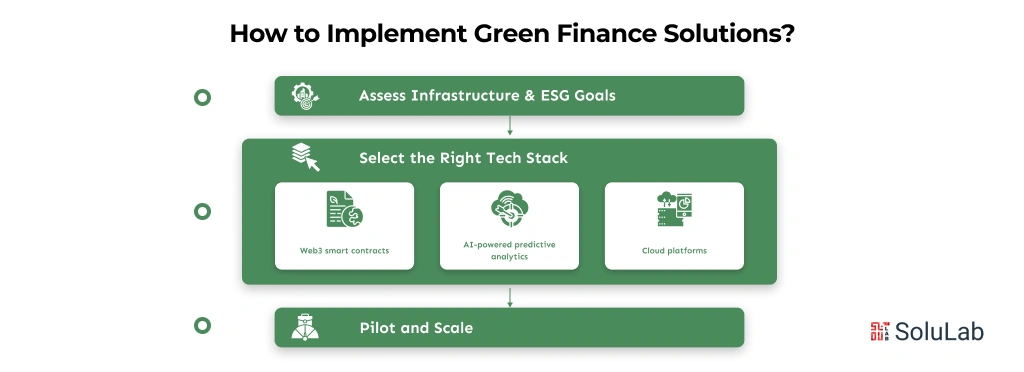
How to Implement Green Finance Solutions

As global finance shifts toward sustainability, the next challenge for businesses, investors, and governments is implementation, turning green finance concepts into measurable impact. Here’s a step-by-step look at how organizations can practically integrate green finance strategies and technologies in 2026:

1. Assess Infrastructure & ESG Goals

Begin by reviewing your current finance systems, reporting processes, and sustainability targets. Conduct a gap analysis to identify areas where green finance trends and sustainable finance trends can create the most impact. Look for opportunities to integrate tools like carbon accounting platforms, automated ESG reporting dashboards, or blockchain-based transaction tracking. 

This step ensures your enterprise aligns with regulatory expectations and global ESG standards, while also identifying quick-win areas for ROI.

2. Select the Right Tech Stack

Choose technologies that are proven, scalable, and compliant with evolving trends in green finance. For example:

  • Web3 smart contracts for automated ESG compliance and real-time verification of green bonds.
  • AI-powered predictive analytics to score ESG risks, track sustainability KPIs, and forecast carbon impact.
  • Cloud platforms and APIs to capture, store, and share real-time carbon data across your enterprise systems.

These solutions not only make your green and sustainable finance operations more efficient but also position your company as a leader in sustainable and green finance adoption.

3. Pilot and Scale

Deploy a pilot for a single product or service line, such as a tokenized green bond platform or an AI-driven ESG dashboard. Measure performance, calculate ROI, and refine workflows. Once validated, scale across multiple products or geographies. 

This phased, data-driven approach keeps you ahead of trends in sustainable finance, reduces operational risk, and builds confidence with investors, regulators, and corporate partners.

How Our Development Agency Accelerates Adoption?

Our leading blockchain development company helps enterprises implement the latest trends in green finance with scalable technology. We deliver:

  • Custom Blockchain Platforms for issuing and managing tokenized assets like green bonds and verifiable carbon credits.
  • AI-Powered ESG Dashboards that automate reporting and provide real-time analytics aligned with global standards.
  • Secure API Integrations that embed sustainable green finance capabilities, such as automated carbon tracking, into your existing banking or trading systems.

This combination of blockchain, AI, and cloud architecture ensures your business can adopt top green finance trends quickly while maintaining enterprise-grade security and compliance.

CTA2

Conclusion

2026 is set to shape the future of green finance companies and business innovation. From AI-powered ESG analytics to blockchain-enabled carbon trading, technology is driving faster, smarter, and more transparent finance solutions. 

Companies that focus on green finance trends, sustainable finance trends, and green and sustainable finance now will be best positioned to attract investors, reduce risk, and stay ahead of competitors. 

For business enterprises, adopting these trends is not just about compliance; it’s about growth, efficiency, and leading the market in sustainability-driven finance.

FAQs

1. How Can Startups and SMEs Enter the Green Finance Space?

Startups can integrate sustainability metrics into their business models early — through carbon-tracking APIs, green payment gateways, or tokenized funding models. Partnering with fintech or blockchain developers can help them build compliance-ready green finance platforms at scale.

2. How Can Companies Prevent Greenwashing in 2026?

By adopting data-backed verification systems such as blockchain-based ESG ledgers, AI-driven performance audits, and third-party sustainability scoring. Authenticity and verifiable proof of impact are the only ways to maintain compliance and trust.

3. How Can My Business Benefit from Adopting Green Finance Practices?

Green finance practices help businesses attract eco-conscious investors, qualify for government incentives, and enhance brand reputation. They also lead to operational savings through energy-efficient processes and stronger access to ESG-aligned funding opportunities.

4. How Can Enterprises Measure the Impact of Their Green Finance Strategy?

Enterprises can track performance using carbon accounting systems, AI-based ESG dashboards, and blockchain analytics. Measuring reductions in emissions, energy usage, and waste output helps calculate both environmental and financial returns.

5. How Can SoluLab Help Implement Green Finance Solutions?

SoluLab develops AI and blockchain-powered platforms that enable ESG tracking, green asset tokenization, and transparent carbon credit systems. Our solutions help financial institutions, fintechs, and enterprises align their business goals with sustainability and compliance standards.


 

Top 15 Web3 Development Companies in Dubai 2025 Edition

[fusion_builder_container hundred_percent=”no” hundred_percent_height=”no” hundred_percent_height_scroll=”no” hundred_percent_height_center_content=”yes” equal_height_columns=”no” menu_anchor=”” hide_on_mobile=”small-visibility,medium-visibility,large-visibility” status=”published” publish_date=”” class=”” id=”” border_size=”” border_color=”” border_style=”solid” margin_top=”” margin_bottom=”” padding_top=”” padding_right=”” padding_bottom=”” padding_left=”” gradient_start_color=”” gradient_end_color=”” gradient_start_position=”0″ gradient_end_position=”100″ gradient_type=”linear” radial_direction=”center” linear_angle=”180″ background_color=”” background_image=”” background_position=”center center” background_repeat=”no-repeat” fade=”no” background_parallax=”none” enable_mobile=”no” parallax_speed=”0.3″ background_blend_mode=”none” video_mp4=”” video_webm=”” video_ogv=”” video_url=”” video_aspect_ratio=”16:9″ video_loop=”yes” video_mute=”yes” video_preview_image=”” filter_hue=”0″ filter_saturation=”100″ filter_brightness=”100″ filter_contrast=”100″ filter_invert=”0″ filter_sepia=”0″ filter_opacity=”100″ filter_blur=”0″ filter_hue_hover=”0″ filter_saturation_hover=”100″ filter_brightness_hover=”100″ filter_contrast_hover=”100″ filter_invert_hover=”0″ filter_sepia_hover=”0″ filter_opacity_hover=”100″ filter_blur_hover=”0″][fusion_builder_row][fusion_builder_column type=”1_1″ layout=”1_1″ spacing=”” center_content=”no” link=”” target=”_self” min_height=”” hide_on_mobile=”small-visibility,medium-visibility,large-visibility” class=”” id=”” hover_type=”none” border_size=”0″ border_color=”” border_style=”solid” border_position=”all” border_radius=”” box_shadow=”no” dimension_box_shadow=”” box_shadow_blur=”0″ box_shadow_spread=”0″ box_shadow_color=”” box_shadow_style=”” padding_top=”” padding_right=”” padding_bottom=”” padding_left=”” margin_top=”” margin_bottom=”” background_type=”single” gradient_start_color=”” gradient_end_color=”” gradient_start_position=”0″ gradient_end_position=”100″ gradient_type=”linear” radial_direction=”center” linear_angle=”180″ background_color=”” background_image=”” background_image_id=”” background_position=”left top” background_repeat=”no-repeat” background_blend_mode=”none” animation_type=”” animation_direction=”left” animation_speed=”0.3″ animation_offset=”” filter_type=”regular” filter_hue=”0″ filter_saturation=”100″ filter_brightness=”100″ filter_contrast=”100″ filter_invert=”0″ filter_sepia=”0″ filter_opacity=”100″ filter_blur=”0″ filter_hue_hover=”0″ filter_saturation_hover=”100″ filter_brightness_hover=”100″ filter_contrast_hover=”100″ filter_invert_hover=”0″ filter_sepia_hover=”0″ filter_opacity_hover=”100″ filter_blur_hover=”0″ last=”true” first=”true”][fusion_text columns=”” column_min_width=”” column_spacing=”” rule_style=”default” rule_size=”” rule_color=”” hide_on_mobile=”small-visibility,medium-visibility,large-visibility” class=”” id=”” animation_type=”” animation_direction=”left” animation_speed=”0.3″ animation_offset=””]

Dubai is known for adaptable and innovative technology. The latest developments in Web3 are reshaping the gaming, decentralized finance (DeFi), and supply chain management. UAE’s fast adaptability positions it as a top choice to start a Web3 company. 

In this blog, we will know the top 15 web3 development companies in Dubai that fit your business requirements. Based on your goal, choose the best partner and bring your goal into reality. 

[/fusion_text][fusion_text columns=”” column_min_width=”” column_spacing=”” rule_style=”default” rule_size=”” rule_color=”” hide_on_mobile=”small-visibility,medium-visibility,large-visibility” class=”” id=”” animation_type=”” animation_direction=”left” animation_speed=”0.3″ animation_offset=””]

Why is Dubai Leading in Web3 Adoption?

Dubai is now home to over 700 blockchain firms. Across the UAE, nearly 1,500 Web3 organizations are actively shaping the DeFi ecosystem.

Innovation is being driven by initiatives like:

  • Dubai AI and Web3 Campus offering infrastructure, licensing, and funding.
  • Abu Dhabi Global Market (ADGM) focuses on regulation and institutional-grade frameworks.
  • VARA regulations and RAK DAO are introducing progressive rules for virtual assets and DAOs.

These efforts have attracted major global players, including Binance and Crypto.com, further cementing the UAE’s leadership in the sector.

[/fusion_text][fusion_text columns=”” column_min_width=”” column_spacing=”” rule_style=”default” rule_size=”” rule_color=”” hide_on_mobile=”small-visibility,medium-visibility,large-visibility” class=”” id=”” animation_type=”” animation_direction=”left” animation_speed=”0.3″ animation_offset=””]

UAE Blockchain and Web3 Market Growth and Adoption

The UAE blockchain market is projected to grow at a 42% CAGR between 2025 and 2030.

  • In 2024 alone, $34 billion flowed into digital assets in the UAE.
  • This marks a 42% year-on-year increase.
  • Almost 30% of the population has already adopted digital assets.
  • A recent WealthInsights report indicates that 39% of UAE affluent/ultra-HNW investors hold crypto and digital assets.

Such rapid growth shows the region’s readiness to scale Web3 adoption. Startups are attracting significant funding, with projects like TON Foundation and Farcana securing multimillion-dollar support.

Across the MENA region, the blockchain market is expected to reach $40 billion by 2027. In the recent GITEX GLOBAL 2025, the 45th edition held in Dubai featured over 6,800 exhibitors, 2,000 startups from 180 countries, and 1,200 investors. This reinforces the UAE’s positioning as a Web3 & tech hub.

The UAE’s dual strategy drives this progress:

  • Dubai is agile and commercial-focused.
  • Abu Dhabi is institutional, structured, and regulatory-driven.

This balance ensures resilience while creating space for both startups and established enterprises. The UAE’s success is strongly tied to its leadership. Initiatives such as the UAE Blockchain Strategy 2021 and the Dubai Blockchain Strategy have laid the foundation.

[/fusion_text][/fusion_builder_column][/fusion_builder_row][/fusion_builder_container][fusion_builder_container hundred_percent=”no” hundred_percent_height=”no” hundred_percent_height_scroll=”no” hundred_percent_height_center_content=”yes” equal_height_columns=”no” menu_anchor=”” hide_on_mobile=”small-visibility,medium-visibility,large-visibility” status=”published” publish_date=”” class=”” id=”” border_size=”” border_color=”” border_style=”solid” margin_top=”” margin_bottom=”” padding_top=”” padding_right=”0px” padding_bottom=”” padding_left=”0px” gradient_start_color=”” gradient_end_color=”” gradient_start_position=”0″ gradient_end_position=”100″ gradient_type=”linear” radial_direction=”center” linear_angle=”180″ background_color=”” background_image=”” background_position=”center center” background_repeat=”no-repeat” fade=”no” background_parallax=”none” enable_mobile=”no” parallax_speed=”0.3″ background_blend_mode=”none” video_mp4=”” video_webm=”” video_ogv=”” video_url=”” video_aspect_ratio=”16:9″ video_loop=”yes” video_mute=”yes” video_preview_image=”” filter_hue=”0″ filter_saturation=”100″ filter_brightness=”100″ filter_contrast=”100″ filter_invert=”0″ filter_sepia=”0″ filter_opacity=”100″ filter_blur=”0″ filter_hue_hover=”0″ filter_saturation_hover=”100″ filter_brightness_hover=”100″ filter_contrast_hover=”100″ filter_invert_hover=”0″ filter_sepia_hover=”0″ filter_opacity_hover=”100″ filter_blur_hover=”0″ admin_toggled=”no”][fusion_builder_row][fusion_builder_column type=”1_1″ layout=”1_1″ spacing=”” center_content=”no” link=”” target=”_self” min_height=”” hide_on_mobile=”small-visibility,medium-visibility,large-visibility” class=”” id=”” hover_type=”none” border_size=”0″ border_color=”” border_style=”solid” border_position=”all” box_shadow=”no” box_shadow_blur=”0″ box_shadow_spread=”0″ box_shadow_color=”” box_shadow_style=”” background_type=”single” gradient_start_position=”0″ gradient_end_position=”100″ gradient_type=”linear” radial_direction=”center” linear_angle=”180″ background_color=”” background_image=”” background_image_id=”” background_position=”left top” background_repeat=”no-repeat” background_blend_mode=”none” animation_type=”” animation_direction=”left” animation_speed=”0.3″ animation_offset=”” filter_type=”regular” filter_hue=”0″ filter_saturation=”100″ filter_brightness=”100″ filter_contrast=”100″ filter_invert=”0″ filter_sepia=”0″ filter_opacity=”100″ filter_blur=”0″ filter_hue_hover=”0″ filter_saturation_hover=”100″ filter_brightness_hover=”100″ filter_contrast_hover=”100″ filter_invert_hover=”0″ filter_sepia_hover=”0″ filter_opacity_hover=”100″ filter_blur_hover=”0″ first=”true” last=”true” padding_right=”30px” padding_left=”30px”][fusion_text columns=”” column_min_width=”” column_spacing=”” rule_style=”default” rule_size=”” rule_color=”” hide_on_mobile=”small-visibility,medium-visibility,large-visibility” class=”” id=”” animation_type=”” animation_direction=”left” animation_speed=”0.3″ animation_offset=””]

Top Web3 Development Companies in Dubai to Watch Out for in 2026

By encouraging blockchain adoption early, the UAE has positioned itself as a trailblazer in the global Web3 economy. Let’s check out the top Web3 development companies to look for before 2025 ends that are shaping the Dubai digital innovations.

[/fusion_text][fusion_code]PHN0eWxlPgogIC5ib3gtc2VjdGlvbiB7CiAgICBwYWRkaW5nOiAyNXB4IDBweCAhaW1wb3J0YW50OwogIH0KCiAgLmJveC1zZWN0aW9uLWNvbnRhaW5lciB7CiAgICBtYXgtd2lkdGg6IDEwMjBweDsKICAgIG1hcmdpbjogYXV0bzsKICB9CgogIC5maXJzdC1yb3csCiAgLnNlY29uZC1yb3cgewogICAgYm9yZGVyOiAxcHggc29saWQgI2UyZTJlMjsKICB9CgogIC5ib3gtc2VjdGlvbiAuY29sLTEgewogICAgd2lkdGg6IDcwLjYyNSU7CiAgICBwYWRkaW5nOiAwcHggMHB4IDBweCAyMHB4OwogIH0KCiAgLmJveC1zZWN0aW9uIC5jb2wtMiB7CiAgICB3aWR0aDogMjguODc1JTsKICAgIGRpc3BsYXk6IGZsZXg7CiAgICBhbGlnbi1pdGVtczogY2VudGVyOwogICAganVzdGlmeS1jb250ZW50OiBjZW50ZXI7CiAgfQoKICAuYm94LXNlY3Rpb24gLnJvdyB7CiAgICBkaXNwbGF5OiBmbGV4OwogIH0KCiAgLmJveC1zZWN0aW9uIC5oZWFkaW5nLWJveCB7CiAgICBkaXNwbGF5OiBmbGV4OwogIH0KCiAgLmJveC1zZWN0aW9uIC5oZWFkaW5nLWJveCBpbWcgewogICAgd2lkdGg6IDU5cHg7CiAgICBoZWlnaHQ6IGZpdC1jb250ZW50OwogIH0KCiAgLmhlYWRpbmctYm94IGg0IHsKICAgIHBhZGRpbmctbGVmdDogMTVweCAhaW1wb3J0YW50OwogICAgZm9udC1zaXplOiAyNHB4ICFpbXBvcnRhbnQ7CiAgICBmb250LWZhbWlseTogIkhlbHZldGljYSBOZXVlIiwgSGVsdmV0aWNhLCBBcmlhbCwgc2Fucy1zZXJpZiAhaW1wb3J0YW50OwogICAgZm9udC13ZWlnaHQ6IDcwMCAhaW1wb3J0YW50OwogICAgY29sb3I6ICMwMDAgIWltcG9ydGFudDsKICB9CgogIC5oZWFkaW5nLWJveCB7CiAgICBkaXNwbGF5OiBmbGV4ICFpbXBvcnRhbnQ7CiAgICBhbGlnbi1pdGVtczogY2VudGVyICFpbXBvcnRhbnQ7CiAgfQoKICAuZmlyc3Qtcm93IC5oZWFkaW5nLWJ0biBhIHsKICAgIGNvbG9yOiAjZmZmOwogICAgYm9yZGVyLXJhZGl1czogNHB4OwogICAgZm9udC1zaXplOiAxN3B4OwogICAgcGFkZGluZzogMTBweCAyMHB4OwogICAgYmFja2dyb3VuZC1jb2xvcjogI2UwMzQzNCAhaW1wb3J0YW50OwogICAgdGV4dC1kZWNvcmF0aW9uOiBub25lOwogICAgZm9udC1mYW1pbHk6ICJIZWx2ZXRpY2EgTmV1ZSIsIEhlbHZldGljYSwgQXJpYWwsIHNhbnMtc2VyaWYgIWltcG9ydGFudDsKICB9CgogIC5wYXJhZ3JhcGgtY29udGVudCBwIHsKICAgIGZvbnQtd2VpZ2h0OiA0MDAgIWltcG9ydGFudDsKICAgIGZvbnQtZmFtaWx5OiAiSGVsdmV0aWNhIE5ldWUiLCBIZWx2ZXRpY2EsIEFyaWFsLCBzYW5zLXNlcmlmICFpbXBvcnRhbnQ7CiAgICBjb2xvcjogIzAwMCAhaW1wb3J0YW50OwogICAgcGFkZGluZy1sZWZ0OiAxNXB4ICFpbXBvcnRhbnQ7CiAgICBmb250LXNpemU6IDE4cHggIWltcG9ydGFudDsKICB9CgogIC5wYXJhZ3JhcGgtY29udGVudCB7CiAgICBwYWRkaW5nOiAyMHB4IDMwcHggMHB4IDBweCAhaW1wb3J0YW50OwogIH0KCiAgLmJveC1zZWN0aW9uIC5pY29uLWxpc3QgewogICAgcGFkZGluZzogMTdweCAxMHB4IDBweCAxMHB4OwogICAgYm9yZGVyLWxlZnQ6IDFweCBzb2xpZCAjZTJlMmUyOwogIH0KCiAgLmljb24tbGlzdCBwIHsKICAgIGRpc3BsYXk6IGZsZXggIWltcG9ydGFudDsKICAgIHBhZGRpbmctYm90dG9tOiAxZW0gIWltcG9ydGFudDsKICAgIG1hcmdpbjogOHB4IDBweCAhaW1wb3J0YW50OwogICAgYWxpZ24taXRlbXM6IGZsZXgtc3RhcnQ7CiAgfQoKICAuaWNvbi1saXN0IHAgc3BhbiB7CiAgICBwYWRkaW5nLWxlZnQ6IDEycHggIWltcG9ydGFudDsKICAgIGZvbnQtc2l6ZTogMThweCAhaW1wb3J0YW50OwogIH0KCiAgLnNlY29uZC1yb3cgLmNvbC0yIHsKICAgIGp1c3RpZnktY29udGVudDogbGVmdCAhaW1wb3J0YW50OwogICAgYWxpZ24taXRlbXM6IHN0YXJ0ICFpbXBvcnRhbnQ7CiAgfQoKICAuaWNvbi1saXN0IGltZyB7CiAgICB3aWR0aDogMjVweCAhaW1wb3J0YW50OwogIH0KCiAgLmZpcnN0LXJvdyAucm93IHsKICAgIHBhZGRpbmc6IDEwcHggIWltcG9ydGFudDsKICB9CgogIC5oZWFkaW5nLWJveCBpbWcgewogICAgbWFyZ2luOiAwcHggIWltcG9ydGFudDsKICB9CgogIC5wYXJhZ3JhcGgtY29udGVudC1saXN0IHsKICAgIG1hcmdpbjogMTBweCAyMHB4ICFpbXBvcnRhbnQ7CiAgfQoKICAucGFyYWdyYXBoLWNvbnRlbnQtbGlzdCBsaSB7CiAgICBmb250LXNpemU6IDE4cHggIWltcG9ydGFudDsKICB9CgogIEBtZWRpYSBzY3JlZW4gYW5kIChtYXgtd2lkdGg6IDc2OHB4KSBhbmQgKG1pbi13aWR0aDogNDI1cHgpIHsKICAgIC5ib3gtc2VjdGlvbiAucm93IHsKICAgICAgZGlzcGxheTogYmxvY2sgIWltcG9ydGFudDsKICAgIH0KCiAgICAuYm94LXNlY3Rpb24gLmNvbC0xLAogICAgLmJveC1zZWN0aW9uIC5jb2wtMiB7CiAgICAgIHdpZHRoOiAxMDAlICFpbXBvcnRhbnQ7CiAgICB9CgogICAgLmJveC1zZWN0aW9uIC5pY29uLWxpc3QgewogICAgICBib3JkZXItbGVmdDogMHB4IHNvbGlkICNlMmUyZTIgIWltcG9ydGFudDsKICAgICAgbWFyZ2luLWxlZnQ6IDIwcHggIWltcG9ydGFudDsKICAgIH0KICB9CgogIEBtZWRpYSBzY3JlZW4gYW5kIChtYXgtd2lkdGg6IDQyNHB4KSBhbmQgKG1pbi13aWR0aDogMzIwcHgpIHsKICAgIC5ib3gtc2VjdGlvbiAucm93IHsKICAgICAgZGlzcGxheTogYmxvY2sgIWltcG9ydGFudDsKICAgIH0KCiAgICAuYm94LXNlY3Rpb24gLmNvbC0xLAogICAgLmJveC1zZWN0aW9uIC5jb2wtMiB7CiAgICAgIHdpZHRoOiAxMDAlICFpbXBvcnRhbnQ7CiAgICB9CgogICAgLmJveC1zZWN0aW9uIC5pY29uLWxpc3QgewogICAgICBib3JkZXItbGVmdDogMHB4IHNvbGlkICNlMmUyZTIgIWltcG9ydGFudDsKICAgICAgbWFyZ2luLWxlZnQ6IDIwcHggIWltcG9ydGFudDsKICAgIH0KCiAgICAuaGVhZGluZy1ib3ggaDQgewogICAgICBmb250LXNpemU6IDIwcHggIWltcG9ydGFudDsKICAgIH0KCiAgICAuaGVhZGluZy1ib3ggaW1nIHsKICAgICAgd2lkdGg6IDQwcHggIWltcG9ydGFudDsKICAgIH0KCiAgICAuaGVhZGluZy1idG4gewogICAgICBtYXJnaW46IDE1cHggMHB4ICFpbXBvcnRhbnQ7CiAgICB9CgogICAgLmJveC1zZWN0aW9uIC5jb2wtMSB7CiAgICAgIHBhZGRpbmc6IDBweCAhaW1wb3J0YW50OwogICAgfQoKICAgIC5oZWFkaW5nLWJveCB7CiAgICAgIGp1c3RpZnktY29udGVudDogY2VudGVyICFpbXBvcnRhbnQ7CiAgICB9CgogICAgLnBhcmFncmFwaC1jb250ZW50IHsKICAgICAgcGFkZGluZzogMjBweCAzMHB4IDBweCAyMHB4ICFpbXBvcnRhbnQ7CiAgICAgIHRleHQtYWxpZ246IGxlZnQ7CiAgICB9CiAgfQo8L3N0eWxlPgoKPHNlY3Rpb24gY2xhc3M9ImJveC1zZWN0aW9uIj4KICA8ZGl2IGNsYXNzPSJib3gtc2VjdGlvbi1jb250YWluZXIiPgogICAgPGRpdiBjbGFzcz0ibWFpbi1ib3giPgogICAgICA8ZGl2IGNsYXNzPSJmaXJzdC1yb3ciPgogICAgICAgIDxkaXYgY2xhc3M9InJvdyI+CiAgICAgICAgICA8ZGl2IGNsYXNzPSJjb2wgY29sLTEiPgogICAgICAgICAgICA8ZGl2IGNsYXNzPSJoZWFkaW5nLWJveCI+CiAgICAgICAgICAgICAgPGltZyBzcmM9Imh0dHBzOi8vd3d3LnNvbHVsYWIuY29tL3dwLWNvbnRlbnQvdXBsb2Fkcy8yMDIzLzA1L0dyb3VwLTExMTY2MDAxNDctbmV3LnBuZyIgYWx0PSJzb2x1bGFiIj4KICAgICAgICAgICAgICA8aDQ+PHNwYW4+MS4gU29sdUxhYjwvc3Bhbj48L2g0PgogICAgICAgICAgICA8L2Rpdj4KICAgICAgICAgIDwvZGl2PgogICAgICAgICAgPGRpdiBjbGFzcz0iY29sIGNvbC0yIj4KICAgICAgICAgICAgPGRpdiBjbGFzcz0iaGVhZGluZy1idG4iPgogICAgICAgICAgICAgIDxhIGhyZWY9Imh0dHBzOi8vd3d3LnNvbHVsYWIuY29tLyIgdGFyZ2V0ID0gIl9ibGFuayI+VmlzaXQgV2Vic2l0ZTwvYT4KICAgICAgICAgICAgPC9kaXY+CiAgICAgICAgICA8L2Rpdj4KICAgICAgICA8L2Rpdj4KICAgICAgPC9kaXY+CiAgICAgIDxkaXYgY2xhc3M9InNlY29uZC1yb3ciPgogICAgICAgIDxkaXYgY2xhc3M9InJvdyI+CiAgICAgICAgICA8ZGl2IGNsYXNzPSJjb2wgY29sLTEiPgogICAgICAgICAgICA8ZGl2IGNsYXNzPSJwYXJhZ3JhcGgtY29udGVudCI+CjxwPlNvbHVMYWIgaXMgdGhlIHRvcCBXZWIzIGRldmVsb3BtZW50IGNvbXBhbnkgdGhhdCBoZWxwcyBlbnRyZXByZW5ldXJzIGFuZCBlc3RhYmxpc2hlZCBidXNpbmVzc2VzIGJ1aWxkIGVmZmVjdGl2ZSBzb2x1dGlvbnMuIFRoZSBjb21wYW55IGhhcyAxMCB5ZWFycyBvZiBpbmR1c3RyaWFsIGV4cGVyaWVuY2UgYWNyb3NzIEFJLCBibG9ja2NoYWluLCBnYW1pbmcsIGFuZCBtYW55IG1vcmUgc2VjdG9ycy4gU29sdUxhYiBzZXJ2aWNlcyBpbmNsdWRlIGN1c3RvbWl6aW5nLCBpbnRlZ3JhdGluZyBtdWx0aXBsZSB0ZWNobm9sb2dpZXMgYW5kIGFwcGxpY2F0aW9ucy48L3A+CjxwPlRoZWlyIGZvY3VzIGV4dGVuZGVkIHRvIGRlY2VudHJhbGl6ZWQgYXBwbGljYXRpb25zLCBwbGF0Zm9ybXMsIE5GVHMsIG11bHRpLWNoYWluIHNvbHV0aW9ucywgYW5kIHdhbGxldCBjcmVhdGlvbiBldGMuIEhlbmNlLCBpZiB5b3UgYXJlIGxvb2tpbmcgZm9yIGEgcmVsaWFibGUgcGFydG5lciBmb3IgV2ViMyBkZXZlbG9wbWVudCwgU29sdUxhYiBpcyBvbmUgb2YgdGhlIHRvcCBvcHRpb25zLjwvcD4KCjwvZGl2PgogICAgICAgICAgPC9kaXY+CiAgICAgICAgICA8ZGl2IGNsYXNzPSJjb2wgY29sLTIiPgogICAgICAgICAgICA8ZGl2IGNsYXNzPSJpY29uLWxpc3QiPgoKICAgICAgICAgICAgICA8cD4KICAgICAgICAgICAgICAgIDxpbWcgc3JjPSJodHRwczovL3d3dy5zb2x1bGFiLmNvbS93cC1jb250ZW50L3VwbG9hZHMvMjAyMy8wNS90YWJsZXItaWNvbi1jb2luLnN2ZyIgd2lkdGg9IjI1cHgiCiAgICAgICAgICAgICAgICAgIGhlaWdodD0iMjVweCI+CiAgICAgICAgICAgICAgICA8c3Bhbj4kMjUgLSAkNDkvIGhyPC9zcGFuPgogICAgICAgICAgICAgIDwvcD4KCiAgICAgICAgICAgICAgPHA+CiAgICAgICAgICAgICAgICA8aW1nIHNyYz0iaHR0cHM6Ly93d3cuc29sdWxhYi5jb20vd3AtY29udGVudC91cGxvYWRzLzIwMjMvMDUvdGFibGVyLWljb24tdXNlcnMtMS5zdmciIHdpZHRoPSIyNXB4IgogICAgICAgICAgICAgICAgICBoZWlnaHQ9IjI1cHgiPgogICAgICAgICAgICAgICAgPHNwYW4+MjAwIOKAkyAyNDk8L3NwYW4+CiAgICAgICAgICAgICAgPC9wPgoKICAgICAgICAgICAgICA8cD4KICAgICAgICAgICAgICAgIDxpbWcgc3JjPSJodHRwczovL3d3dy5zb2x1bGFiLmNvbS93cC1jb250ZW50L3VwbG9hZHMvMjAyMy8wNS90YWJsZXItaWNvbi1jYWxlbmRhci1kdWUtMS5zdmciCiAgICAgICAgICAgICAgICAgIHdpZHRoPSIyNXB4IiBoZWlnaHQ9IjI1cHgiPgogICAgICAgICAgICAgICAgPHNwYW4+MjAxNDwvc3Bhbj4KICAgICAgICAgICAgICA8L3A+CgogICAgICAgICAgICA8L2Rpdj4KICAgICAgICAgIDwvZGl2PgogICAgICAgIDwvZGl2PgogICAgICA8L2Rpdj4KICAgIDwvZGl2PgogIDwvZGl2Pgo8L3NlY3Rpb24+[/fusion_code][fusion_code]PHNlY3Rpb24gY2xhc3M9ImJveC1zZWN0aW9uIj4KICA8ZGl2IGNsYXNzPSJib3gtc2VjdGlvbi1jb250YWluZXIiPgogICAgPGRpdiBjbGFzcz0ibWFpbi1ib3giPgogICAgICA8ZGl2IGNsYXNzPSJmaXJzdC1yb3ciPgogICAgICAgIDxkaXYgY2xhc3M9InJvdyI+CiAgICAgICAgICA8ZGl2IGNsYXNzPSJjb2wgY29sLTEiPgogICAgICAgICAgICA8ZGl2IGNsYXNzPSJoZWFkaW5nLWJveCI+CiAgICAgICAgICAgICAgPGltZyBzcmM9Imh0dHBzOi8vd3d3LnNvbHVsYWIuY29tL3dwLWNvbnRlbnQvdXBsb2Fkcy8yMDI1LzExL0ludGVsaXN5bmMucG5nIiBhbHQ9IkludGVsaXN5bmMiPgogICAgICAgICAgICAgIDxoND48c3Bhbj4yLiBJbnRlbGlzeW5jPC9zcGFuPjwvaDQ+CiAgICAgICAgICAgIDwvZGl2PgogICAgICAgICAgPC9kaXY+CiAgICAgICAgICA8ZGl2IGNsYXNzPSJjb2wgY29sLTIiPgogICAgICAgICAgICA8ZGl2IGNsYXNzPSJoZWFkaW5nLWJ0biI+CiAgICAgICAgICAgICAgPGEgaHJlZj0iaHR0cHM6Ly93d3cuaW50ZWxpc3luYy5haS8iIHRhcmdldCA9ICJfYmxhbmsiIHJlbCA9ICJub2ZvbGxvdyBub29wZW5lciI+VmlzaXQgV2Vic2l0ZTwvYT4KICAgICAgICAgICAgPC9kaXY+CiAgICAgICAgICA8L2Rpdj4KICAgICAgICA8L2Rpdj4KICAgICAgPC9kaXY+CiAgICAgIDxkaXYgY2xhc3M9InNlY29uZC1yb3ciPgogICAgICAgIDxkaXYgY2xhc3M9InJvdyI+CiAgICAgICAgICA8ZGl2IGNsYXNzPSJjb2wgY29sLTEiPgogICAgICAgICAgICA8ZGl2IGNsYXNzPSJwYXJhZ3JhcGgtY29udGVudCI+CjxwPkludGVsaXN5bmMsIGJhc2VkIGluIER1YmFpLCBpcyBhIGxlYWRpbmcgV2ViMyBhbmQgYmxvY2tjaGFpbiBtYXJrZXRpbmcgYW5kIGRldmVsb3BtZW50IGFnZW5jeS4gVGhpcyBoZWxwcyBicmFuZHMgc2NhbGUsIHNlY3VyZSwgYW5kIHVubG9jayBuZXcgb3Bwb3J0dW5pdGllcyBpbiB0aGUgZGVjZW50cmFsaXplZCBlY29ub215LjwvcD4KPHA+VGhlIGNvbXBhbnkgc3BlY2lhbGl6ZXMgaW4gYmxvY2tjaGFpbiBzb2x1dGlvbnMgc3VjaCBhcyBzZWN1cmUgZEFwcHMsIERlRmkgcGxhdGZvcm1zLCBSV0EgdG9rZW5pemF0aW9uLCBhbmQgbW9yZS4gSW50ZWxpc3luYyBhbHNvIHByb3ZpZGVzIGNvbXByZWhlbnNpdmUgV2ViMyBtYXJrZXRpbmcgc2VydmljZXMuPC9wPgoKPC9kaXY+CiAgICAgICAgICA8L2Rpdj4KICAgICAgICAgIDxkaXYgY2xhc3M9ImNvbCBjb2wtMiI+CiAgICAgICAgICAgIDxkaXYgY2xhc3M9Imljb24tbGlzdCI+CiAgICAgICAgICAgICAgICAgICAgICAgICAgICA8cD4KPGltZyBzcmM9Imh0dHBzOi8vd3d3LnNvbHVsYWIuY29tL3dwLWNvbnRlbnQvdXBsb2Fkcy8yMDIzLzA1L3RhYmxlci1pY29uLWNvaW4uc3ZnIiB3aWR0aD0iMjVweCIgaGVpZ2h0PSIyNXB4Ij4KICAgIDxzcGFuPiQzMC0kNjA8L3NwYW4+CjwvcD4KCjxwPgo8aW1nIHNyYz0iaHR0cHM6Ly93d3cuc29sdWxhYi5jb20vd3AtY29udGVudC91cGxvYWRzLzIwMjMvMDUvdGFibGVyLWljb24tdXNlcnMtMS5zdmciIHdpZHRoPSIyNXB4IiBoZWlnaHQ9IjI1cHgiPgogICAgPHNwYW4+NTAtMjAwPC9zcGFuPgo8L3A+Cgo8cD4KPGltZyBzcmM9Imh0dHBzOi8vd3d3LnNvbHVsYWIuY29tL3dwLWNvbnRlbnQvdXBsb2Fkcy8yMDIzLzA1L3RhYmxlci1pY29uLWNhbGVuZGFyLWR1ZS0xLnN2ZyIgd2lkdGg9IjI1cHgiIGhlaWdodD0iMjVweCI+CiAgICA8c3Bhbj4yMDIzPC9zcGFuPgo8L3A+CgogICAgICAgICAgICA8L2Rpdj4KICAgICAgICAgIDwvZGl2PgogICAgICAgIDwvZGl2PgogICAgICA8L2Rpdj4KICAgIDwvZGl2PgogIDwvZGl2Pgo8L3NlY3Rpb24+[/fusion_code][fusion_code]PHNlY3Rpb24gY2xhc3M9ImJveC1zZWN0aW9uIj4KICAgIDxkaXYgY2xhc3M9ImJveC1zZWN0aW9uLWNvbnRhaW5lciI+CiAgICAgIDxkaXYgY2xhc3M9Im1haW4tYm94Ij4KICAgICAgICA8ZGl2IGNsYXNzPSJmaXJzdC1yb3ciPgogICAgICAgICAgPGRpdiBjbGFzcz0icm93Ij4KICAgICAgICAgICAgPGRpdiBjbGFzcz0iY29sIGNvbC0xIj4KICAgICAgICAgICAgICA8ZGl2IGNsYXNzPSJoZWFkaW5nLWJveCI+CiAgICAgICAgICAgICAgICA8aW1nIHNyYz0iaHR0cHM6Ly93d3cuc29sdWxhYi5jb20vd3AtY29udGVudC91cGxvYWRzLzIwMjUvMTEvUXVlc3QtR2xvYmFsLVRlY2hub2xvZ2llcy1MaW1pdGVkLnBuZyIgYWx0PSJRdWVzdCBHbG9iYWwgVGVjaG5vbG9naWVzIj4KICAgICAgICAgICAgICAgIDxoND48c3Bhbj4zLiBRdWVzdCBHbG9iYWwgVGVjaG5vbG9naWVzPC9zcGFuPjwvaDQ+CiAgICAgICAgICAgICAgPC9kaXY+CiAgICAgICAgICAgIDwvZGl2PgogICAgICAgICAgICA8ZGl2IGNsYXNzPSJjb2wgY29sLTIiPgogICAgICAgICAgICAgIDxkaXYgY2xhc3M9ImhlYWRpbmctYnRuIj4KICAgICAgICAgICAgICAgIDxhIGhyZWY9Imh0dHBzOi8vd3d3LnF1ZXN0Z2x0LmNvbS8iIHRhcmdldCA9ICJfYmxhbmsiIHJlbCA9ICJub2ZvbGxvdyBub29wZW5lciI+VmlzaXQgV2Vic2l0ZTwvYT4KICAgICAgICAgICAgICA8L2Rpdj4KICAgICAgICAgICAgPC9kaXY+CiAgICAgICAgICA8L2Rpdj4KICAgICAgICA8L2Rpdj4KICAgICAgICA8ZGl2IGNsYXNzPSJzZWNvbmQtcm93Ij4KICAgICAgICAgIDxkaXYgY2xhc3M9InJvdyI+CiAgICAgICAgICAgIDxkaXYgY2xhc3M9ImNvbCBjb2wtMSI+CiAgICAgICAgICAgICAgPGRpdiBjbGFzcz0icGFyYWdyYXBoLWNvbnRlbnQiPgo8cD5RdWVzdCBHbG9iYWwgVGVjaG5vbG9naWVzIExpbWl0ZWQgc3RhbmRzIG91dCBhbW9uZyB0aGUgdG9wIFdlYjMgZGV2ZWxvcGVycyBpbiB0aGUgVUFFLiBUaGUgZmlybSBzcGVjaWFsaXplcyBpbiBibG9ja2NoYWluIGRldmVsb3BtZW50LCBjdXN0b20gc29mdHdhcmUsIGFuZCBkZWNlbnRyYWxpemVkIGFwcGxpY2F0aW9uIGNyZWF0aW9uLjwvcD4KPHA+VGhlaXIgc2VydmljZXMgYXJlIHBvcHVsYXIgYW1vbmcgZW50ZXJwcmlzZXMgbG9va2luZyBmb3Igc2VjdXJlIGFuZCBzY2FsYWJsZSBibG9ja2NoYWluIHNvbHV0aW9ucy4gV2l0aCBvdmVyIDMwIHByb2plY3RzIGNvbXBsZXRlZCwgUXVlc3QgR2xvYmFsIFRlY2hub2xvZ2llcyBoYXMgZWFybmVkIGEgcmVwdXRhdGlvbiBmb3IgcmVsaWFiaWxpdHkgaW4gdGhlIHJlZ2lvbi48L3A+CjwvZGl2PgogICAgICAgICAgICA8L2Rpdj4KICAgICAgICAgICAgPGRpdiBjbGFzcz0iY29sIGNvbC0yIj4KICAgICAgICAgICAgICA8ZGl2IGNsYXNzPSJpY29uLWxpc3QiPgogICAgICAgICAgICAgICAgPHA+CjxpbWcgc3JjPSJodHRwczovL3d3dy5zb2x1bGFiLmNvbS93cC1jb250ZW50L3VwbG9hZHMvMjAyMy8wNS90YWJsZXItaWNvbi1jb2luLnN2ZyIgd2lkdGg9IjI1cHgiIGhlaWdodD0iMjVweCI+CiAgICA8c3Bhbj4kMjUtJDcwLyBocjwvc3Bhbj4KPC9wPgoKPHA+CjxpbWcgc3JjPSJodHRwczovL3d3dy5zb2x1bGFiLmNvbS93cC1jb250ZW50L3VwbG9hZHMvMjAyMy8wNS90YWJsZXItaWNvbi11c2Vycy0xLnN2ZyIgd2lkdGg9IjI1cHgiIGhlaWdodD0iMjVweCI+CiAgICA8c3Bhbj41MC0yMDA8L3NwYW4+CjwvcD4KCjxwPgo8aW1nIHNyYz0iaHR0cHM6Ly93d3cuc29sdWxhYi5jb20vd3AtY29udGVudC91cGxvYWRzLzIwMjMvMDUvdGFibGVyLWljb24tY2FsZW5kYXItZHVlLTEuc3ZnIiB3aWR0aD0iMjVweCIgaGVpZ2h0PSIyNXB4Ij4KICAgIDxzcGFuPjIwMTM8L3NwYW4+CjwvcD4KCiAgICAgICAgICAgICAgPC9kaXY+CiAgICAgICAgICAgIDwvZGl2PgogICAgICAgICAgPC9kaXY+CiAgICAgICAgPC9kaXY+CiAgICAgIDwvZGl2PgogICAgPC9kaXY+CiAgPC9zZWN0aW9uPg==[/fusion_code][fusion_code]PHNlY3Rpb24gY2xhc3M9ImJveC1zZWN0aW9uIj4KICAgIDxkaXYgY2xhc3M9ImJveC1zZWN0aW9uLWNvbnRhaW5lciI+CiAgICAgIDxkaXYgY2xhc3M9Im1haW4tYm94Ij4KICAgICAgICA8ZGl2IGNsYXNzPSJmaXJzdC1yb3ciPgogICAgICAgICAgPGRpdiBjbGFzcz0icm93Ij4KICAgICAgICAgICAgPGRpdiBjbGFzcz0iY29sIGNvbC0xIj4KICAgICAgICAgICAgICA8ZGl2IGNsYXNzPSJoZWFkaW5nLWJveCI+CiAgICAgICAgICAgICAgICA8aW1nIHNyYz0iaHR0cHM6Ly93d3cuc29sdWxhYi5jb20vd3AtY29udGVudC91cGxvYWRzLzIwMjUvMTEvU0VST0tFTEwucG5nIiBhbHQ9IlNFUk9LRUxMIj4KICAgICAgICAgICAgICAgIDxoND48c3Bhbj40LiBTRVJPS0VMTDwvc3Bhbj48L2g0PgogICAgICAgICAgICAgIDwvZGl2PgogICAgICAgICAgICA8L2Rpdj4KICAgICAgICAgICAgPGRpdiBjbGFzcz0iY29sIGNvbC0yIj4KICAgICAgICAgICAgICA8ZGl2IGNsYXNzPSJoZWFkaW5nLWJ0biI+CiAgICAgICAgICAgICAgICA8YSBocmVmPSJodHRwczovL2VlLmxpbmtlZGluLmNvbS9jb21wYW55L3Nlcm9rZWxsIiB0YXJnZXQgPSAiX2JsYW5rIiByZWwgPSAibm9mb2xsb3cgbm9vcGVuZXIiPlZpc2l0IFdlYnNpdGU8L2E+CiAgICAgICAgICAgICAgPC9kaXY+CiAgICAgICAgICAgIDwvZGl2PgogICAgICAgICAgPC9kaXY+CiAgICAgICAgPC9kaXY+CiAgICAgICAgPGRpdiBjbGFzcz0ic2Vjb25kLXJvdyI+CiAgICAgICAgICA8ZGl2IGNsYXNzPSJyb3ciPgogICAgICAgICAgICA8ZGl2IGNsYXNzPSJjb2wgY29sLTEiPgogICAgICAgICAgICAgIDxkaXYgY2xhc3M9InBhcmFncmFwaC1jb250ZW50Ij4KCjxwPlNFUk9LRUxMIGlzIGEgcmVjb2duaXplZCBwbGF5ZXIgaW4gYmxvY2tjaGFpbiBhbmQgQUkgc29sdXRpb25zLiBUaGlzIGNvbXBhbnkgaGFzIGRldmVsb3BlZCBhIHN0cm9uZyByZXB1dGF0aW9uIGZvciBpdHMgZXhwZXJ0aXNlIGluIHNtYXJ0IGNvbnRyYWN0IGRldmVsb3BtZW50IGFuZCBkZWNlbnRyYWxpemVkIHN5c3RlbSBkZXNpZ24uPC9wPgo8cD5Lbm93biBmb3IgcHJvYmxlbS1zb2x2aW5nIHNraWxscyBhbmQgYSBkZWVwIHVuZGVyc3RhbmRpbmcgb2YgYmxvY2tjaGFpbiwgU0VST0tFTEwgZW5qb3lzIGEgc29saWQgcG9zaXRpb24gYW1vbmcgdGhlIHRvcCBXZWIgMy4wIGNvbXBhbmllcyBpbiB0aGUgVUFFLjwvcD4KPC9kaXY+CiAgICAgICAgICAgIDwvZGl2PgogICAgICAgICAgICA8ZGl2IGNsYXNzPSJjb2wgY29sLTIiPgogICAgICAgICAgICAgIDxkaXYgY2xhc3M9Imljb24tbGlzdCI+CiAgICAgICAgICAgICAgICA8cD4KPGltZyBzcmM9Imh0dHBzOi8vd3d3LnNvbHVsYWIuY29tL3dwLWNvbnRlbnQvdXBsb2Fkcy8yMDIzLzA1L3RhYmxlci1pY29uLWNvaW4uc3ZnIiB3aWR0aD0iMjVweCIgaGVpZ2h0PSIyNXB4Ij4KICAgIDxzcGFuPiQ1MCAtICQ5OS8gaHI8L3NwYW4+CjwvcD4KCjxwPgo8aW1nIHNyYz0iaHR0cHM6Ly93d3cuc29sdWxhYi5jb20vd3AtY29udGVudC91cGxvYWRzLzIwMjMvMDUvdGFibGVyLWljb24tdXNlcnMtMS5zdmciIHdpZHRoPSIyNXB4IiBoZWlnaHQ9IjI1cHgiPgogICAgPHNwYW4+NTEtMjAwPC9zcGFuPgo8L3A+Cgo8cD4KPGltZyBzcmM9Imh0dHBzOi8vd3d3LnNvbHVsYWIuY29tL3dwLWNvbnRlbnQvdXBsb2Fkcy8yMDIzLzA1L3RhYmxlci1pY29uLWNhbGVuZGFyLWR1ZS0xLnN2ZyIgd2lkdGg9IjI1cHgiIGhlaWdodD0iMjVweCI+CiAgICA8c3Bhbj4yMDE1PC9zcGFuPgo8L3A+CgogICAgICAgICAgICAgIDwvZGl2PgogICAgICAgICAgICA8L2Rpdj4KICAgICAgICAgIDwvZGl2PgogICAgICAgIDwvZGl2PgogICAgICA8L2Rpdj4KICAgIDwvZGl2PgogIDwvc2VjdGlvbj4=[/fusion_code][fusion_code]PHNlY3Rpb24gY2xhc3M9ImJveC1zZWN0aW9uIj4KICAgIDxkaXYgY2xhc3M9ImJveC1zZWN0aW9uLWNvbnRhaW5lciI+CiAgICAgIDxkaXYgY2xhc3M9Im1haW4tYm94Ij4KICAgICAgICA8ZGl2IGNsYXNzPSJmaXJzdC1yb3ciPgogICAgICAgICAgPGRpdiBjbGFzcz0icm93Ij4KICAgICAgICAgICAgPGRpdiBjbGFzcz0iY29sIGNvbC0xIj4KICAgICAgICAgICAgICA8ZGl2IGNsYXNzPSJoZWFkaW5nLWJveCI+CiAgICAgICAgICAgICAgICA8aW1nIHNyYz0iaHR0cHM6Ly93d3cuc29sdWxhYi5jb20vd3AtY29udGVudC91cGxvYWRzLzIwMjUvMTEvSW50ZXJleHkucG5nIiBhbHQ9IkludGVyZXh5Ij4KICAgICAgICAgICAgICAgIDxoND48c3Bhbj41LiBJbnRlcmV4eTwvc3Bhbj48L2g0PgogICAgICAgICAgICAgIDwvZGl2PgogICAgICAgICAgICA8L2Rpdj4KICAgICAgICAgICAgPGRpdiBjbGFzcz0iY29sIGNvbC0yIj4KICAgICAgICAgICAgICA8ZGl2IGNsYXNzPSJoZWFkaW5nLWJ0biI+CiAgICAgICAgICAgICAgICA8YSBocmVmPSJodHRwczovL2ludGVyZXh5LmNvbS8iIHRhcmdldCA9ICJfYmxhbmsiIHJlbCA9ICJub2ZvbGxvdyBub29wZW5lciI+VmlzaXQgV2Vic2l0ZTwvYT4KICAgICAgICAgICAgICA8L2Rpdj4KICAgICAgICAgICAgPC9kaXY+CiAgICAgICAgICA8L2Rpdj4KICAgICAgICA8L2Rpdj4KICAgICAgICA8ZGl2IGNsYXNzPSJzZWNvbmQtcm93Ij4KICAgICAgICAgIDxkaXYgY2xhc3M9InJvdyI+CiAgICAgICAgICAgIDxkaXYgY2xhc3M9ImNvbCBjb2wtMSI+CiAgICAgICAgICAgICAgPGRpdiBjbGFzcz0icGFyYWdyYXBoLWNvbnRlbnQiPgo8cD5JbnRlcmV4eSBpcyBhIGxhcmdlLXNjYWxlIGRldmVsb3BtZW50IGZpcm0gdGhhdCBmb2N1c2VzIG9uIGJsb2NrY2hhaW4sIEFJLCBhbmQgbW9iaWxlIGFwcCBzb2x1dGlvbnMuIFRoZSBjb21wYW55IGlzIHBvcHVsYXIgZm9yIGl0cyBlbnRlcnByaXNlIFdlYjMgZGV2ZWxvcG1lbnQgc2VydmljZXMsIGVzcGVjaWFsbHkgaW4gaW50ZWdyYXRpbmcgYmxvY2tjaGFpbiBpbnRvIGV4aXN0aW5nIGJ1c2luZXNzIGVjb3N5c3RlbXMuPC9wPgo8cD5XaXRoIG92ZXIgc2l4dHkgcHJvamVjdHMsIEludGVyZXh5IGhhcyBidWlsdCBhIHJlcHV0YXRpb24gZm9yIGFkYXB0YWJpbGl0eSBhbmQgaW5ub3ZhdGl2ZSBwcm9ibGVtLXNvbHZpbmcuIFRoZWlyIGNhcGFjaXR5IHRvIGhhbmRsZSBjb21wbGV4IGNoYWxsZW5nZXMgd2hpbGUgbWFpbnRhaW5pbmcgY2xpZW50IGNvbGxhYm9yYXRpb24gc2V0cyB0aGVtIGFwYXJ0IGluIHRoZSBVQUUuPC9wPgoKPC9kaXY+CiAgICAgICAgICAgIDwvZGl2PgogICAgICAgICAgICA8ZGl2IGNsYXNzPSJjb2wgY29sLTIiPgogICAgICAgICAgICAgIDxkaXYgY2xhc3M9Imljb24tbGlzdCI+CiAgICAgICAgICAgICAgICA8cD4KPGltZyBzcmM9Imh0dHBzOi8vd3d3LnNvbHVsYWIuY29tL3dwLWNvbnRlbnQvdXBsb2Fkcy8yMDIzLzA1L3RhYmxlci1pY29uLWNvaW4uc3ZnIiB3aWR0aD0iMjVweCIgaGVpZ2h0PSIyNXB4Ij4KICAgIDxzcGFuPiQyNS0kNDkvIGhyPC9zcGFuPgo8L3A+Cgo8cD4KPGltZyBzcmM9Imh0dHBzOi8vd3d3LnNvbHVsYWIuY29tL3dwLWNvbnRlbnQvdXBsb2Fkcy8yMDIzLzA1L3RhYmxlci1pY29uLXVzZXJzLTEuc3ZnIiB3aWR0aD0iMjVweCIgaGVpZ2h0PSIyNXB4Ij4KICAgIDxzcGFuPjM1MCs8L3NwYW4+CjwvcD4KCjxwPgo8aW1nIHNyYz0iaHR0cHM6Ly93d3cuc29sdWxhYi5jb20vd3AtY29udGVudC91cGxvYWRzLzIwMjMvMDUvdGFibGVyLWljb24tY2FsZW5kYXItZHVlLTEuc3ZnIiB3aWR0aD0iMjVweCIgaGVpZ2h0PSIyNXB4Ij4KICAgIDxzcGFuPjIwMTc8L3NwYW4+CjwvcD4KCiAgICAgIAogICAgICAgICAgICAgIDwvZGl2PgogICAgICAgICAgICA8L2Rpdj4KICAgICAgICAgIDwvZGl2PgogICAgICAgIDwvZGl2PgogICAgICA8L2Rpdj4KICAgIDwvZGl2PgogIDwvc2VjdGlvbj4=[/fusion_code][fusion_code]PHNlY3Rpb24gY2xhc3M9ImJveC1zZWN0aW9uIj4KICAgIDxkaXYgY2xhc3M9ImJveC1zZWN0aW9uLWNvbnRhaW5lciI+CiAgICAgIDxkaXYgY2xhc3M9Im1haW4tYm94Ij4KICAgICAgICA8ZGl2IGNsYXNzPSJmaXJzdC1yb3ciPgogICAgICAgICAgPGRpdiBjbGFzcz0icm93Ij4KICAgICAgICAgICAgPGRpdiBjbGFzcz0iY29sIGNvbC0xIj4KICAgICAgICAgICAgICA8ZGl2IGNsYXNzPSJoZWFkaW5nLWJveCI+CiAgICAgICAgICAgICAgICA8aW1nIHNyYz0iaHR0cHM6Ly93d3cuc29sdWxhYi5jb20vd3AtY29udGVudC91cGxvYWRzLzIwMjUvMTEvZXJybmFfbG9nby0xLnBuZyIgYWx0PSJFUlJOQSI+CiAgICAgICAgICAgICAgICA8aDQ+PHNwYW4+Ni4gRVJSTkE8L3NwYW4+PC9oND4KICAgICAgICAgICAgICA8L2Rpdj4KICAgICAgICAgICAgPC9kaXY+CiAgICAgICAgICAgIDxkaXYgY2xhc3M9ImNvbCBjb2wtMiI+CiAgICAgICAgICAgICAgPGRpdiBjbGFzcz0iaGVhZGluZy1idG4iPgogICAgICAgICAgICAgICAgPGEgaHJlZj0iaHR0cHM6Ly93d3cuZXJybmEuY29tLyIgdGFyZ2V0ID0gIl9ibGFuayIgcmVsID0gIm5vZm9sbG93IG5vb3BlbmVyIj5WaXNpdCBXZWJzaXRlPC9hPgogICAgICAgICAgICAgIDwvZGl2PgogICAgICAgICAgICA8L2Rpdj4KICAgICAgICAgIDwvZGl2PgogICAgICAgIDwvZGl2PgogICAgICAgIDxkaXYgY2xhc3M9InNlY29uZC1yb3ciPgogICAgICAgICAgPGRpdiBjbGFzcz0icm93Ij4KICAgICAgICAgICAgPGRpdiBjbGFzcz0iY29sIGNvbC0xIj4KICAgICAgICAgICAgICA8ZGl2IGNsYXNzPSJwYXJhZ3JhcGgtY29udGVudCI+Cgo8cD5FUlJOQSBpcyBiYXNlZCBpbiBTaGFyamFoIGFuZCBicmluZ3MgYSBzcGVjaWFsaXplZCBmb2N1cyBvbiBibG9ja2NoYWluLCBjeWJlcnNlY3VyaXR5LCBhbmQgbWFya2V0aW5nIHN0cmF0ZWd5LiBXaXRoIGFuIGVtcGhhc2lzIG9uIFdlYjMsIEV0aGVyZXVtIHNvbHV0aW9ucywgYW5kIGluaXRpYWwgY29pbiBvZmZlcmluZ3MsIEVSUk5BIG9mZmVycyBlbmQtdG8tZW5kIGJsb2NrY2hhaW4gc2VydmljZXMuPC9wPgo8cD4gRW50ZXJwcmlzZXMgbG9va2luZyBmb3IgYWZmb3JkYWJsZSB5ZXQgcmVsaWFibGUgYmxvY2tjaGFpbiBzb2x1dGlvbnMgY2FuIGNvbnNpZGVyIEVSUk5BIGFzIGEgdHJ1c3R3b3J0aHkgcHJvdmlkZXIuPC9wPgo8L2Rpdj4KICAgICAgICAgICAgPC9kaXY+CiAgICAgICAgICAgIDxkaXYgY2xhc3M9ImNvbCBjb2wtMiI+CiAgICAgICAgICAgICAgPGRpdiBjbGFzcz0iaWNvbi1saXN0Ij4KICAgICAgICAgICAgICAgPHA+CjxpbWcgc3JjPSJodHRwczovL3d3dy5zb2x1bGFiLmNvbS93cC1jb250ZW50L3VwbG9hZHMvMjAyMy8wNS90YWJsZXItaWNvbi1jb2luLnN2ZyIgd2lkdGg9IjI1cHgiIGhlaWdodD0iMjVweCI+CiAgICA8c3Bhbj4kMTAwLSQxNTAvIGhyPC9zcGFuPgo8L3A+Cgo8cD4KPGltZyBzcmM9Imh0dHBzOi8vd3d3LnNvbHVsYWIuY29tL3dwLWNvbnRlbnQvdXBsb2Fkcy8yMDIzLzA1L3RhYmxlci1pY29uLXVzZXJzLTEuc3ZnIiB3aWR0aD0iMjVweCIgaGVpZ2h0PSIyNXB4Ij4KICAgIDxzcGFuPjUwLTE1MDwvc3Bhbj4KPC9wPgoKPHA+CjxpbWcgc3JjPSJodHRwczovL3d3dy5zb2x1bGFiLmNvbS93cC1jb250ZW50L3VwbG9hZHMvMjAyMy8wNS90YWJsZXItaWNvbi1jYWxlbmRhci1kdWUtMS5zdmciIHdpZHRoPSIyNXB4IiBoZWlnaHQ9IjI1cHgiPgogICAgPHNwYW4+MjAwMzwvc3Bhbj4KPC9wPgoKICAgICAgICAgICAgICA8L2Rpdj4KICAgICAgICAgICAgPC9kaXY+CiAgICAgICAgICA8L2Rpdj4KICAgICAgICA8L2Rpdj4KICAgICAgPC9kaXY+CiAgICA8L2Rpdj4KICA8L3NlY3Rpb24+[/fusion_code][fusion_code]PHNlY3Rpb24gY2xhc3M9ImJveC1zZWN0aW9uIj4KICAgIDxkaXYgY2xhc3M9ImJveC1zZWN0aW9uLWNvbnRhaW5lciI+CiAgICAgIDxkaXYgY2xhc3M9Im1haW4tYm94Ij4KICAgICAgICA8ZGl2IGNsYXNzPSJmaXJzdC1yb3ciPgogICAgICAgICAgPGRpdiBjbGFzcz0icm93Ij4KICAgICAgICAgICAgPGRpdiBjbGFzcz0iY29sIGNvbC0xIj4KICAgICAgICAgICAgICA8ZGl2IGNsYXNzPSJoZWFkaW5nLWJveCI+CiAgICAgICAgICAgICAgICA8aW1nIHNyYz0iaHR0cHM6Ly93d3cuc29sdWxhYi5jb20vd3AtY29udGVudC91cGxvYWRzLzIwMjUvMTEvSWRlYVNvZnQuaW9fLnBuZyIgYWx0PSJJZGVhU29mdCI+CiAgICAgICAgICAgICAgICA8aDQ+PHNwYW4+Ny4gSWRlYVNvZnQ8L3NwYW4+PC9oND4KICAgICAgICAgICAgICA8L2Rpdj4KICAgICAgICAgICAgPC9kaXY+CiAgICAgICAgICAgIDxkaXYgY2xhc3M9ImNvbCBjb2wtMiI+CiAgICAgICAgICAgICAgPGRpdiBjbGFzcz0iaGVhZGluZy1idG4iPgogICAgICAgICAgICAgICAgPGEgaHJlZj0iaHR0cHM6Ly9pZGVhc29mdC5pby8iIHRhcmdldCA9ICJfYmxhbmsiIHJlbCA9ICJub2ZvbGxvdyBub29wZW5lciI+VmlzaXQgV2Vic2l0ZTwvYT4KICAgICAgICAgICAgICA8L2Rpdj4KICAgICAgICAgICAgPC9kaXY+CiAgICAgICAgICA8L2Rpdj4KICAgICAgICA8L2Rpdj4KICAgICAgICA8ZGl2IGNsYXNzPSJzZWNvbmQtcm93Ij4KICAgICAgICAgIDxkaXYgY2xhc3M9InJvdyI+CiAgICAgICAgICAgIDxkaXYgY2xhc3M9ImNvbCBjb2wtMSI+CiAgICAgICAgICAgICAgPGRpdiBjbGFzcz0icGFyYWdyYXBoLWNvbnRlbnQiPgoKPHA+SWRlYVNvZnQuaW8gaGFzIG1hZGUgYSBuYW1lIGluIHNtYXJ0IGNvbnRyYWN0cyBhbmQgY3J5cHRvY3VycmVuY3kgZGV2ZWxvcG1lbnQuIFdpdGggb2ZmaWNlcyBpbiBEdWJhaSwgdGhlIGZpcm0gY2F0ZXJzIHRvIGVudGVycHJpc2VzIHNlZWtpbmcgYWR2YW5jZWQgV2ViMyBhbmQgZGVjZW50cmFsaXplZCBzb2x1dGlvbnMuPC9wPgo8cD5JZGVhU29mdOKAmXMgZXhwZXJ0aXNlIGxpZXMgaW4gYnJpZGdpbmcgdGVjaG5pY2FsIGNvbXBsZXhpdHkgd2l0aCBjbGllbnQgZXhwZWN0YXRpb25zLCBlbnN1cmluZyBzbW9vdGggcHJvamVjdCBleGVjdXRpb24uIFRoZWlyIHN0cm9uZyByZXB1dGF0aW9uIG1ha2VzIHRoZW0gYSByZWxpYWJsZSBjb250ZW5kZXIgYW1vbmcgdGhlIHRvcCBXZWIzIGRldmVsb3BlcnMgaW4gVUFFLjwvcD4KPC9kaXY+CiAgICAgICAgICAgIDwvZGl2PgogICAgICAgICAgICA8ZGl2IGNsYXNzPSJjb2wgY29sLTIiPgogICAgICAgICAgICAgIDxkaXYgY2xhc3M9Imljb24tbGlzdCI+CiAgICAgICAgICAgICAgICA8cD4KPGltZyBzcmM9Imh0dHBzOi8vd3d3LnNvbHVsYWIuY29tL3dwLWNvbnRlbnQvdXBsb2Fkcy8yMDIzLzA1L3RhYmxlci1pY29uLWNvaW4uc3ZnIiB3aWR0aD0iMjVweCIgaGVpZ2h0PSIyNXB4Ij4KICAgIDxzcGFuPiQ1MC0gJDk5LyBocjwvc3Bhbj4KPC9wPgoKPHA+CjxpbWcgc3JjPSJodHRwczovL3d3dy5zb2x1bGFiLmNvbS93cC1jb250ZW50L3VwbG9hZHMvMjAyMy8wNS90YWJsZXItaWNvbi11c2Vycy0xLnN2ZyIgd2lkdGg9IjI1cHgiIGhlaWdodD0iMjVweCI+CiAgICA8c3Bhbj4xNTAtMjAwPC9zcGFuPgo8L3A+Cgo8cD4KPGltZyBzcmM9Imh0dHBzOi8vd3d3LnNvbHVsYWIuY29tL3dwLWNvbnRlbnQvdXBsb2Fkcy8yMDIzLzA1L3RhYmxlci1pY29uLWNhbGVuZGFyLWR1ZS0xLnN2ZyIgd2lkdGg9IjI1cHgiIGhlaWdodD0iMjVweCI+CiAgICA8c3Bhbj4yMDE2PC9zcGFuPgo8L3A+CgogICAgICAgICAgICAgIDwvZGl2PgogICAgICAgICAgICA8L2Rpdj4KICAgICAgICAgIDwvZGl2PgogICAgICAgIDwvZGl2PgogICAgICA8L2Rpdj4KICAgIDwvZGl2PgogIDwvc2VjdGlvbj4=[/fusion_code][fusion_code]PHNlY3Rpb24gY2xhc3M9ImJveC1zZWN0aW9uIj4KICAgIDxkaXYgY2xhc3M9ImJveC1zZWN0aW9uLWNvbnRhaW5lciI+CiAgICAgIDxkaXYgY2xhc3M9Im1haW4tYm94Ij4KICAgICAgICA8ZGl2IGNsYXNzPSJmaXJzdC1yb3ciPgogICAgICAgICAgPGRpdiBjbGFzcz0icm93Ij4KICAgICAgICAgICAgPGRpdiBjbGFzcz0iY29sIGNvbC0xIj4KICAgICAgICAgICAgICA8ZGl2IGNsYXNzPSJoZWFkaW5nLWJveCI+CiAgICAgICAgICAgICAgICA8aW1nIHNyYz0iaHR0cHM6Ly93d3cuc29sdWxhYi5jb20vd3AtY29udGVudC91cGxvYWRzLzIwMjUvMTEvT0lTLVNvbHV0aW9ucy5wbmciIGFsdD0iT0lTIFNvbHV0aW9ucyI+CiAgICAgICAgICAgICAgICA8aDQ+PHNwYW4+OC4gT0lTIFNvbHV0aW9uczwvc3Bhbj48L2g0PgogICAgICAgICAgICAgIDwvZGl2PgogICAgICAgICAgICA8L2Rpdj4KICAgICAgICAgICAgPGRpdiBjbGFzcz0iY29sIGNvbC0yIj4KICAgICAgICAgICAgICA8ZGl2IGNsYXNzPSJoZWFkaW5nLWJ0biI+CiAgICAgICAgICAgICAgICA8YSBocmVmPSJodHRwczovL29pc3NvbHV0aW9ucy5uZXQvZW4vbWFpbi8iIHRhcmdldCA9ICJfYmxhbmsiIHJlbCA9ICJub2ZvbGxvdyBub29wZW5lciI+VmlzaXQgV2Vic2l0ZTwvYT4KICAgICAgICAgICAgICA8L2Rpdj4KICAgICAgICAgICAgPC9kaXY+CiAgICAgICAgICA8L2Rpdj4KICAgICAgICA8L2Rpdj4KICAgICAgICA8ZGl2IGNsYXNzPSJzZWNvbmQtcm93Ij4KICAgICAgICAgIDxkaXYgY2xhc3M9InJvdyI+CiAgICAgICAgICAgIDxkaXYgY2xhc3M9ImNvbCBjb2wtMSI+CiAgICAgICAgICAgICAgPGRpdiBjbGFzcz0icGFyYWdyYXBoLWNvbnRlbnQiPgo8cD5PSVMgU29sdXRpb25zIHByb3ZpZGVzIHNlcnZpY2VzIGluIGJsb2NrY2hhaW4sIHdlYiBkZXZlbG9wbWVudCwgYW5kIGN1c3RvbSBhcHBsaWNhdGlvbnMuIFRoZWlyIGV4cGVydGlzZSBpbiBzbWFydCBjb250cmFjdCBkZXZlbG9wbWVudCBhbmQgTkZUIG1hcmtldHBsYWNlIGNyZWF0aW9uIGhhcyBwb3NpdGlvbmVkIHRoZW0gc3Ryb25nbHkgaW4gdGhlIFVBRSBibG9ja2NoYWluIHNjZW5lLjwvcD4KPHA+Rm9yIGVudGVycHJpc2VzIHNlZWtpbmcgZGVwZW5kYWJsZSBlbnRlcnByaXNlIFdlYjMgZGV2ZWxvcG1lbnQsIE9JUyBTb2x1dGlvbnMgb2ZmZXJzIGEgYmFsYW5jZWQgbWl4IG9mIHRlY2huaWNhbCBza2lsbCBhbmQgcHJvamVjdCBtYW5hZ2VtZW50LjwvcD4KPC9kaXY+CiAgICAgICAgICAgIDwvZGl2PgogICAgICAgICAgICA8ZGl2IGNsYXNzPSJjb2wgY29sLTIiPgogICAgICAgICAgICAgIDxkaXYgY2xhc3M9Imljb24tbGlzdCI+CiAgICAgICAgICAgICAgICA8cD4KPGltZyBzcmM9Imh0dHBzOi8vd3d3LnNvbHVsYWIuY29tL3dwLWNvbnRlbnQvdXBsb2Fkcy8yMDIzLzA1L3RhYmxlci1pY29uLWNvaW4uc3ZnIiB3aWR0aD0iMjVweCIgaGVpZ2h0PSIyNXB4Ij4KICAgIDxzcGFuPiQyMC0kNDUvIGhyPC9zcGFuPgo8L3A+Cgo8cD4KPGltZyBzcmM9Imh0dHBzOi8vd3d3LnNvbHVsYWIuY29tL3dwLWNvbnRlbnQvdXBsb2Fkcy8yMDIzLzA1L3RhYmxlci1pY29uLXVzZXJzLTEuc3ZnIiB3aWR0aD0iMjVweCIgaGVpZ2h0PSIyNXB4Ij4KICAgIDxzcGFuPjUwLTIwMDwvc3Bhbj4KPC9wPgoKPHA+CjxpbWcgc3JjPSJodHRwczovL3d3dy5zb2x1bGFiLmNvbS93cC1jb250ZW50L3VwbG9hZHMvMjAyMy8wNS90YWJsZXItaWNvbi1jYWxlbmRhci1kdWUtMS5zdmciIHdpZHRoPSIyNXB4IiBoZWlnaHQ9IjI1cHgiPgogICAgPHNwYW4+MjAxMjwvc3Bhbj4KPC9wPgoKICAgICAgICAgICAgICA8L2Rpdj4KICAgICAgICAgICAgPC9kaXY+CiAgICAgICAgICA8L2Rpdj4KICAgICAgICA8L2Rpdj4KICAgICAgPC9kaXY+CiAgICA8L2Rpdj4KICA8L3NlY3Rpb24+[/fusion_code][fusion_code]PHNlY3Rpb24gY2xhc3M9ImJveC1zZWN0aW9uIj4KICAgIDxkaXYgY2xhc3M9ImJveC1zZWN0aW9uLWNvbnRhaW5lciI+CiAgICAgIDxkaXYgY2xhc3M9Im1haW4tYm94Ij4KICAgICAgICA8ZGl2IGNsYXNzPSJmaXJzdC1yb3ciPgogICAgICAgICAgPGRpdiBjbGFzcz0icm93Ij4KICAgICAgICAgICAgPGRpdiBjbGFzcz0iY29sIGNvbC0xIj4KICAgICAgICAgICAgICA8ZGl2IGNsYXNzPSJoZWFkaW5nLWJveCI+CiAgICAgICAgICAgICAgICA8aW1nIHNyYz0iaHR0cHM6Ly93d3cuc29sdWxhYi5jb20vd3AtY29udGVudC91cGxvYWRzLzIwMjUvMTEvUm9ja25CbG9jay5wbmciIGFsdD0iUm9ja+KAmW7igJlCbG9jayI+CiAgICAgICAgICAgICAgICA8aDQ+PHNwYW4+OS4gUm9ja+KAmW7igJlCbG9jazwvc3Bhbj48L2g0PgogICAgICAgICAgICAgIDwvZGl2PgogICAgICAgICAgICA8L2Rpdj4KICAgICAgICAgICAgPGRpdiBjbGFzcz0iY29sIGNvbC0yIj4KICAgICAgICAgICAgICA8ZGl2IGNsYXNzPSJoZWFkaW5nLWJ0biI+CiAgICAgICAgICAgICAgICA8YSBocmVmPSJodHRwczovL3JvY2tuYmxvY2suaW8vIiB0YXJnZXQgPSAiX2JsYW5rIiByZWwgPSAibm9mb2xsb3cgbm9vcGVuZXIiPlZpc2l0IFdlYnNpdGU8L2E+CiAgICAgICAgICAgICAgPC9kaXY+CiAgICAgICAgICAgIDwvZGl2PgogICAgICAgICAgPC9kaXY+CiAgICAgICAgPC9kaXY+CiAgICAgICAgPGRpdiBjbGFzcz0ic2Vjb25kLXJvdyI+CiAgICAgICAgICA8ZGl2IGNsYXNzPSJyb3ciPgogICAgICAgICAgICA8ZGl2IGNsYXNzPSJjb2wgY29sLTEiPgogICAgICAgICAgICAgIDxkaXYgY2xhc3M9InBhcmFncmFwaC1jb250ZW50Ij4KCjxwPlJvY2vigJlu4oCZQmxvY2sgc3BlY2lhbGl6ZXMgaW4gV2ViMyBhbmQgYmxvY2tjaGFpbiBkZXZlbG9wbWVudCwgd2l0aCBleHBlcnRpc2UgaW4gc2VjdXJpdHkgYXVkaXRzIGFuZCBjcm9zcy1jaGFpbiBzb2x1dGlvbnMuIFRoZWlyIHByb2plY3RzIG9mdGVuIGZvY3VzIG9uIGVuc3VyaW5nIHJlbGlhYmlsaXR5IGFuZCBzYWZlZ3VhcmRpbmcgZGVjZW50cmFsaXplZCBzeXN0ZW1zLiBUaGVpciBleHBlcnRpc2UgaW4gYm90aCBkZXZlbG9wbWVudCBhbmQgYXVkaXRpbmcgZ2l2ZXMgdGhlbSBhIHVuaXF1ZSBwb3NpdGlvbiBpbiB0aGUgbWFya2V0LjwvcD4KPHA+Um9ja+KAmW7igJlCbG9jayBpcyByZWNvbW1lbmRlZCBmb3IgZW50ZXJwcmlzZXMgbG9va2luZyBmb3IgYmxvY2tjaGFpbiBzb2x1dGlvbnMgdGhhdCByZXF1aXJlIHNlY3VyaXR5LWZvY3VzZWQgc2VydmljZXMgYWxvbmdzaWRlIHJlZ3VsYXIgZGV2ZWxvcG1lbnQuPC9wPgo8L2Rpdj4KICAgICAgICAgICAgPC9kaXY+CiAgICAgICAgICAgIDxkaXYgY2xhc3M9ImNvbCBjb2wtMiI+CiAgICAgICAgICAgICAgPGRpdiBjbGFzcz0iaWNvbi1saXN0Ij4KICAgICAgICAgICAgICAgIDxwPgo8aW1nIHNyYz0iaHR0cHM6Ly93d3cuc29sdWxhYi5jb20vd3AtY29udGVudC91cGxvYWRzLzIwMjMvMDUvdGFibGVyLWljb24tY29pbi5zdmciIHdpZHRoPSIyNXB4IiBoZWlnaHQ9IjI1cHgiPgogICAgPHNwYW4+JDUwLSQ5OS8gaHI8L3NwYW4+CjwvcD4KCjxwPgo8aW1nIHNyYz0iaHR0cHM6Ly93d3cuc29sdWxhYi5jb20vd3AtY29udGVudC91cGxvYWRzLzIwMjMvMDUvdGFibGVyLWljb24tdXNlcnMtMS5zdmciIHdpZHRoPSIyNXB4IiBoZWlnaHQ9IjI1cHgiPgogICAgPHNwYW4+MjAwLTI0OTwvc3Bhbj4KPC9wPgoKPHA+CjxpbWcgc3JjPSJodHRwczovL3d3dy5zb2x1bGFiLmNvbS93cC1jb250ZW50L3VwbG9hZHMvMjAyMy8wNS90YWJsZXItaWNvbi1jYWxlbmRhci1kdWUtMS5zdmciIHdpZHRoPSIyNXB4IiBoZWlnaHQ9IjI1cHgiPgogICAgPHNwYW4+MjAxNzwvc3Bhbj4KPC9wPgogICAgICAgICAgICAgIDwvZGl2PgogICAgICAgICAgICA8L2Rpdj4KICAgICAgICAgIDwvZGl2PgogICAgICAgIDwvZGl2PgogICAgICA8L2Rpdj4KICAgIDwvZGl2PgogIDwvc2VjdGlvbj4=[/fusion_code][fusion_code]PHNlY3Rpb24gY2xhc3M9ImJveC1zZWN0aW9uIj4KICAgIDxkaXYgY2xhc3M9ImJveC1zZWN0aW9uLWNvbnRhaW5lciI+CiAgICAgIDxkaXYgY2xhc3M9Im1haW4tYm94Ij4KICAgICAgICA8ZGl2IGNsYXNzPSJmaXJzdC1yb3ciPgogICAgICAgICAgPGRpdiBjbGFzcz0icm93Ij4KICAgICAgICAgICAgPGRpdiBjbGFzcz0iY29sIGNvbC0xIj4KICAgICAgICAgICAgICA8ZGl2IGNsYXNzPSJoZWFkaW5nLWJveCI+CiAgICAgICAgICAgICAgICA8aW1nIHNyYz0iaHR0cHM6Ly93d3cuc29sdWxhYi5jb20vd3AtY29udGVudC91cGxvYWRzLzIwMjUvMTEvRGVmaW5tZS5wbmciIGFsdD0iRGVmaW5tZSI+CiAgICAgICAgICAgICAgICA8aDQ+PHNwYW4+MTAuIERlZmlubWU8L3NwYW4+PC9oND4KICAgICAgICAgICAgICA8L2Rpdj4KICAgICAgICAgICAgPC9kaXY+CiAgICAgICAgICAgIDxkaXYgY2xhc3M9ImNvbCBjb2wtMiI+CiAgICAgICAgICAgICAgPGRpdiBjbGFzcz0iaGVhZGluZy1idG4iPgogICAgICAgICAgICAgICAgPGEgaHJlZj0iaHR0cHM6Ly9kZWZpbm1lLmNvbS8iIHRhcmdldCA9ICJfYmxhbmsiIHJlbCA9ICJub2ZvbGxvdyBub29wZW5lciI+VmlzaXQgV2Vic2l0ZTwvYT4KICAgICAgICAgICAgICA8L2Rpdj4KICAgICAgICAgICAgPC9kaXY+CiAgICAgICAgICA8L2Rpdj4KICAgICAgICA8L2Rpdj4KICAgICAgICA8ZGl2IGNsYXNzPSJzZWNvbmQtcm93Ij4KICAgICAgICAgIDxkaXYgY2xhc3M9InJvdyI+CiAgICAgICAgICAgIDxkaXYgY2xhc3M9ImNvbCBjb2wtMSI+CiAgICAgICAgICAgICAgPGRpdiBjbGFzcz0icGFyYWdyYXBoLWNvbnRlbnQiPgoKPHA+RGVmaW5tZSBpcyBhIGJvdXRpcXVlIGJsb2NrY2hhaW4gZGV2ZWxvcG1lbnQgY29tcGFueSBrbm93biBmb3IgY3J5cHRvIGFwcGxpY2F0aW9ucyBhbmQgTkZUIG1hcmtldHBsYWNlIHNvbHV0aW9ucy4gV2l0aCBhIHNtYWxsZXIgdGVhbSBzaXplLCB0aGV5IG1haW50YWluIGNsb3NlIGNvbW11bmljYXRpb24gd2l0aCBjbGllbnRzIGFuZCBmb2N1cyBvbiBkZWxpdmVyaW5nIGhpZ2hseSB0YWlsb3JlZCBzb2x1dGlvbnMuPC9wPgo8cD5SZXZpZXdzIGhpZ2hsaWdodCB0aGVpciB1bmRlcnN0YW5kaW5nIG9mIGluZHVzdHJ5LXNwZWNpZmljIGNoYWxsZW5nZXMsIHdoaWNoIG1ha2VzIHRoZW0gYSBzdHJvbmcgcGFydG5lciBmb3IgZW50ZXJwcmlzZXMgd29ya2luZyBvbiBjb21wbGV4IGJsb2NrY2hhaW4gdXNlIGNhc2VzLiBUaGVpciBjdXN0b21lciBzYXRpc2ZhY3Rpb24gcmF0aW5ncyBwbGFjZSB0aGVtIGFtb25nIHRoZSBtb3JlIHByb21pc2luZyB0b3AgV2ViIDMuMCBjb21wYW5pZXMgaW4gdGhlIFVBRS48L3A+CjwvZGl2PgogICAgICAgICAgICA8L2Rpdj4KICAgICAgICAgICAgPGRpdiBjbGFzcz0iY29sIGNvbC0yIj4KICAgICAgICAgICAgICA8ZGl2IGNsYXNzPSJpY29uLWxpc3QiPgogICAgICAgICAgICAgICAgPHA+CjxpbWcgc3JjPSJodHRwczovL3d3dy5zb2x1bGFiLmNvbS93cC1jb250ZW50L3VwbG9hZHMvMjAyMy8wNS90YWJsZXItaWNvbi1jb2luLnN2ZyIgd2lkdGg9IjI1cHgiIGhlaWdodD0iMjVweCI+CiAgICA8c3Bhbj4kNTAtJDEwMC8gaHI8L3NwYW4+CjwvcD4KCjxwPgo8aW1nIHNyYz0iaHR0cHM6Ly93d3cuc29sdWxhYi5jb20vd3AtY29udGVudC91cGxvYWRzLzIwMjMvMDUvdGFibGVyLWljb24tdXNlcnMtMS5zdmciIHdpZHRoPSIyNXB4IiBoZWlnaHQ9IjI1cHgiPgogICAgPHNwYW4+MTAtNDk8L3NwYW4+CjwvcD4KCjxwPgo8aW1nIHNyYz0iaHR0cHM6Ly93d3cuc29sdWxhYi5jb20vd3AtY29udGVudC91cGxvYWRzLzIwMjMvMDUvdGFibGVyLWljb24tY2FsZW5kYXItZHVlLTEuc3ZnIiB3aWR0aD0iMjVweCIgaGVpZ2h0PSIyNXB4Ij4KICAgIDxzcGFuPjIwMTg8L3NwYW4+CjwvcD4KCiAgICAgICAgICAgICAgPC9kaXY+CiAgICAgICAgICAgIDwvZGl2PgogICAgICAgICAgPC9kaXY+CiAgICAgICAgPC9kaXY+CiAgICAgIDwvZGl2PgogICAgPC9kaXY+CiAgPC9zZWN0aW9uPg==[/fusion_code][fusion_code]PHNlY3Rpb24gY2xhc3M9ImJveC1zZWN0aW9uIj4KICAgIDxkaXYgY2xhc3M9ImJveC1zZWN0aW9uLWNvbnRhaW5lciI+CiAgICAgIDxkaXYgY2xhc3M9Im1haW4tYm94Ij4KICAgICAgICA8ZGl2IGNsYXNzPSJmaXJzdC1yb3ciPgogICAgICAgICAgPGRpdiBjbGFzcz0icm93Ij4KICAgICAgICAgICAgPGRpdiBjbGFzcz0iY29sIGNvbC0xIj4KICAgICAgICAgICAgICA8ZGl2IGNsYXNzPSJoZWFkaW5nLWJveCI+CiAgICAgICAgICAgICAgICA8aW1nIHNyYz0iaHR0cHM6Ly93d3cuc29sdWxhYi5jb20vd3AtY29udGVudC91cGxvYWRzLzIwMjUvMTEvTW9iaWxvaXR0ZS5wbmciIGFsdD0iTW9iaWxvaXR0ZSI+CiAgICAgICAgICAgICAgICA8aDQ+PHNwYW4+MTEuIE1vYmlsb2l0dGU8L3NwYW4+PC9oND4KICAgICAgICAgICAgICA8L2Rpdj4KICAgICAgICAgICAgPC9kaXY+CiAgICAgICAgICAgIDxkaXYgY2xhc3M9ImNvbCBjb2wtMiI+CiAgICAgICAgICAgICAgPGRpdiBjbGFzcz0iaGVhZGluZy1idG4iPgogICAgICAgICAgICAgICAgPGEgaHJlZj0iaHR0cHM6Ly93d3cubW9iaWxvaXR0ZS5jb20vIiB0YXJnZXQgPSAiX2JsYW5rIiByZWwgPSAibm9mb2xsb3cgbm9vcGVuZXIiPlZpc2l0IFdlYnNpdGU8L2E+CiAgICAgICAgICAgICAgPC9kaXY+CiAgICAgICAgICAgIDwvZGl2PgogICAgICAgICAgPC9kaXY+CiAgICAgICAgPC9kaXY+CiAgICAgICAgPGRpdiBjbGFzcz0ic2Vjb25kLXJvdyI+CiAgICAgICAgICA8ZGl2IGNsYXNzPSJyb3ciPgogICAgICAgICAgICA8ZGl2IGNsYXNzPSJjb2wgY29sLTEiPgogICAgICAgICAgICAgIDxkaXYgY2xhc3M9InBhcmFncmFwaC1jb250ZW50Ij4KPHA+TW9iaWxvaXR0ZSBvZmZlcnMgc2VydmljZXMgdGhhdCBzcGFuIGJsb2NrY2hhaW4sIEFJLCBhbmQgbW9iaWxlIGFwcGxpY2F0aW9ucy4gVGhlIGNvbXBhbnkgaGFzIGRldmVsb3BlZCBhIHJlcHV0YXRpb24gZm9yIGlubm92YXRpdmUgYmxvY2tjaGFpbiBzb2x1dGlvbnMgd2hpbGUgYWxzbyBzdXBwb3J0aW5nIGVudGVycHJpc2VzIHdpdGggc2NhbGFibGUgQUkgaW50ZWdyYXRpb24uPC9wPgo8cD5UaGUgY29tcGFueeKAmXMgdGltZWx5IGRlbGl2ZXJ5IGFuZCBmbGV4aWJpbGl0eSBtYWtlIHRoZW0gYSBkZXBlbmRhYmxlIHBhcnRuZXIuIEZvciBidXNpbmVzc2VzIHNlZWtpbmcgdmVyc2F0aWxlIHNvbHV0aW9ucyB0aGF0IGNvbWJpbmUgYmxvY2tjaGFpbiBhbmQgQUksIE1vYmlsb2l0dGUgb2ZmZXJzIGEgc3Ryb25nIG9wdGlvbi48L3A+CjwvZGl2PgogICAgICAgICAgICA8L2Rpdj4KICAgICAgICAgICAgPGRpdiBjbGFzcz0iY29sIGNvbC0yIj4KICAgICAgICAgICAgICA8ZGl2IGNsYXNzPSJpY29uLWxpc3QiPgogICAgICAgICAgICAgICAgPHA+CjxpbWcgc3JjPSJodHRwczovL3d3dy5zb2x1bGFiLmNvbS93cC1jb250ZW50L3VwbG9hZHMvMjAyMy8wNS90YWJsZXItaWNvbi1jb2luLnN2ZyIgd2lkdGg9IjI1cHgiIGhlaWdodD0iMjVweCI+CiAgICA8c3Bhbj4kMjAwLSQzMDAvIGhyPC9zcGFuPgo8L3A+Cgo8cD4KPGltZyBzcmM9Imh0dHBzOi8vd3d3LnNvbHVsYWIuY29tL3dwLWNvbnRlbnQvdXBsb2Fkcy8yMDIzLzA1L3RhYmxlci1pY29uLXVzZXJzLTEuc3ZnIiB3aWR0aD0iMjVweCIgaGVpZ2h0PSIyNXB4Ij4KICAgIDxzcGFuPjQwMC01MDA8L3NwYW4+CjwvcD4KCjxwPgo8aW1nIHNyYz0iaHR0cHM6Ly93d3cuc29sdWxhYi5jb20vd3AtY29udGVudC91cGxvYWRzLzIwMjMvMDUvdGFibGVyLWljb24tY2FsZW5kYXItZHVlLTEuc3ZnIiB3aWR0aD0iMjVweCIgaGVpZ2h0PSIyNXB4Ij4KICAgIDxzcGFuPjIwMDk8L3NwYW4+CjwvcD4KCiAgICAgICAgICAgICAgPC9kaXY+CiAgICAgICAgICAgIDwvZGl2PgogICAgICAgICAgPC9kaXY+CiAgICAgICAgPC9kaXY+CiAgICAgIDwvZGl2PgogICAgPC9kaXY+CiAgPC9zZWN0aW9uPg==[/fusion_code][fusion_code]PHNlY3Rpb24gY2xhc3M9ImJveC1zZWN0aW9uIj4KICAgIDxkaXYgY2xhc3M9ImJveC1zZWN0aW9uLWNvbnRhaW5lciI+CiAgICAgIDxkaXYgY2xhc3M9Im1haW4tYm94Ij4KICAgICAgICA8ZGl2IGNsYXNzPSJmaXJzdC1yb3ciPgogICAgICAgICAgPGRpdiBjbGFzcz0icm93Ij4KICAgICAgICAgICAgPGRpdiBjbGFzcz0iY29sIGNvbC0xIj4KICAgICAgICAgICAgICA8ZGl2IGNsYXNzPSJoZWFkaW5nLWJveCI+CiAgICAgICAgICAgICAgICA8aW1nIHNyYz0iaHR0cHM6Ly93d3cuc29sdWxhYi5jb20vd3AtY29udGVudC91cGxvYWRzLzIwMjUvMTEvQmxveGJ5dGVzLnBuZyIgYWx0PSJCbG94Ynl0ZXMiPgogICAgICAgICAgICAgICAgPGg0PjxzcGFuPjEyLiBCbG94Ynl0ZXM8L3NwYW4+PC9oND4KICAgICAgICAgICAgICA8L2Rpdj4KICAgICAgICAgICAgPC9kaXY+CiAgICAgICAgICAgIDxkaXYgY2xhc3M9ImNvbCBjb2wtMiI+CiAgICAgICAgICAgICAgPGRpdiBjbGFzcz0iaGVhZGluZy1idG4iPgogICAgICAgICAgICAgICAgPGEgaHJlZj0iaHR0cHM6Ly9ibG94Ynl0ZXMuY29tLyIgdGFyZ2V0ID0gIl9ibGFuayIgcmVsID0gIm5vZm9sbG93IG5vb3BlbmVyIj5WaXNpdCBXZWJzaXRlPC9hPgogICAgICAgICAgICAgIDwvZGl2PgogICAgICAgICAgICA8L2Rpdj4KICAgICAgICAgIDwvZGl2PgogICAgICAgIDwvZGl2PgogICAgICAgIDxkaXYgY2xhc3M9InNlY29uZC1yb3ciPgogICAgICAgICAgPGRpdiBjbGFzcz0icm93Ij4KICAgICAgICAgICAgPGRpdiBjbGFzcz0iY29sIGNvbC0xIj4KICAgICAgICAgICAgICA8ZGl2IGNsYXNzPSJwYXJhZ3JhcGgtY29udGVudCI+Cgo8cD5CbG94Ynl0ZXMgaXMgYSBibG9ja2NoYWluIGRldmVsb3BtZW50IGNvbXBhbnkgZm9jdXNpbmcgb24gTkZUIGNyZWF0aW9uIGFuZCBzbWFydCBjb250cmFjdCBpbnRlZ3JhdGlvbi4gVGhlaXIgdGVhbXMgcHJvdmlkZSByZXNwb25zaXZlIHByb2plY3QgbWFuYWdlbWVudCBhbmQgdXNlIGNyZWF0aXZlIGNvbW11bmljYXRpb24gY2hhbm5lbHMgdG8gY29sbGFib3JhdGUgd2l0aCBjbGllbnRzIGVmZmVjdGl2ZWx5LiA8L3A+CjxwPkRlc3BpdGUgYmVpbmcgYSByZWxhdGl2ZWx5IG5ldyBwbGF5ZXIgd2l0aCBmZXdlciByZXZpZXdzLCB0aGVpciBhZGFwdGFiaWxpdHkgYW5kIGFiaWxpdHkgdG8gbWVldCBkZWFkbGluZXMgc3RhbmQgb3V0LiBGb3IgZW50ZXJwcmlzZXMgaW50ZXJlc3RlZCBpbiBORlQgYW5kIFdlYjMgZGV2ZWxvcG1lbnQsIEJsb3hieXRlcyBpcyB3b3J0aCBjb25zaWRlcmluZy48L3A+CjwvZGl2PgogICAgICAgICAgICA8L2Rpdj4KICAgICAgICAgICAgPGRpdiBjbGFzcz0iY29sIGNvbC0yIj4KICAgICAgICAgICAgICA8ZGl2IGNsYXNzPSJpY29uLWxpc3QiPgogICAgICAgICAgICAgICAgPHA+CjxpbWcgc3JjPSJodHRwczovL3d3dy5zb2x1bGFiLmNvbS93cC1jb250ZW50L3VwbG9hZHMvMjAyMy8wNS90YWJsZXItaWNvbi1jb2luLnN2ZyIgd2lkdGg9IjI1cHgiIGhlaWdodD0iMjVweCI+CiAgICA8c3Bhbj4kMjUtJDUwLyBocjwvc3Bhbj4KPC9wPgoKPHA+CjxpbWcgc3JjPSJodHRwczovL3d3dy5zb2x1bGFiLmNvbS93cC1jb250ZW50L3VwbG9hZHMvMjAyMy8wNS90YWJsZXItaWNvbi11c2Vycy0xLnN2ZyIgd2lkdGg9IjI1cHgiIGhlaWdodD0iMjVweCI+CiAgICA8c3Bhbj4xMDAtMTUwPC9zcGFuPgo8L3A+Cgo8cD4KPGltZyBzcmM9Imh0dHBzOi8vd3d3LnNvbHVsYWIuY29tL3dwLWNvbnRlbnQvdXBsb2Fkcy8yMDIzLzA1L3RhYmxlci1pY29uLWNhbGVuZGFyLWR1ZS0xLnN2ZyIgd2lkdGg9IjI1cHgiIGhlaWdodD0iMjVweCI+CiAgICA8c3Bhbj4yMDIxPC9zcGFuPgo8L3A+CgogICAgICAgICAgICAgIDwvZGl2PgogICAgICAgICAgICA8L2Rpdj4KICAgICAgICAgIDwvZGl2PgogICAgICAgIDwvZGl2PgogICAgICA8L2Rpdj4KICAgIDwvZGl2PgogIDwvc2VjdGlvbj4=[/fusion_code][fusion_code]PHNlY3Rpb24gY2xhc3M9ImJveC1zZWN0aW9uIj4KICAgIDxkaXYgY2xhc3M9ImJveC1zZWN0aW9uLWNvbnRhaW5lciI+CiAgICAgIDxkaXYgY2xhc3M9Im1haW4tYm94Ij4KICAgICAgICA8ZGl2IGNsYXNzPSJmaXJzdC1yb3ciPgogICAgICAgICAgPGRpdiBjbGFzcz0icm93Ij4KICAgICAgICAgICAgPGRpdiBjbGFzcz0iY29sIGNvbC0xIj4KICAgICAgICAgICAgICA8ZGl2IGNsYXNzPSJoZWFkaW5nLWJveCI+CiAgICAgICAgICAgICAgICA8aW1nIHNyYz0iaHR0cHM6Ly93d3cuc29sdWxhYi5jb20vd3AtY29udGVudC91cGxvYWRzLzIwMjUvMTEvQml0aXVtLUFnZW5jeS5wbmciIGFsdD0iQml0aXVtIEFnZW5jeSI+CiAgICAgICAgICAgICAgICA8aDQ+PHNwYW4+MTMuIEJpdGl1bSBBZ2VuY3k8L3NwYW4+PC9oND4KICAgICAgICAgICAgICA8L2Rpdj4KICAgICAgICAgICAgPC9kaXY+CiAgICAgICAgICAgIDxkaXYgY2xhc3M9ImNvbCBjb2wtMiI+CiAgICAgICAgICAgICAgPGRpdiBjbGFzcz0iaGVhZGluZy1idG4iPgogICAgICAgICAgICAgICAgPGEgaHJlZj0iaHR0cHM6Ly93d3cuYml0aXVtLmFnZW5jeS8iIHRhcmdldCA9ICJfYmxhbmsiIHJlbCA9ICJub2ZvbGxvdyBub29wZW5lciI+VmlzaXQgV2Vic2l0ZTwvYT4KICAgICAgICAgICAgICA8L2Rpdj4KICAgICAgICAgICAgPC9kaXY+CiAgICAgICAgICA8L2Rpdj4KICAgICAgICA8L2Rpdj4KICAgICAgICA8ZGl2IGNsYXNzPSJzZWNvbmQtcm93Ij4KICAgICAgICAgIDxkaXYgY2xhc3M9InJvdyI+CiAgICAgICAgICAgIDxkaXYgY2xhc3M9ImNvbCBjb2wtMSI+CiAgICAgICAgICAgICAgPGRpdiBjbGFzcz0icGFyYWdyYXBoLWNvbnRlbnQiPgoKPHA+Qml0aXVtIEFnZW5jeSBpcyBhIER1YmFpLWJhc2VkIGZpcm0gd2l0aCBhIHByaW1hcnkgZm9jdXMgb24gV2ViMywgc21hcnQgY29udHJhY3RzLCBhbmQgYmxvY2tjaGFpbiBkZXZlbG9wbWVudC4gVGhlIGNvbXBhbnkgaGFzIGFpbWVkIHRvIGNyZWF0ZSBzY2FsYWJsZSBhbmQgZGVjZW50cmFsaXplZCBidXNpbmVzcyBhcHBsaWNhdGlvbnMuIDwvcD4KPHA+QXMgYW4gZW1lcmdpbmcgZmlybSwgdGhleSBvZmZlciBjb3N0LWVmZmVjdGl2ZSBzb2x1dGlvbnMgZm9yIGVudGVycHJpc2VzIHNlZWtpbmcgdG8gZXhwbG9yZSBXZWIzIHRlY2hub2xvZ2llcyB3aXRob3V0IGxhcmdlIHVwZnJvbnQgaW52ZXN0bWVudHMuPC9wPgo8L2Rpdj4KICAgICAgICAgICAgPC9kaXY+CiAgICAgICAgICAgIDxkaXYgY2xhc3M9ImNvbCBjb2wtMiI+CiAgICAgICAgICAgICAgPGRpdiBjbGFzcz0iaWNvbi1saXN0Ij4KICAgICAgICAgICAgICAgIDxwPgo8aW1nIHNyYz0iaHR0cHM6Ly93d3cuc29sdWxhYi5jb20vd3AtY29udGVudC91cGxvYWRzLzIwMjMvMDUvdGFibGVyLWljb24tY29pbi5zdmciIHdpZHRoPSIyNXB4IiBoZWlnaHQ9IjI1cHgiPgogICAgPHNwYW4+JDIwLSQ0OS8gaHI8L3NwYW4+CjwvcD4KCjxwPgo8aW1nIHNyYz0iaHR0cHM6Ly93d3cuc29sdWxhYi5jb20vd3AtY29udGVudC91cGxvYWRzLzIwMjMvMDUvdGFibGVyLWljb24tdXNlcnMtMS5zdmciIHdpZHRoPSIyNXB4IiBoZWlnaHQ9IjI1cHgiPgogICAgPHNwYW4+MTAtNDk8L3NwYW4+CjwvcD4KCjxwPgo8aW1nIHNyYz0iaHR0cHM6Ly93d3cuc29sdWxhYi5jb20vd3AtY29udGVudC91cGxvYWRzLzIwMjMvMDUvdGFibGVyLWljb24tY2FsZW5kYXItZHVlLTEuc3ZnIiB3aWR0aD0iMjVweCIgaGVpZ2h0PSIyNXB4Ij4KICAgIDxzcGFuPjIwMjE8L3NwYW4+CjwvcD4KCiAgICAgICAgICAgICAgPC9kaXY+CiAgICAgICAgICAgIDwvZGl2PgogICAgICAgICAgPC9kaXY+CiAgICAgICAgPC9kaXY+CiAgICAgIDwvZGl2PgogICAgPC9kaXY+CiAgPC9zZWN0aW9uPg==[/fusion_code][fusion_code]PHNlY3Rpb24gY2xhc3M9ImJveC1zZWN0aW9uIj4KICAgIDxkaXYgY2xhc3M9ImJveC1zZWN0aW9uLWNvbnRhaW5lciI+CiAgICAgIDxkaXYgY2xhc3M9Im1haW4tYm94Ij4KICAgICAgICA8ZGl2IGNsYXNzPSJmaXJzdC1yb3ciPgogICAgICAgICAgPGRpdiBjbGFzcz0icm93Ij4KICAgICAgICAgICAgPGRpdiBjbGFzcz0iY29sIGNvbC0xIj4KICAgICAgICAgICAgICA8ZGl2IGNsYXNzPSJoZWFkaW5nLWJveCI+CiAgICAgICAgICAgICAgICA8aW1nIHNyYz0iaHR0cHM6Ly93d3cuc29sdWxhYi5jb20vd3AtY29udGVudC91cGxvYWRzLzIwMjUvMTEvRGV4b2xhLnBuZyIgYWx0PSJEZXhvbGEiPgogICAgICAgICAgICAgICAgPGg0PjxzcGFuPjE0LiBEZXhvbGE8L3NwYW4+PC9oND4KICAgICAgICAgICAgICA8L2Rpdj4KICAgICAgICAgICAgPC9kaXY+CiAgICAgICAgICAgIDxkaXYgY2xhc3M9ImNvbCBjb2wtMiI+CiAgICAgICAgICAgICAgPGRpdiBjbGFzcz0iaGVhZGluZy1idG4iPgogICAgICAgICAgICAgICAgPGEgaHJlZj0iaHR0cHM6Ly9kZXhvbGEuY29tLyIgdGFyZ2V0ID0gIl9ibGFuayIgcmVsID0gIm5vZm9sbG93IG5vb3BlbmVyIj5WaXNpdCBXZWJzaXRlPC9hPgogICAgICAgICAgICAgIDwvZGl2PgogICAgICAgICAgICA8L2Rpdj4KICAgICAgICAgIDwvZGl2PgogICAgICAgIDwvZGl2PgogICAgICAgIDxkaXYgY2xhc3M9InNlY29uZC1yb3ciPgogICAgICAgICAgPGRpdiBjbGFzcz0icm93Ij4KICAgICAgICAgICAgPGRpdiBjbGFzcz0iY29sIGNvbC0xIj4KICAgICAgICAgICAgICA8ZGl2IGNsYXNzPSJwYXJhZ3JhcGgtY29udGVudCI+CjxwPkRleG9sYSBpcyBhbW9uZyB0aGUgdG9wIFdlYjMgZGV2ZWxvcGVycyBpbiBVQUUsIGtub3duIGZvciBibGVuZGluZyBibG9ja2NoYWluIHdpdGggdHJhZGl0aW9uYWwgYnVzaW5lc3Mgc3lzdGVtcy4gVGhlaXIgc2VydmljZXMgY292ZXIgYmxvY2tjaGFpbiBkZXZlbG9wbWVudCwgc21hcnQgY29udHJhY3QgYXVkaXRpbmcsIGFuZCBkZWNlbnRyYWxpemVkIGFwcGxpY2F0aW9ucy48L3A+CjxwPkRleG9sYSBoYXMgZXN0YWJsaXNoZWQgaXRzZWxmIGFzIGEgcmVsaWFibGUgcGFydG5lciBmb3IgZW50ZXJwcmlzZXMgYWltaW5nIHRvIG1lcmdlIGNvbnZlbnRpb25hbCBzeXN0ZW1zIHdpdGggYmxvY2tjaGFpbi4gVGhlaXIgYWJpbGl0eSB0byBiYWxhbmNlIGlubm92YXRpb24gd2l0aCBwcmFjdGljYWwgaW1wbGVtZW50YXRpb24gbWFrZXMgdGhlbSBhIHRydXN0ZWQgZmlybSBpbiB0aGUgVUFFLjwvcD4KPC9kaXY+CiAgICAgICAgICAgIDwvZGl2PgogICAgICAgICAgICA8ZGl2IGNsYXNzPSJjb2wgY29sLTIiPgogICAgICAgICAgICAgIDxkaXYgY2xhc3M9Imljb24tbGlzdCI+CiAgICAgICAgICAgICAgICA8cD4KPGltZyBzcmM9Imh0dHBzOi8vd3d3LnNvbHVsYWIuY29tL3dwLWNvbnRlbnQvdXBsb2Fkcy8yMDIzLzA1L3RhYmxlci1pY29uLWNvaW4uc3ZnIiB3aWR0aD0iMjVweCIgaGVpZ2h0PSIyNXB4Ij4KICAgIDxzcGFuPiQ2MC0kMTAwLyBocjwvc3Bhbj4KPC9wPgoKPHA+CjxpbWcgc3JjPSJodHRwczovL3d3dy5zb2x1bGFiLmNvbS93cC1jb250ZW50L3VwbG9hZHMvMjAyMy8wNS90YWJsZXItaWNvbi11c2Vycy0xLnN2ZyIgd2lkdGg9IjI1cHgiIGhlaWdodD0iMjVweCI+CiAgICA8c3Bhbj4yMDAtMjQ5PC9zcGFuPgo8L3A+Cgo8cD4KPGltZyBzcmM9Imh0dHBzOi8vd3d3LnNvbHVsYWIuY29tL3dwLWNvbnRlbnQvdXBsb2Fkcy8yMDIzLzA1L3RhYmxlci1pY29uLWNhbGVuZGFyLWR1ZS0xLnN2ZyIgd2lkdGg9IjI1cHgiIGhlaWdodD0iMjVweCI+CiAgICA8c3Bhbj4yMDIwPC9zcGFuPgo8L3A+CgogICAgICAgICAgICAgIDwvZGl2PgogICAgICAgICAgICA8L2Rpdj4KICAgICAgICAgIDwvZGl2PgogICAgICAgIDwvZGl2PgogICAgICA8L2Rpdj4KICAgIDwvZGl2PgogIDwvc2VjdGlvbj4=[/fusion_code][fusion_code]PHNlY3Rpb24gY2xhc3M9ImJveC1zZWN0aW9uIj4KICAgIDxkaXYgY2xhc3M9ImJveC1zZWN0aW9uLWNvbnRhaW5lciI+CiAgICAgIDxkaXYgY2xhc3M9Im1haW4tYm94Ij4KICAgICAgICA8ZGl2IGNsYXNzPSJmaXJzdC1yb3ciPgogICAgICAgICAgPGRpdiBjbGFzcz0icm93Ij4KICAgICAgICAgICAgPGRpdiBjbGFzcz0iY29sIGNvbC0xIj4KICAgICAgICAgICAgICA8ZGl2IGNsYXNzPSJoZWFkaW5nLWJveCI+CiAgICAgICAgICAgICAgICA8aW1nIHNyYz0iaHR0cHM6Ly93d3cuc29sdWxhYi5jb20vd3AtY29udGVudC91cGxvYWRzLzIwMjUvMTEvQmxvY2tBcGV4LnBuZyIgYWx0PSJCbG9ja0FwZXgiPgogICAgICAgICAgICAgICAgPGg0PjxzcGFuPjE1LiBCbG9ja0FwZXg8L3NwYW4+PC9oND4KICAgICAgICAgICAgICA8L2Rpdj4KICAgICAgICAgICAgPC9kaXY+CiAgICAgICAgICAgIDxkaXYgY2xhc3M9ImNvbCBjb2wtMiI+CiAgICAgICAgICAgICAgPGRpdiBjbGFzcz0iaGVhZGluZy1idG4iPgogICAgICAgICAgICAgICAgPGEgaHJlZj0iaHR0cHM6Ly9ibG9ja2FwZXguaW8vIiB0YXJnZXQgPSAiX2JsYW5rIiByZWwgPSAibm9mb2xsb3cgbm9vcGVuZXIiPlZpc2l0IFdlYnNpdGU8L2E+CiAgICAgICAgICAgICAgPC9kaXY+CiAgICAgICAgICAgIDwvZGl2PgogICAgICAgICAgPC9kaXY+CiAgICAgICAgPC9kaXY+CiAgICAgICAgPGRpdiBjbGFzcz0ic2Vjb25kLXJvdyI+CiAgICAgICAgICA8ZGl2IGNsYXNzPSJyb3ciPgogICAgICAgICAgICA8ZGl2IGNsYXNzPSJjb2wgY29sLTEiPgogICAgICAgICAgICAgIDxkaXYgY2xhc3M9InBhcmFncmFwaC1jb250ZW50Ij4KPHA+QmxvY2tBcGV4IGZvY3VzZXMgaGVhdmlseSBvbiBibG9ja2NoYWluLCBjeWJlcnNlY3VyaXR5LCBhbmQgZGVjZW50cmFsaXplZCBhcHBsaWNhdGlvbnMuIFRoZSBjb21wYW55IGhhcyBlc3RhYmxpc2hlZCBpdHNlbGYgYXMgYSBzcGVjaWFsaXN0IGluIHNtYXJ0IGNvbnRyYWN0IGRldmVsb3BtZW50IGFuZCBXZWIzIHNvbHV0aW9ucy48L3A+CjxwPkNsaWVudHMgYXBwcmVjaWF0ZSB0aGVpciBleHBlcnRpc2UgYW5kIHJlc3BvbnNpdmVuZXNzLCBhbHRob3VnaCBzb21lIHN1Z2dlc3QgaW1wcm92ZW1lbnRzIGluIGludGVybmFsIGNvbW11bmljYXRpb24gcHJvY2Vzc2VzLiBXaGF0IG1ha2VzIEJsb2NrQXBleCB1bmlxdWUgaXMgaXRzIHRlY2huaWNhbCBtYXN0ZXJ5IG9mIEV0aGVyZXVtIGFuZCBkZWNlbnRyYWxpemVkIGZpbmFuY2Ugc3lzdGVtcy4gPC9wPgo8L2Rpdj4KICAgICAgICAgICAgPC9kaXY+CiAgICAgICAgICAgIDxkaXYgY2xhc3M9ImNvbCBjb2wtMiI+CiAgICAgICAgICAgICAgPGRpdiBjbGFzcz0iaWNvbi1saXN0Ij4KICAgICAgICAgICAgICAgIDxwPgo8aW1nIHNyYz0iaHR0cHM6Ly93d3cuc29sdWxhYi5jb20vd3AtY29udGVudC91cGxvYWRzLzIwMjMvMDUvdGFibGVyLWljb24tY29pbi5zdmciIHdpZHRoPSIyNXB4IiBoZWlnaHQ9IjI1cHgiPgogICAgPHNwYW4+JDMwLSQ3NS8gaHI8L3NwYW4+CjwvcD4KCjxwPgo8aW1nIHNyYz0iaHR0cHM6Ly93d3cuc29sdWxhYi5jb20vd3AtY29udGVudC91cGxvYWRzLzIwMjMvMDUvdGFibGVyLWljb24tdXNlcnMtMS5zdmciIHdpZHRoPSIyNXB4IiBoZWlnaHQ9IjI1cHgiPgogICAgPHNwYW4+MjAwLTI0OTwvc3Bhbj4KPC9wPgoKPHA+CjxpbWcgc3JjPSJodHRwczovL3d3dy5zb2x1bGFiLmNvbS93cC1jb250ZW50L3VwbG9hZHMvMjAyMy8wNS90YWJsZXItaWNvbi1jYWxlbmRhci1kdWUtMS5zdmciIHdpZHRoPSIyNXB4IiBoZWlnaHQ9IjI1cHgiPgogICAgPHNwYW4+MjAxOTwvc3Bhbj4KPC9wPgoKICAgICAgICAgICAgICA8L2Rpdj4KICAgICAgICAgICAgPC9kaXY+CiAgICAgICAgICA8L2Rpdj4KICAgICAgICA8L2Rpdj4KICAgICAgPC9kaXY+CiAgICA8L2Rpdj4KICA8L3NlY3Rpb24+[/fusion_code][/fusion_builder_column][/fusion_builder_row][/fusion_builder_container][fusion_builder_container hundred_percent=”no” hundred_percent_height=”no” hundred_percent_height_scroll=”no” hundred_percent_height_center_content=”yes” equal_height_columns=”no” menu_anchor=”” hide_on_mobile=”small-visibility,medium-visibility,large-visibility” status=”published” publish_date=”” class=”” id=”” border_size=”” border_color=”” border_style=”solid” margin_top=”” margin_bottom=”” padding_top=”” padding_right=”” padding_bottom=”” padding_left=”” gradient_start_color=”” gradient_end_color=”” gradient_start_position=”0″ gradient_end_position=”100″ gradient_type=”linear” radial_direction=”center” linear_angle=”180″ background_color=”” background_image=”” background_position=”center center” background_repeat=”no-repeat” fade=”no” background_parallax=”none” enable_mobile=”no” parallax_speed=”0.3″ background_blend_mode=”none” video_mp4=”” video_webm=”” video_ogv=”” video_url=”” video_aspect_ratio=”16:9″ video_loop=”yes” video_mute=”yes” video_preview_image=”” filter_hue=”0″ filter_saturation=”100″ filter_brightness=”100″ filter_contrast=”100″ filter_invert=”0″ filter_sepia=”0″ filter_opacity=”100″ filter_blur=”0″ filter_hue_hover=”0″ filter_saturation_hover=”100″ filter_brightness_hover=”100″ filter_contrast_hover=”100″ filter_invert_hover=”0″ filter_sepia_hover=”0″ filter_opacity_hover=”100″ filter_blur_hover=”0″][fusion_builder_row][fusion_builder_column type=”1_1″ layout=”1_1″ spacing=”” center_content=”no” link=”” target=”_self” min_height=”” hide_on_mobile=”small-visibility,medium-visibility,large-visibility” class=”” id=”” hover_type=”none” border_size=”0″ border_color=”” border_style=”solid” border_position=”all” border_radius=”” box_shadow=”no” dimension_box_shadow=”” box_shadow_blur=”0″ box_shadow_spread=”0″ box_shadow_color=”” box_shadow_style=”” padding_top=”” padding_right=”” padding_bottom=”” padding_left=”” margin_top=”” margin_bottom=”” background_type=”single” gradient_start_color=”” gradient_end_color=”” gradient_start_position=”0″ gradient_end_position=”100″ gradient_type=”linear” radial_direction=”center” linear_angle=”180″ background_color=”” background_image=”” background_image_id=”” background_position=”left top” background_repeat=”no-repeat” background_blend_mode=”none” animation_type=”” animation_direction=”left” animation_speed=”0.3″ animation_offset=”” filter_type=”regular” filter_hue=”0″ filter_saturation=”100″ filter_brightness=”100″ filter_contrast=”100″ filter_invert=”0″ filter_sepia=”0″ filter_opacity=”100″ filter_blur=”0″ filter_hue_hover=”0″ filter_saturation_hover=”100″ filter_brightness_hover=”100″ filter_contrast_hover=”100″ filter_invert_hover=”0″ filter_sepia_hover=”0″ filter_opacity_hover=”100″ filter_blur_hover=”0″ last=”true” first=”true”][fusion_imageframe image_id=”163609|full” max_width=”” style_type=”” blur=”” stylecolor=”” hover_type=”none” bordersize=”” bordercolor=”” borderradius=”” align=”none” lightbox=”no” gallery_id=”” lightbox_image=”” lightbox_image_id=”” alt=”Tokenization Development Company” link=”https://staging.solulab.com/web3-development-company/?utm_source=SoluLabBlogs&utm_medium=TopWeb3DevelopmentCompaniesinDubai_CTA” linktarget=”_blank” hide_on_mobile=”small-visibility,medium-visibility,large-visibility” class=”” id=”” animation_type=”” animation_direction=”left” animation_speed=”0.3″ animation_offset=””]https://staging.solulab.com/wp-content/uploads/2025/11/Web3-Development-Company.webp[/fusion_imageframe][fusion_text columns=”” column_min_width=”” column_spacing=”” rule_style=”default” rule_size=”” rule_color=”” hide_on_mobile=”small-visibility,medium-visibility,large-visibility” class=”” id=”” animation_type=”” animation_direction=”left” animation_speed=”0.3″ animation_offset=””]

Conclusion

The above top 15 web3 development companies in Dubai have their own process and focus points. As the UAE’s adoption of the web3 ecosystem grows, strong regulations and vision support it towards new ideas. This agility in development is bringing many industrialists to the country, boosting its economy. 

If you are also looking for the best web3 development company, SoluLab is here for you. We, at SoluLab, build secure, scalable, and future-ready solutions for your business goals. Our experts combine tech with industry knowledge and help you grow the digital economy market.

Contact us today to discuss your project.

[/fusion_text][/fusion_builder_column][/fusion_builder_row][/fusion_builder_container][fusion_builder_container hundred_percent=”no” hundred_percent_height=”no” hundred_percent_height_scroll=”no” hundred_percent_height_center_content=”yes” equal_height_columns=”no” menu_anchor=”” hide_on_mobile=”small-visibility,medium-visibility,large-visibility” status=”published” publish_date=”” class=”” id=”” border_size=”” border_color=”” border_style=”solid” margin_top=”” margin_bottom=”” padding_top=”” padding_right=”” padding_bottom=”” padding_left=”” gradient_start_color=”” gradient_end_color=”” gradient_start_position=”0″ gradient_end_position=”100″ gradient_type=”linear” radial_direction=”center” linear_angle=”180″ background_color=”” background_image=”” background_position=”center center” background_repeat=”no-repeat” fade=”no” background_parallax=”none” enable_mobile=”no” parallax_speed=”0.3″ background_blend_mode=”none” video_mp4=”” video_webm=”” video_ogv=”” video_url=”” video_aspect_ratio=”16:9″ video_loop=”yes” video_mute=”yes” video_preview_image=”” filter_hue=”0″ filter_saturation=”100″ filter_brightness=”100″ filter_contrast=”100″ filter_invert=”0″ filter_sepia=”0″ filter_opacity=”100″ filter_blur=”0″ filter_hue_hover=”0″ filter_saturation_hover=”100″ filter_brightness_hover=”100″ filter_contrast_hover=”100″ filter_invert_hover=”0″ filter_sepia_hover=”0″ filter_opacity_hover=”100″ filter_blur_hover=”0″][fusion_builder_row][fusion_builder_column type=”1_1″ layout=”1_1″ spacing=”” center_content=”no” link=”” target=”_self” min_height=”” hide_on_mobile=”small-visibility,medium-visibility,large-visibility” class=”” id=”” hover_type=”none” border_size=”0″ border_color=”” border_style=”solid” border_position=”all” border_radius=”” box_shadow=”no” dimension_box_shadow=”” box_shadow_blur=”0″ box_shadow_spread=”0″ box_shadow_color=”” box_shadow_style=”” padding_top=”” padding_right=”” padding_bottom=”” padding_left=”” margin_top=”” margin_bottom=”” background_type=”single” gradient_start_color=”” gradient_end_color=”” gradient_start_position=”0″ gradient_end_position=”100″ gradient_type=”linear” radial_direction=”center” linear_angle=”180″ background_color=”” background_image=”” background_image_id=”” background_position=”left top” background_repeat=”no-repeat” background_blend_mode=”none” animation_type=”” animation_direction=”left” animation_speed=”0.3″ animation_offset=”” filter_type=”regular” filter_hue=”0″ filter_saturation=”100″ filter_brightness=”100″ filter_contrast=”100″ filter_invert=”0″ filter_sepia=”0″ filter_opacity=”100″ filter_blur=”0″ filter_hue_hover=”0″ filter_saturation_hover=”100″ filter_brightness_hover=”100″ filter_contrast_hover=”100″ filter_invert_hover=”0″ filter_sepia_hover=”0″ filter_opacity_hover=”100″ filter_blur_hover=”0″ last=”true” first=”true”][fusion_text columns=”” column_min_width=”” column_spacing=”” rule_style=”default” rule_size=”” rule_color=”” hide_on_mobile=”small-visibility,medium-visibility,large-visibility” class=”” id=”” animation_type=”” animation_direction=”left” animation_speed=”0.3″ animation_offset=””]

FAQs

1. Why is Dubai becoming a Web3 hub? 

Dubai embraces innovation, supports blockchain technology adoption, and offers strong regulations. Global players like Binance and Crypto.com trust its ecosystem, making it an ideal hub for Web3 growth.

2. What makes SoluLab different from other Web3 companies? 

SoluLab blends technical expertise with industry knowledge. They deliver secure, scalable, and user-friendly blockchain solutions tailored to business goals, ensuring long-term success in the digital economy.

3. How fast is Web3 adoption growing in the UAE?

Almost 30% of the UAE population uses digital assets. The market shows 42% annual growth, signaling huge opportunities for startups and enterprises.

4. Can small businesses benefit from Web3 in Dubai?

Yes, Dubai’s supportive ecosystem helps both startups and enterprises. With expert partners like SoluLab, even small businesses can explore decentralization confidently and grow.

5. What’s the biggest myth about Web3 in Dubai?

Many believe Web3 development is only for tech giants. In reality, creative startups, artists, and small brands are shaping Dubai’s decentralized future every day.

[/fusion_text][/fusion_builder_column][/fusion_builder_row][/fusion_builder_container]

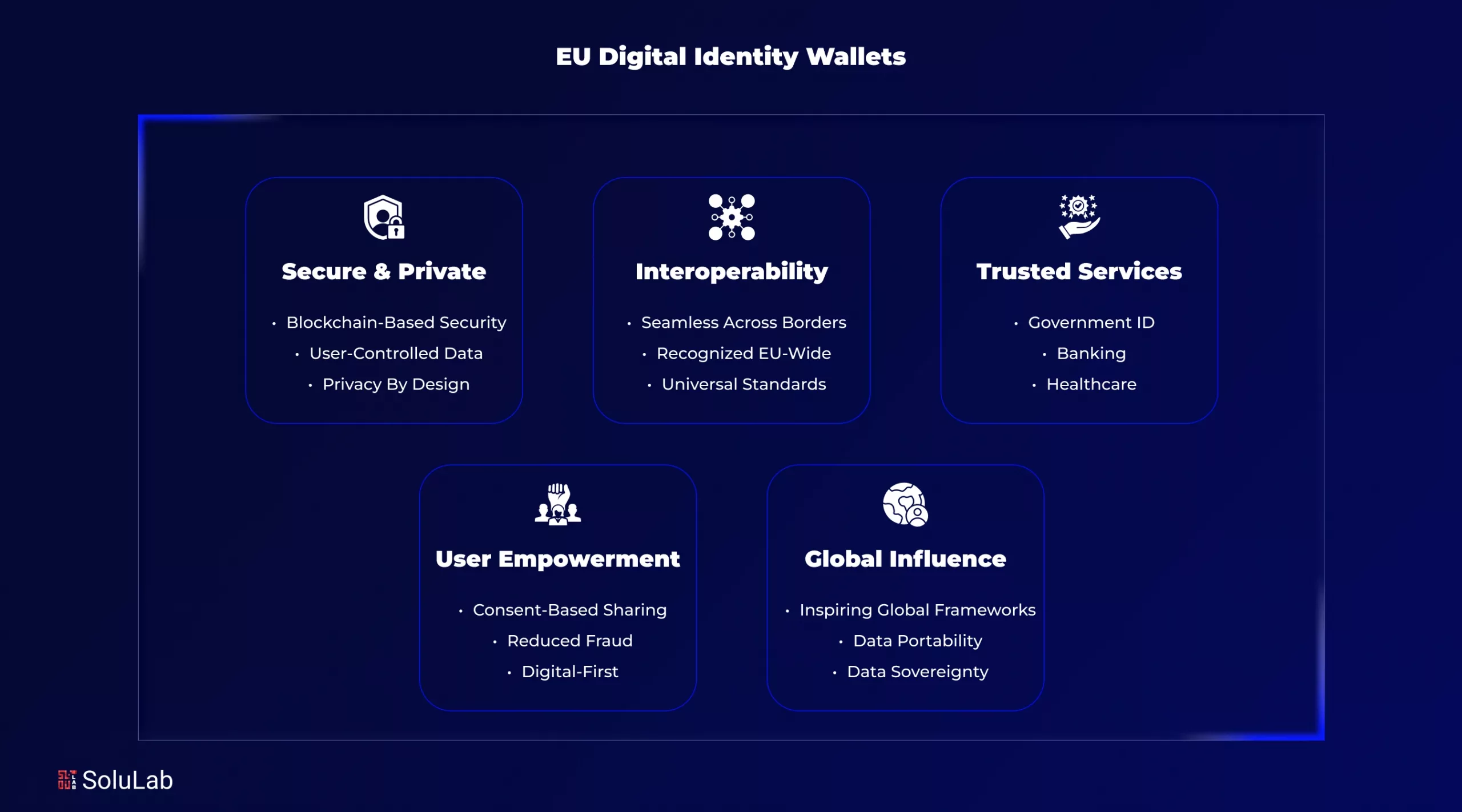
How EU Digital Identity Wallets are Setting Global Benchmarks for 2026?

EU Digital Identity Wallets

What if you could access healthcare, banking, travel, and even education, all with a single digital ID?
That’s the vision behind the EU’s Digital Identity Wallet (EUDI Wallet), a unified, secure, and user-controlled way to verify identity across borders. As Europe fast-tracks its rollout for 2026, this initiative isn’t just transforming how citizens interact with governments and businesses; it’s setting new global standards for digital trust, privacy, and interoperability.

Across Europe, more than 400 million citizens will soon use the EU digital identity wallets under the new eIDAS 2 regulation. This initiative marks a major change in how digital identities operate across borders. With this system, users control personal information, access services securely, and verify identities without paper documents. 

The EUDI framework is not only about convenience but also about trust, interoperability, and secure digital applications. This blog gives you the details on EU digital identity wallets use cases and why they are gaining popularity in 2025. 

What is the EU Digital Identity Wallet, And How Does It Work?

The EU digital identity wallet (EUDI wallet) is currently gaining popularity among users. Its secure systems enable citizens and businesses to verify identity, store credentials, and access services across Europe. It comes under the EU digital identity wallet regulation authority, which gives full access to the individual on their personal data. This wallet system follows EU standards to ensure cross-border interoperability. The EUDI Wallet replaces fragmented identity verification systems with a unified digital framework.

The digital identity wallet providers and the European Digital Identity Wallet Consortium ensure that all wallets comply with privacy, security, and interoperability rules. Each user’s credentials, like ID, driver’s license, or academic degree, are stored digitally and shared selectively when needed.

The digital identity wallet EU solution operates through secure verification layers and standard APIs.

  • Users register with a national identity provider.
  • The wallet connects to trusted service providers using secure communication protocols.
  • Identity verification happens in real time, using multi-factor authentication.
  • The verified credentials are stored locally in encrypted form.

The European Commission adopted a new round of seven implementing regulations in July 2025, detailing technical specifications for trust services and electronic attestations to ensure interoperability across the EU. 

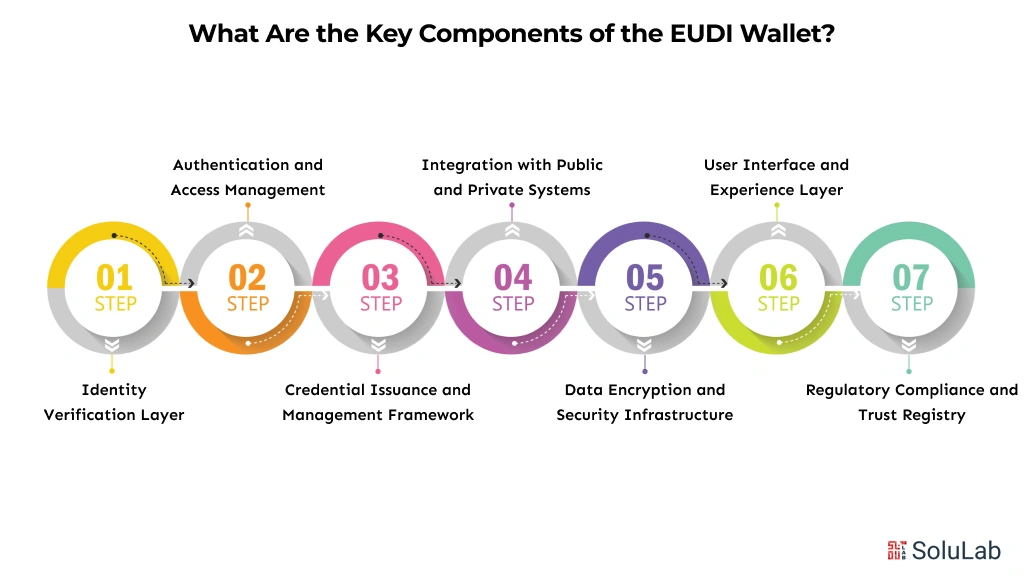
What Are the Key Components of the EUDI Wallet?

The EUDI Wallet consists of multiple interconnected layers that ensure secure operation, compliance, and user control. Each layer performs a specific function for safe and reliable identity management using blockchain.

What Are the Key Components of the EUDI Wallet

  • Identity Verification Layer

This layer handles identity validation through government-issued digital credentials and biometric checks. Verification occurs using data from national ID systems, passports, or driving licenses. The EU digital identity wallet regulation defines how this data should be validated and stored.

  • Authentication and Access Management

Authentication makes sure that the user credentials in the EU digital identity wallet app are valid. It uses multi-factor authentication, ie, biometrics, pins, making it secure and trustworthy. Similar way, enterprises also use this layer for authentication and wallet integration to validate the customer and employee. 

  • Credential Issuance and Management Framework

This framework allows trusted authorities to issue and revoke credentials. Each credential, such as a health record, tax certificate, or professional qualification, is digitally signed and stored securely. The digital identity wallet providers follow EU-defined protocols for data exchange and verification. 

  • Integration with Public and Private Systems

The EUDI Wallet supports seamless integration through standardized APIs. It connects with e-government portals, banks, healthcare systems, and educational institutions. This integration allows businesses and governments to authenticate users without storing sensitive personal data directly.

  • Data Encryption and Security Infrastructure

All stored data is encrypted both in transit and at rest. The system relies on blockchain-based identity management and advanced cryptographic protocols. Security infrastructure includes public key cryptography, digital certificates, and tamper-proof logs. Moreover, compliance with EU GDPR standards ensures strong data protection.

  • User Interface and Experience Layer

The EU digital identity wallet app includes a unified, easy-to-navigate interface. This design ensures quick access to identity credentials, digital signatures, and verification records. For businesses building similar platforms, emphasis lies on simple user flows, secure authentication screens, and easy credential sharing options.

  • Regulatory Compliance and Trust Registry

All operations in the wallet are backed by the EU trust registry, which lists certified providers and services. This registry ensures that only verified institutions issue or accept credentials. It maintains transparency, legal compliance, and traceability of all digital interactions.

Business and User Benefits of the EUDI Wallet

The EU digital identity wallet offers a secure place to store and use identity details such as ID cards, driver’s licenses, bank cards, and academic records. Let’s see how EUDI wallets are used in different industries that help both businesses and citizens of Europe. 

  • Healthcare and Cross-Border Access

In healthcare, EUDI wallets allow citizens to store medical records, prescriptions, and health insurance information. When traveling across EU countries, patients can easily share the required data with hospitals or pharmacies without lengthy paperwork.

This helps citizens receive medical services faster and ensures their data stays private. Businesses such as healthcare providers and insurers save time and cost in patient verification and claim processing. Governments gain better coordination of cross-border healthcare services and stronger fraud prevention systems.

  • Travel and Transport

The wallet simplifies travel by allowing users to carry digital versions of passports, driving licenses, and tickets. Whether booking a flight or renting a car, verification becomes seamless and paper-free. Travelers can move freely without worrying about lost documents or long verification lines.

This benefits citizens by offering convenience and security during cross-border travel. Businesses, including airlines and rental agencies, experience faster check-ins and reduced identity verification costs. Governments achieve improved border management and stronger digital authentication across systems.

  • Education and Academic Verification

The EU digital identity wallet supports digital academic credentials, making it easier for students and professionals to prove qualifications across member states. Universities can issue verified diplomas and certificates directly into the wallet, which can be instantly shared with employers.

This helps citizens manage and share credentials without delays or paperwork. Businesses benefit from quick and reliable background checks during hiring. Governments support mobility, transparency, and mutual recognition of qualifications across Europe’s education systems.

  • Financial Services and Online Transactions

The wallet brings greater trust to financial services and e-commerce. Citizens can use it to verify identity during online banking, payments, or digital contract signing. The process becomes secure and compliant with EU data protection rules.

This benefits citizens by reducing the risk of fraud and simplifying secure digital payments. Businesses, including banks and fintech firms, save costs on KYC and customer onboarding while speeding up transactions. Governments gain better oversight, lower financial fraud, and stronger enforcement of digital identity regulations.

  • Public Services and e-Governance

Through the EU digital identity wallet, citizens can log into multiple government platforms, whether for tax filing, social benefits, or vehicle registration, using one verified digital identity. This eliminates repeated logins and long verification steps.

It benefits citizens by offering faster, easier access to essential public services. Businesses can handle government tenders or compliance filings without delays. Governments gain operational efficiency through integrated systems and accurate citizen data management.

Top Features You Must Have in the EU Digital Identity Wallet

The digital identity wallet European Commission framework defines several features that ensure security, trust, and usability.

Top Features You Must Have in the EU Digital Identity Wallet

1. Cross-Border Interoperability Across EU Member States

The wallet must function in all member states without additional integration work. Businesses developing secure digital applications must ensure compatibility with EU interoperability standards.
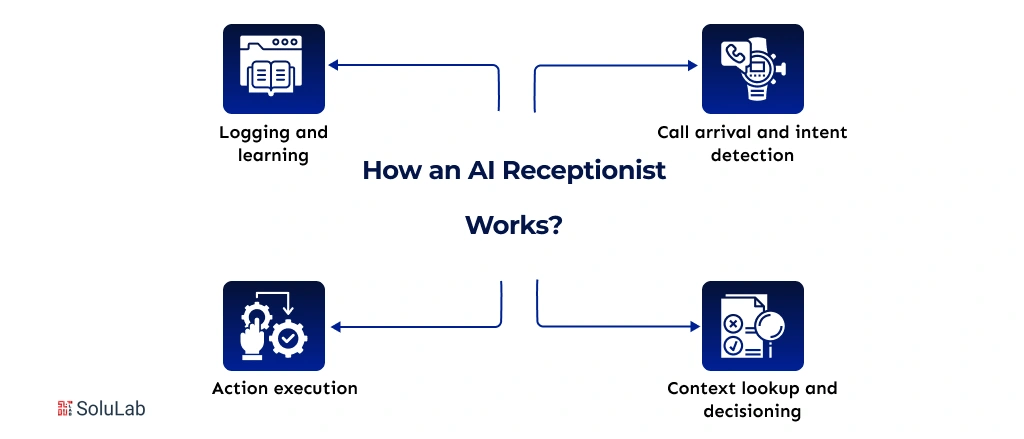
Interoperability promotes smooth digital operations and simplifies international trade.

2. User-Controlled Data and Privacy-by-Design

Users decide what data to share. This approach aligns with the self-sovereign identity model. Each wallet logs every transaction, allowing users to monitor where and when their information is shared.

Privacy-by-design remains a core requirement for any digital identity wallet EU project.

3. Multi-Purpose Functionality for Everyday Use

The EUDI Wallet supports diverse use cases: accessing e-government services, verifying professional qualifications, or signing agreements.

Businesses can integrate the wallet into their digital workflows, reducing the need for multiple logins or identity systems.

4. Legally Binding Digital Signatures

The wallet includes digital signature capabilities. These signatures hold legal validity across all EU states.

This feature allows users and businesses to sign contracts, approve transactions, or submit documents without paper processes. It ensures compliance with the EU eIDAS regulation.

5. Additional Future-Ready Capabilities

The EUDI Wallet roadmap includes several futuristic developments that enhance scalability and innovation:

  • AI-based credential verification for faster processing.
  • Blockchain-backed transparency for audit trails.
  • Open API ecosystem for third-party integrations.
  • Offline functionality for secure verification without the internet.
  • Advanced biometric security ensures strong identity assurance.

6. Cost and Time Estimates

If you’re also looking to build EUDI wallet frameworks, then going for a partner is the best idea. Let’s see the expenses and time frame. 

  • Building an EU digital identity wallet typically costs between €60,000 and €150,000, depending on features and integrations. 
  • Third-party blockchain development companies can build a secure, compliant wallet in a cost-efficient way within 8 to 16 weeks

Integration of advanced services, such as biometric verification or cross-border identity checks, can increase both cost and timeline.

Crypto Wallet Services

Conclusion

As per the above details, you should have gained a comprehensive understanding of EUDI wallets’ usage and how they are fostering trust among people. If you are looking to integrate a wallet or build from scratch, SoluLab is here to help in every step. 

We, at SoluLab, a top blockchain development company, build secure and simplified platforms for your business goals. Our expert team seamlessly integrates blockchain into your existing infrastructure or migrates to a more advanced blockchain network. For more information, contact us today. 

FAQs

1. What makes the EU Digital Identity Wallet different from any other ID app?

Unlike typical ID apps, it’s built on EU-wide regulations and blockchain-backed security, allowing users to verify, sign, and access services securely and instantly anywhere across Europe.

2. How secure is the EUDI Wallet really?

It uses advanced encryption, blockchain technology, and multi-factor authentication to protect your data, making identity theft or fraud nearly impossible across EU digital platforms.

3.  Who can use the EU Digital Identity Wallet?

Any EU citizen or resident can use it to access government, finance, healthcare, and travel services, all under one secure, verified digital identity framework.

4.  How can SoluLab help in building an EU Digital Identity Wallet?

SoluLab specializes in blockchain app development solutions, helping enterprises design and deploy secure, regulation-compliant digital identity wallet systems customized for EU and global frameworks.

5. Could the EUDI Wallet someday replace physical passports or ID cards?

Maybe soon! The EU aims for digital IDs to become valid across borders, meaning your digital wallet could eventually serve as a full replacement for physical documents.

How AI Tools for Student Engagement in Education Keep Them Tuned In?

AI Tools for Student Engagement in Education

Some classrooms buzz with energy. Students ask questions, laugh at examples, and stay curious. Others feel heavy, like everyone’s watching the clock. The difference often lies in how they learn.

That’s where AI steps in. I first saw its potential while reading student discussions on NoCramming, a community where learners trade experiences about study tools and AI tutors. The posts didn’t sound like hype. They sounded like students figuring out what helps them learn. 

The truth is simple: when technology listens, adapts, and interacts, students stop zoning out and start engaging.

Learning That Feels Personal

One of the most exciting things about AI in classrooms is personalisation. Traditional teaching usually moves at one speed, which doesn’t suit everyone. Adaptive learning tools like Century Tech and DreamBox change that. They observe how each student learns and adjust the material to fit.

If someone struggles with fractions, the program slows down, adds visuals, or gives practice problems. If another student races through algebra, it raises the difficulty. This steady calibration keeps boredom and frustration low. Students get small wins that build confidence and curiosity.

Teachers benefit, too. Instead of guessing who’s lost, they see real-time data on who needs attention.

AI Agents For Student Support in Education

Today’s AI agents act like learning companions rather than silent apps. They quiz, chat, and encourage reflection. A history bot might ask, “What do you think this event teaches us about leadership?” The question doesn’t test recall it builds critical thinking.

These agents also create safe spaces for students who hesitate to speak up. A shy learner can type a question, get feedback, and build confidence to share in person next time. Over time, engagement spreads across the room because more voices join the discussion.

When Learning Becomes a Conversation

AI can’t replace human connection, but it can amplify it. Interactive tools prompt students to ask better questions and explain their reasoning out loud. That shift from absorbing information to articulating it turns passive listening into active learning.

Imagine a science class where an AI assistant helps students run virtual experiments, or a literature lesson where a chatbot discusses character motivation. These activities keep attention anchored on the topic instead of drifting to phones or daydreams.

For teachers, the data behind these tools helps refine lesson flow. If the AI detects that half the class is rewatching a concept video, that’s a signal to review the topic together. When educators respond to those insights, students see that feedback works both ways.

Staying on Track with AI Tools for Student Productivity

Even the most engaging lessons fail if students are exhausted or scattered. That’s where AI apps help manage time, concentration, and mental load. 

Motion and Notion AI, for instance, can break long projects into small steps. Tools like Otter.ai or GrammarlyGO take over routine work like transcribing or proofreading.

Students also discover their productivity rhythms. After a week or two, the app might show that focus drops after 40 minutes or spikes in the evening. With that insight, learners can plan study sessions that match their natural pace.

The Most Helpful AI Tools for Students

Not every app lives up to the buzz. Below is a quick rundown of some of the most effective AI tools for students. These platforms were chosen because they blend ease of use, adaptability, and classroom value.

Tool Best for Key features Why students like it
GrammarlyGO Writing assistance Grammar fixes, tone rewrites, AI phrasing help Speeds up essay writing without losing voice
Notion AI Organization & note-taking Task planning, AI summaries, smart reminders Keeps study materials in one place
Quizlet Memory-based learning AI-generated flashcards, adaptive testing Turns studying into a game
Otter.ai Transcription & lectures Records and transcribes classes instantly Saves time and keeps notes searchable
Perplexity AI Research help Sources verification, quick Q&A summaries Simplifies complex topics into clear insights
Khanmigo (Khan Academy) Tutoring & explanations Step-by-step reasoning, AI study coach Feels like a personal tutor on demand
Elicit Research organization AI-supported literature review and data summaries Ideal for essay prep and academic research
Socratic by Google Homework guidance AI explanations via camera or text Makes tough concepts easier to understand

Used right, these tools become quiet allies that keep motivation steady and study sessions productive.

Tracking the Impact

Schools now have numbers to measure the impact of AI on student engagement in education. Universities using adaptive and interactive tools report higher participation and lower dropout rates. 

A 2024 peer-reviewed study across four countries found that AI-supported coursework significantly increases students’ intrinsic motivation and improves their learning experience.

For teachers, AI reduces busywork and gives clearer insight into learning patterns. Instead of spending evenings grading or checking attendance, they can spend that time on feedback and mentoring. The technology takes care of repetition so humans can focus on connection.

What works best:

  • Adaptive lessons that respond to performance rather than forcing one path.
  • AI chat tools that guide students to explain ideas in their own words.
  • Simple productivity features that prevent overload.

What to watch out for:

  • Relying on automation in place of group interaction.
  • Neglecting privacy and consent when collecting student data.
  • Assuming every new app automatically improves learning.

In short, AI succeeds when it supports curiosity, not when it tries to run the classroom.

Listening to Students

Real engagement grows when students are part of the conversation. Surveys on student perspectives on AI in higher education show that most learners value AI’s flexibility but want transparency about how it works. 

They like tools that help them manage workload and stay motivated, but they’re quick to notice when technology feels impersonal.

In feedback sessions, many students describe AI as a “study partner,” not a teacher. They appreciate guidance and reminders but want final control over their process. That sense of agency keeps learning human even when algorithms are involved.

When schools listen to that feedback and adapt accordingly, the technology evolves alongside the people who use it.

Wrapping Up

AI tools for student engagement in education are reshaping how classrooms function. They personalise lessons, prompt reflection, and make studying less of a solo struggle. When combined with thoughtful teaching and honest feedback from students, they turn learning into a shared experience.

Technology alone won’t keep students engaged but when it’s used to empower, not replace, human effort, it brings the classroom to life.


The Main Benefits of Crypto Payments for Casino Operators 

crypto payment

The crypto discussions seem to be especially loud at the moment. Bitcoin is about to reach new price heights, while altcoins are widely used as an alternative source of income. Despite the dynamic growth of cryptocurrencies, many industries are still assessing the pros and cons of this investment. Casino operators were quick to add virtual currencies as a payment method. Benefits outweigh the potential risks. This is why it’s getting easy to find a gaming platform that specializes partially or fully in crypto. 

Fraud Prevention through Improved Security Measures 

Crypto payments have become a popular choice among casino operators and average players. Based on blockchain technology, crypto transactions are recorded on a decentralized ledger. Once confirmed, a transaction can’t be altered or reversed, which reduces chargebacks. Traditional payment methods allow players to dispute legitimate transactions, forcing operators to refund payments and absorb losses. Cryptocurrency transactions provide operators with financial security and peace of mind while reducing administrative overhead caused by dispute management. 

Crypto wallets add another layer of security. Feel free to try online with money by placing your first crypto deposit. This digital safe can be accessed through the unique cryptographic key that is hard to guess. All funds remain secure from any hacking attempts. 

What’s more, blockchain has high transparency that allows both operators and players to verify every payment independently. Online casinos have an opportunity to build trust and reduce on their platforms. Aligning with universal standards like GDPR and PCI DSS is a safe way to prevent data breaches. 

Global Reach and Accessibility to a Large Audience 

One of the strongest advantages of crypto payments is their ability to process smooth cross-border transactions. Traditional payment methods are often restricted by regional regulations, exchange rates, and processing delays. Cryptocurrencies don’t fall under these limitations, allowing operators to accept payments instantly from different parts of the world. Global accessibility opens doors to new markets and helps operators attract a larger audience. 

As of 2024, global cryptocurrency ownership exceeded 560 million crypto holders worldwide. While this indicator keeps growing, casino operators should take extra effort to draw the attention of crypto holders as their potential users. 

Cost Efficiency 

Casino operators always try to keep their operational costs as low as possible. Traditional payment methods come with third-party charges, processing fees, and administrative overhead don’t sit right with them. Cryptocurrencies offer more attractive conditions by removing intermediaries and enabling direct transactions between players and operators. 

Banks and other financial institutions often charge 2–5% per transaction, in addition to international transfer costs. Crypto offers great savings in this regard. Blockchain fees are quite low. Bitcoin and Ethereum transactions charge just a few dollars per transaction. For operators handling thousands of daily transactions, these savings can be lifesaving. Faster settlements also improve cash flow, encouraging operators to reinvest money into marketing, upgrades, and exclusive rewards. 

Quick Transactions 

In the world of online casinos, speed is everything. Players expect instant deposits and quick withdrawals to come without delay. Traditional payment providers may take hours, days, or even weeks to complete fraud checks and approve a transaction. Potential delays may also keep players frustrated while impacting casino retention. 

Virtual coins offer quick payments on decentralized blockchain networks. Bitcoin, Ethereum, and Tether have already been widely used by online casinos. But the list of available coins is constantly expanded by operators. Now players can use many altcoins to deposit or withdraw their money. Cryptocurrencies can handle thousands of transactions per second, which allows players to play games and access winnings straight away. 

Speed builds trust and loyalty. Most crypto players confirm the high speed of withdrawals as their main reason for choosing crypto platforms. Quick payouts make them feel secure, reduce disputes, and encourage repeat play. Platforms offering instant settlements see higher retention. Instant transactions also improve cash flow. So funds can be reinvested into marketing, platform upgrades, and player rewards. 

High Anonymity and Privacy Policy 

Privacy is a significant issue for casino players who don’t want to become victims of fraud. When joining an online casino, they realize the need to share their personal and financial details, which involves a certain risk of exposure. Cryptocurrencies promise to solve this problem by offering secure transactions without asking for sensitive information. Unlike traditional payment methods, crypto payments just need players to enter a digital wallet address. 

Privacy is what really matters in online gambling. Cryptocurrencies help casino operators adjust their offering to high security standards, especially when it comes to sensitive information. Players don’t have to upload their identity documents to transfer money to or from the casino account. How is this possible? Blockchain relies on the ledger when monitoring transactions and keeping player identities private. Many platforms still decide to integrate KYC while trying to set the right balance between privacy and regulatory compliance. This means that crypto casinos can attract conscious players by complying with gambling regulations. High privacy can boost both player confidence and business sustainability. 


Why Forward-Thinking CPAs Are Investing in AI-Driven Accounting Tools?

AI-Driven Accounting Tools for CPA

What if accountants could predict financial trends before they happen, automate tedious tasks, and make decisions backed by real-time data? That’s not a distant dream — it’s the reality AI is creating for today’s Certified Public Accountants (CPAs).

In an industry where accuracy, efficiency, and compliance are everything, AI-driven accounting tools are transforming how CPAs work. From automating bookkeeping to offering predictive insights for better financial planning, artificial intelligence is helping accountants move beyond manual data crunching into strategic advisory roles that add real business value.

The market is poised for growth, as the AI accounting market is projected to be worth approximately $6.7B in 2025 and could reach $67B by 2035.

Forward-thinking CPAs aren’t just adopting AI to keep up with technology, they’re using it to gain a competitive edge, reduce costs, and deliver smarter client outcomes. This guide will show why AI for accounting matters, where to start, and how to get results fast without overwhelming your team.

Why AI for CPAs Matters in 2025?

The accounting industry is entering a new phase where AI tools for accounting and AI-powered bookkeeping automation are necessities. Firms that integrate AI tools for accounting firms are seeing measurable ROI in efficiency, accuracy, and advisory value.

1. Efficiency and Scalability

AI automation cuts hours of manual bookkeeping, reconciliation, and tax prep. With AI in accounting and finance, firms handle more clients without expanding headcount, directly improving profit margins.

2. Accuracy and Compliance

AI bookkeeping tools minimize human error and ensure every transaction aligns with tax and audit standards. For CPA firms, this means stronger compliance and lower risk, key in maintaining long-term client trust.
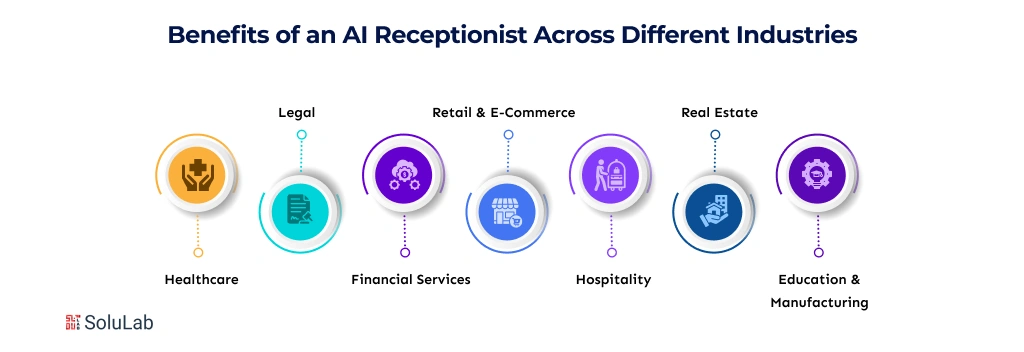
3. Smarter Client Advisory

Beyond automation, AI for CPA firms enables real-time forecasting, expense analysis, and predictive cash flow management. This turns accountants into strategic advisors, not just service providers.

4. Competitive Advantage

Early adopters of AI-powered bookkeeping automation already lead the market. Firms using these tools report higher client retention and faster decision-making, positioning them as forward-thinking financial partners.

So, AI transforms CPA firms from reactive to proactive. It’s not about replacing people, it’s about scaling intelligence, service quality, and revenue potential. But first you need to understand what is right for you. 

Should You Build Custom AI Solution or Buy Off-the-Shelf?

When it comes to using AI for CPAs, you have two paths: use ready-made white label tools or build something custom. If your firm wants quick results, off-the-shelf AI tools for CPAs are usually the best starting point. These tools already handle common work like invoice coding, bank reconciliation, audit prep, and tax notes. They are fast to set up and your team can learn them without stress.

For firms with unique workflows or advanced needs, building a custom layer that integrates accounts payable automation AI helps manage multiple entities and complex reports efficiently.

The key is to keep it simple.

  • One workflow
  • One team
  • One goal
  • One month to test

This gives you a safe trial run where partners can see real results without overwhelming the staff. It also helps your firm learn how to use AI for CPA firms in a steady, confident way..

Top AI Use Cases for CPA Firms That Deliver Quick ROI

If you’re a CPA firm looking to make work faster, smarter, and more profitable, this is where AI in accounting shows real results. These are practical ways to cut costs, save time, and deliver better client service starting this quarter.

Top AI Use Cases for CPA Firms

1. Automated Bookkeeping

AI bookkeeping tools can now handle most of the repetitive work in bookkeeping like categorizing transactions, matching invoices, and reconciling accounts. This reduces manual errors and saves teams hours every week. For firms that manage multiple clients, automation can directly translate into more billable hours and faster turnaround time.

2. Tax Preparation Assistants

Preparing taxes can be one of the most time-consuming parts of accounting. With AI tax preparation tools, CPAs can automate data entry, detect missing forms, and even check for deduction opportunities. In 2025, top firms report up to 85% of repetitive tax work automated, freeing teams to focus on review and client strategy instead of routine paperwork.

Read Our Blog: Generative AI in the Tax Industry

3. Expense Fraud Detection

AI-powered fraud detection systems analyze transactions in real time, flagging unusual spending patterns or suspicious claims. This helps CPA firms protect clients from compliance issues while building trust. Even a small firm can use this to offer “AI-backed audit checks” as a premium service, a clear competitive edge.

4. Predictive Cash Flow Analysis

Machine learning tools can now predict cash flow trends weeks or even months ahead. For CPA firms, this means giving clients proactive advice like when to delay expenses or secure funding. Predictive insights help you move from being just an accountant to becoming a financial advisor clients rely on for strategic planning.

5. Client Support Chatbots

AI-powered chatbots are changing how firms handle client communication. They can answer FAQs, share document links, and schedule calls 24/7. This improves client satisfaction and saves your team from answering repetitive questions. The best part is that Chatbots can be integrated directly into your firm’s website or client portal within days.

Each of these AI use cases for CPA firms brings immediate returns, lower costs, faster turnaround, and happier clients. Firms that start with even one of these solutions often see ROI within the first 60–90 days.

How to Implement AI Solutions for CPAs?

Most CPA firms hear about AI for CPAs and think it’s complicated or takes months to get working but it doesn’t have to. A simple and proven process to help firms use AI integration for accounting firms in just a few weeks. It’s fast, secure, and designed to give you measurable ROI from day one. 

AI Implementation Process for CPA Firms

Step 1: Discovery & Workflow Audit

Every firm has its own way of working. That’s why its good to start with AI strategy consulting for workflow audit and understanding of how your team handles bookkeeping, audits, and tax operations.

Then map out every process and identify where AI applications can deliver quick wins. Common areas include:

  • Repetitive data entry
  • Manual reconciliations
  • Delays in financial reports
  • Tax compliance tracking

Once you know where the bottlenecks are, match each task with the best AI tools for CPAs or plan a custom AI solution if your needs are unique.

Step 2: Build or Integrate AI

Now you have to choose between off-the-shelf AI tools or a custom AI CPA system, whichever fits your goals and budget. Best Off-the-shelf tools work great for quick automations like:

  • Invoice scanning
  • Document sorting
  • Chatbots for client support

Custom-built AI systems are perfect if you want proprietary tools that learn from your client data and workflows. An experienced AI app development company can handle both, building from scratch or connecting existing tools to your systems. 

Step 3: Training the AI Models

Once tools are selected, train your AI in accounting and finance models with your firm’s real data. This is what makes your AI truly intelligent, it learns your processes, tone, and financial logic. Train each CPA AI model to:

  • Understand how your team categorizes transactions
  • Follow your firm’s reporting style
  • Learn from past client data for better predictions

Everything runs in a secure, encrypted environment, so your data is protected end-to-end.

Step 4: Testing, Feedback & Go-Live

Before launch, every system goes through a full testing and feedback cycle with your team. Test accuracy, run real scenarios, and fix edge cases. Once everything is stable, go live and train your team to use the new tools.

AI Security & Compliance to Follow for CPA Firms

When it comes to AI for CPA firms, security isn’t optional, it’s essential. Your clients trust you with their most private financial data. That’s why every AI system should follow strict data protection and compliance standards to keep your firm safe and audit-ready.

Core Security Practices

Don’t take shortcuts safely. Every system must include:

  • End-to-end encryption for all data transfers and storage
  • SOC 2 and ISO 27001 aligned frameworks for full compliance
  • Optional on-premise hosting for large CPA firms that prefer full data control
  • Continuous audit trails and access logs so every action is traceable

Compliance You Can Trust

Meet the highest standards required for AI in finance and accounting, including:

  • IRS Publication 4557 (Data Protection for Tax Professionals)
  • AICPA SOC compliance
  • GDPR for firms with international clients

An expert AI deployment company works as your AI security and compliance partner, making sure every automation layer remains safe, transparent, and aligned with your firm’s regulations. That’s why modern firms hire AI developers for helping them grow with confidence and compliance.

How CPA Firms Are Winning with AI in 2025?

Across the world, top accounting firms are already using AI tools for CPAs to save time, detect errors early, and grab new revenue opportunities. Here are three real stories showing how AI in accounting and finance is transforming the way firms work, win clients, and grow profits, all without increasing staff.

1: Cherry Bekaert LLP – AI Audit Cuts Time by 66%

Challenge:

Cherry Bekaert, a top CPA firm, spent weeks manually testing transactions and spotting fraud. Manual reviews were slow and missed key risks.

Solution:

They used MindBridge AI Auditor, an AI audit tool that checks 100% of transactions and flags unusual activity in real time.

Result:

  • 66% less sampling time
  • 35% faster audits
  • Detected fraud attempts within the first month
  • Full ROI in one year
  • Positioned as an AI leader in accounting

2: Ohio CPA Firm – AI Boosts Revenue 42%

Challenge:

A small Ohio CPA Firm spent 40% of staff time entering invoices manually, leading to slow operations and unhappy clients.

Solution:

They adopted Vic.ai, an AI accounting automation platform that handled invoice processing and approvals. The firm then used the saved time to offer AI-powered advisory services like cash flow forecasting and business insights.

Result:

  • 42% increase in advisory revenue
  • 75% faster invoice processing
  • 90% fewer data entry errors
  • ROI in 9 months
  • Moved from compliance work to strategic business advisory

3: Big Four Firm – Generative AI Saves 89,000 Hours

Challenge:

A big Four accounting firm spent hours preparing client briefs. Thousands of hours were lost to repetitive manual work.

Solution:

They built a custom Generative AI solution using Azure Cognitive Services and Large Language Models (LLMs) to auto-create proposals from data and past projects.

Result:

  • 89,000 staff hours saved yearly
  • Task time cut from 4 hours to under 7 minutes
  • Deployed to 40,000 employees
  • Improved proposal quality and speed
  • Became a model for AI in accounting firms

How Much Does AI for CPAs Cost in 2025?

Many firms think AI is too expensive, but that’s not true. The cost really depends on your firm’s size, the kind of work you do, and how deeply you want to use AI for accounting. Here’s a simple view of what to expect:

AI Solution Type Estimated Cost (USD) Best For
Off-the-Shelf AI Tools $50–$300/month Small firms or solo CPAs who want quick automation.
Custom AI Integration $2,000–$5,000 (one-time setup) Growing firms with 10–50 clients that want to connect AI with their existing software.
Full AI System Build $10,000–$25,000+ Established firms that need a complete AI accounting system across departments.

A CPA firm investing $5,000 in automation saved more than $20,000/year in manual work costs. That’s a full return in just 3 months and pure profit after that. So whether you start small with ready-made tools or go all in with a custom AI solution providers, you’ll see value fast.

cta

Conclusion

It’s no longer a question of if it’s about when and how fast you adopt AI for CPAs. Today, AI in accounting is a real tool that helps firms work smarter, not harder. CPA firms that use AI tools for CPAs are already seeing big improvements.

SoluLab, a renowned AI development company, holds much experience catering to the finance business needs with custom solutions. Backed by top notch technology, our solutions can offer you multiple benefits like:  

  • They complete client work faster.
  • They manage more clients with the same team.
  • They cut down on errors and improve accuracy.
  • They offer high-value advisory services that increase revenue.

It helps automate your daily tasks, boost client satisfaction, and free up your team to focus on strategy instead of data entry.

If you’re a firm owner, it’s the right time to explore AI for CPA firms. Contact us today!

FAQs

1. How do I calculate ROI and time savings from adopting AI tools in my practice?

Track time spent on manual tasks pre- and post-implementation, monitor reduction in errors, and calculate cost savings versus software investment. Most firms report ROI within 6–12 months and see staff hours freed up for billable advisory work.​

2. How do I choose between off-the-shelf and custom AI development for my firm’s needs?

Off-the-shelf solutions work best for standard workflow automation, while custom builds suit unique integrations and proprietary services. Agencies help by mapping requirements, comparing costs, and guiding pilot decisions for best-fit solutions.​

3. How can AI improve client communication, advisory services, and overall value delivery?

AI-powered chatbots, document summarization, and predictive analytics provide clients with faster responses, deeper insights, and more personalized advice, freeing accountants for strategic conversations.​

4. What ongoing support and updates should I expect after deploying AI solutions in my CPA firm?

Regular platform updates, cybersecurity monitoring, vendor-led training, and periodic workflow optimization are essential. At SoluLab, we offer post-launch support, troubleshooting, and best practices for continuous improvement.

How Healthcare Startups in the USA Leverage Generative AI to Cut 40% Costs? 

Generative AI Healthcare Startups in USA

In the USA, healthcare costs keep rising, putting heavy pressure on hospitals, clinics, and healthcare startups that need to stay profitable. High administrative costs, slow medical documentation, and repeated billing backlogs waste billions of dollars every year and reduce margins for service providers.

Many forward-thinking founders now turn to Generative AI as a practical business tool. This technology can automate medical notes, speed up diagnostics, and shorten revenue-cycle management, helping companies cut operating costs and scale faster.

Early case studies show that focused Generative AI solutions can lower documentation and billing expenses by up to 40%, while also improving patient care and overall workflow efficiency.

Rising Cost Challenges in U.S. Healthcare

The U.S. healthcare system is under pressure from rising costs that climb every year. Much of this spending doesn’t go toward actual treatment; it disappears into administrative work and outdated processes.

For a healthcare technology buyer or enterprise leader, the key pain points are easy to see:

1. Administrative drag 

Physicians lose an average of 15–20 hours per week to insurance paperwork, prior authorizations, and compliance tasks. That is time that could be spent on patient care or revenue-generating services.

2. Revenue leakage 

Manual billing and coding errors create 3–5% losses in every claim cycle, eating directly into profit margins for hospitals and private practices alike.

3. Clinical documentation delays 

Slow charting and disconnected electronic health record (EHR) systems delay treatment planning and make it harder to share accurate patient data across teams.

4. Diagnostic bottlenecks 

Repetitive tests, fragmented lab systems, and siloed data increase operational costs and frustrate patients, sometimes leading to lower satisfaction scores and penalties.

These inefficiencies are not just soft costs. They represent billions of dollars in wasted spending across the healthcare industry, and they open the door for automation solutions and AI technology that can reduce expenses while improving care.

Why Startups and Providers Are Turning to Generative AI?

Why Startups and Providers Are Turning to Generative AI

Unlike traditional rule-based automation, generative AI can read and interpret messy, unstructured healthcare data, think about physician notes, lab results, and imaging reports, and produce clear, usable outputs in seconds. 

1. Automation at scale 

From patient intake forms to claims management, generative AI solutions reduce manual data entry, lower full-time staffing requirements, and improve turnaround times.

2. Faster decisions and diagnosis 

AI-driven summaries of lab results and medical imaging allow clinicians to reach decisions more quickly, cutting patient wait times and improving throughput.

3. Fewer human errors 

Advanced models catch inconsistencies in documentation and billing, lowering compliance risk and helping meet regulatory standards such as HIPAA.

4. Personalized patient engagement 

AI creates tailored discharge instructions, follow-up plans, and educational materials, boosting patient satisfaction and long-term outcomes.

Early pilots in large health systems show up to 40% cost savings in high-volume tasks such as documentation, revenue-cycle management, and clinical note summarization.

For any healthcare executive, those numbers represent a clear return on investment and a competitive advantage.

Why Generative AI in Healthcare?

Healthcare is an industry where every second counts; lives depend on speed, accuracy, and personalization. Traditionally, administrative tasks, diagnostic processes, and patient interactions consume significant human and financial resources. Generative AI in Healthcare acts as a transformational solution that reshapes workflows, reduces errors, and drives measurable ROI.

Most people still think of AI as something that writes text or generates content. But in healthcare, its applications are far more strategic:

  • Generating precise clinical notes and reports.
  • Accelerating diagnostic image analysis
  • Automating appeal letters for rejected claims 
  • Designing drug molecules and clinical trial protocols 

For enterprise healthcare startups, these are not incremental improvements; they are game-changing transformations that scale operations without proportional costs.

CTA1

Key Benefits of Generative AI in Healthcare for Startups

For healthcare startups, hospital systems, and enterprise executives evaluating new technology, the benefits are measurable:

1. Automation That Reduces Manual Load

Repetitive tasks like documentation and coding often occupy 30–50% of clinician’s time. Generative AI implementation services eliminate this burden, letting teams focus on patient care while saving significant operational costs.

2. Scalability Without Compromise

Whether a startup serves 100 or 10,000 patients, AI enables enterprise CRM AI integration that scales support, diagnostics, and communications without proportional expense increases.

3. Faster, More Accurate Diagnoses

AI-assisted tools analyze imaging and patient data to shorten time-to-treatment and minimize errors. Startups leveraging generative AI implementation report quicker diagnosis times and reduced misdiagnoses, a clear advantage for patient trust and retention.

4. Personalization at Scale

From appointment reminders to follow-up instructions, AI connects patients with personalized communication. This enhances engagement and reduces call center costs.

5. Error Reduction in Billing & Claims

Claim denials cost startups millions annually. With AI, appeal letters are automated, errors minimized, and reimbursements expedited, one of the highest-impact applications of Generative AI integration services in healthcare.

Key Areas Where Generative AI Cuts Costs

Key Areas Where Generative AI Cuts Costs

Though there are various aspects in costing, some of the key areas where the incorporation of AI can help in cutting costs are:

1. Automated Medical Documentation 

AI writers capture and summarize doctor-patient interactions automatically, translating them into organized Electronic Medical Records (EMR). This minimizes clinician workload by 30–50%, resulting in significant time and cost savings. 

2. Artificial Intelligence Diagnostics & Imaging 

Generative AI in the healthcare industry is applied to scan analysis, show anomalies, and prepare radiology reports. This shortens diagnostic time, enhances accuracy, and prevents unnecessary procedures. 

3. Virtual Health Assistants & Patient Engagement 

AI-powered chatbots manage FAQs, triage, appointment reminders, and follow-ups. This saves call center overhead and enhances patient satisfaction. 

4. Drug Discovery & Clinical Trials 

Generative AI models create drug molecules, select trial candidates, and model outcomes. This reduces years and millions of dollars from R&D pipelines. 

5. Revenue Cycle Management (Billing & Claims)

Startups utilize AI to automatically generate claims, mark denials, and produce appeal letters. This minimizes human errors and facilitates faster reimbursements, one of the most important generative AI applications in healthcare

How Mandolin based in San Francisco Transformed Insurance Verification?

For specialty medications like cancer or Alzheimer’s treatments insurance verification often takes weeks, delaying care and increasing costs. Mandolin applied Generative AI in healthcare to automate the process using AI agents, reducing manual follow-ups and insurer handoffs.

Results:

  • Verification times dropped from ~30 days to 3 days, showing the efficiency of enterprise automation.
  • Fewer denials and financial losses, as the AI escalates complex cases to humans while continuously learning.
  • Staff focus improved, enabling teams to prioritize high-value patient care instead of repetitive tasks, a clear benefit of Generative AI implementation.

Thoughtful AI deployment can speed operations, cut costs, and improve outcomes. Mandolin’s example demonstrates how integrating AI agents into healthcare workflows delivers measurable ROI.

How Generative AI Implementation Helps Beyond Cost Reduction?

For healthcare startups, Generative AI implementation services are not just about saving money, they unlock scalability and efficiency. AI can handle documentation, billing, and initial patient triage across hundreds of clinics without adding staff. This allows your team to focus on growth, strategy, and innovation.

Accuracy improves significantly. By minimizing human errors in documentation, billing, and diagnosis, startups reduce claim denials, rework, and compliance risks. Deploying AI-powered CRM solutions ensures reliable data management while maintaining patient trust, a critical advantage for decision-makers.

Patient experience benefits too. AI reduces wait times, personalizes interactions, and anticipates patient needs. Startups using AI gain stronger patient retention and a competitive edge in a crowded healthcare market.

Tasks that once took months like R&D and trial cycles, can now be completed faster. Generative AI implementation fuels rapid testing, iteration, and scaling of new healthcare solutions.

What is the Future Outlook of AI-Powered Affordable Care?

The AI healthcare market is growing fast, with projections showing exponential expansion by 2030. Generative AI CRM integration is helping startups move from costly, reactive care to preventive, personalized, and affordable healthcare.

Early adopters gain operational savings, competitive differentiation, and stronger patient engagement. For founders, this is a chance to stay ahead of competitors and build scalable, future-ready systems.

Why Founders Should Act Now?

Healthcare is entering a transformative phase. Startups leveraging Generative AI implementation services today can reduce operational costs by up to 40% while improving patient outcomes. 

Delaying adoption means slower growth, missed cost savings, and losing the first-mover advantage in a competitive market. Companies with successful AI pilots are already seeing faster patient onboarding, reduced claim denials, and improved compliance.

CTA2

Conclusion

Generative AI is more than a cost-cutting tool; it drives scalability, innovation, and measurable patient impact. Startups using AI in documentation, billing, and diagnostics can streamline operations, cut expenses, and scale efficiently.

At SoluLab, #1 Generative AI development company, we help healthcare startups design and deploy custom solutions that automate repetitive processes, optimize data workflows, and enhance decision-making accuracy. Recently, we partnered with a California-based healthcare startup to build a GenAI-powered Clinical Decision Support platform, cutting their administrative workload by over 40% within three months.

If your healthcare startup is ready to leverage Generative AI to enhance efficiency, contact us today!

FAQs

1. How long does it take to implement a Generative AI solution in healthcare?

Implementation time depends on project complexity, data volume, and integration needs. On average, SoluLab delivers functional AI prototypes within 8–12 weeks, with full deployment taking up to 4–6 months.

2. What ROI can healthcare startups expect from Generative AI adoption?

Startups typically experience 30–40% cost reductions, improved accuracy in operations, and faster turnaround times in diagnostics and research — leading to better financial and patient outcomes.

3. Can small healthcare startups afford to use Generative AI?

Absolutely. With the rise of custom AI solutions and scalable cloud infrastructure, startups can start small and expand gradually. SoluLab helps design cost-effective AI systems tailored to each startup’s goals and budget.

4. How do healthcare startups ensure AI compliance in the USA?

Startups must follow HIPAA, GDPR, and FDA guidelines when handling medical data. Partnering with experts like SoluLab ensures that AI tools meet all regulatory, ethical, and data protection standards.
5. Why should healthcare startups partner with SoluLab for AI development?

SoluLab specializes in healthcare-specific Generative AI solutions, offering expertise in automation, predictive analytics, and compliance. With proven success stories in US-based healthtech projects, SoluLab helps startups achieve faster results, lower costs, and scalable growth.


How to Evaluate and Choose a Plagiarism Checker for Your Enterprise AI Platform

Choose a Plagarism Checker

As a rule, enterprise AI platforms generate thousands of marketing copies, research summaries, and customer communications. Most probably, yours is not an exception. And, most probably, your team uses the advantages of modern AI tools to save time on research and idea generation. However, this productivity comes with a significant new risk called content integrity. One day, you can discover that a considerable part of your AI-generated content closely mirrors existing copyrighted material and exposes your organization to reputational damage.  

The volume of material your team generates makes manual review hard, if at all possible. Still, the nature of large language models means they often give you text that is very similar to their training data. Is there a way out? The good news is that a reliable AI plagiarism checker might be the solution you are looking for. Enterprises today rely on this sophisticated defense system that can check not just for copy-paste, but for AI-generated text itself. The bad news is that it’s not easy to choose the right tool from a crowded marketplace where capabilities and accuracy vary dramatically. 

To make this quest simpler for you, let’s explore a framework for evaluating and selecting a plagiarism checker that integrates seamlessly with your enterprise AI platform. 

Why AI Changes the Plagiarism Game  

What exactly has the emergence of AI writing tools changed in the way we approach content creation? The main point that immediately comes to mind is that it’s become more difficult to check the originality of every sentence you want to use in your projects. 

Traditional plagiarism checkers do a great job at identifying exact word sequences and minor substitutions. However, modern AI models do not need to copy verbatim. They engage in content synthesis and rapidly generate text that is structurally and semantically similar to existing sources. Sometimes, they behave just like a student on a tight deadline who needs to write a paper and stitch together phrases from multiple sources. Even though this practice might seem acceptable, it is nonetheless a form of plagiarism.  

What you get is a text that’s original in a purely technical sense but infringes upon the intellectual property of different authors. For an enterprise, this ambiguity is a legal and reputational ticking time bomb. 

Therefore, the new threat is two-fold: 

1. AI-generated plagiarism that looks like an unintentional reproduction of copyrighted material from the AI’s training data. 

2. AI global plagiarism occurs when employees submit content that was fully generated by a public language model and passed off as their own original work. 

For true content integrity, a chosen solution must effectively address both the “where” (source match) and the “how” (AI generation probability) of the text. 

Key Features to Evaluate in an Enterprise-Grade Solution  

Now, it’s time to look through the key factors that will influence your decision on which tool to use. 

1. Technical Capabilities 

Processing speed directly impacts the productivity of your team, which means that the tools you use should return results for standard documents within seconds, not minutes. In addition, pay attention to the ability to queue and process large batches overnight or during off-peak hours, as it adds valuable flexibility. Let’s analyze some more features you need to keep in mind. 

2. AI Makes Mistakes 

Your chosen solution should explicitly detect content from major AI models and distinguish between human-written, AI-generated, and AI-assisted content. At least, that’s the way these tools would function if we lived in an ideal world. Unfortunately, we don’t, and the biggest flaw of modern AI detectors is a high rate of false positives (flagging human-written text as AI-generated). Here’s how you can overcome this obstacle and choose a trustworthy checker: 

  • Look for AI plagiarism checkers that use linguistic and statistical patterns. The best tools are trained to identify subtle patterns common to specific writing tools like GPT-4, Gemini, Claude, etc. 
  • The tool should be resistant to humanizing techniques, which include lightly editing AI-generated text or running it through a paraphrasing tool. 

3. Database and Content Coverage 

Database size and coverage are the two characteristics that will help you determine how good or bad a tool can identify matching content. The best and most reliable enterprise solutions compare against billions of web pages and academic publications to eliminate all kinds of plagiarism risks: 

  • Vast public web index. A core requirement is access to a huge and continuously updated index of web pages, blogs, news articles, etc. 
  • Proprietary and academic databases. Enterprise solutions often partner with major academic publishers (like ProQuest) or have access to scholarly journal databases, which are vital for R&D or educational content. 
  • Internal document scanning. Critically, the checker must offer a secure way to scan new content against your organization’s internal knowledge base. Then, it becomes possible to protect proprietary documents and ensure that new content adheres to internal standards. 
  • Code repository check. The ability to scan code repositories for copyrighted snippets or unauthorized open-source use is a powerful feature, so you might check if it’s available. 

4. Various File Formats 

Make sure your plagiarism checker handles Word documents, PDFs, PowerPoint presentations, HTML, markdown, and potentially code files. Batch processing capabilities allow simultaneous checking of multiple files and can dramatically improve your team’s workflow efficiency. 

5. Integration, Security, and Scalability  

Architectural compatibility ensures you can integrate the chosen plagiarism checker into your technology ecosystem. Mind that some enterprises require on-premise deployment for security or compliance reasons. Nonetheless, you can always go for hybrid approaches, where processing occurs in the cloud but sensitive data never leaves your infrastructure: 

  • API and LMS integration. Seamless API access is mandatory for connecting the checker directly to your AI platform, CMS, development pipeline, or internal document systems. Educational organizations will require integration with Learning Management Systems like Canvas or Blackboard. 
  • Enterprise security and privacy. Given the sensitivity of enterprise content, the tool you choose must adhere to the highest security standards. Look for certifications such as SOC 2, SOC 3, and GDPR compliance to ensure data confidentiality.  
  • Scalability. The pricing model and infrastructure must support high-volume scans across thousands of users or large document batches. 

Note that workflow automation possibilities multiply when your plagiarism checker integrates with broader automation platforms. Compatibility with tools like Zapier, Make, or enterprise iPaaS solutions allows you to check content before publication automatically and route reports to appropriate stakeholders. 

6. Reporting and Usability  

All that some checkers do is show you the percentage score of plagiarized content. As you understand, this information is not very helpful, as you don’t know what sentences to rewrite or what citations to include. That’s why the checker you will use needs to have these features: 

  • Reports should clearly delineate between exact matches, minor changes, and paraphrased/semantically similar text using color-coded highlights. 
  • The report must provide verifiable links to the original source material. 
  • Look for the best tools that offer two distinct scores: one for traditional plagiarism and a separate confidence score for AI generation. 

Your Next Steps: A Practical Checklist  

After you’ve created a shortlist of winning tools, here’s what you can do to ensure the implementation process runs smoothly: 

#1 Define a Policy First 

Transparency makes any process better. Therefore, draft a clear company policy on the acceptable use of generative AI and outline what constitutes plagiarism and the consequences.  

#2 Run a Controlled Pilot 

Test the chosen tool with a high-risk team. Then, evaluate its false-positive rate and reporting clarity using a mix of known human and AI-generated content

#3 Ensure Seamless Integration 

Use the API to integrate the checker into your company’s workflow. 

#4 Provide Training 

Train your employees on how to use the tool, but more importantly, how to interpret the reports. 

How Perpetual DEX is Changing the Crypto Derivatives Market?

Perpetual DEX banner

Crypto derivatives are growing faster than ever, and startups need to act now. Decentralized Perpetual Exchange platforms, or perpetual DEX platforms in decentralized finance, are changing how derivatives are traded. They let founders and builders create scalable, efficient, and fully decentralized trading platforms without relying on traditional exchanges.

In Q2 of 2025, the total perpetual trading volume on DEXs hit about $898 billion, marking a record high.

For businesses exploring perpetual dex crypto projects, these platforms provide transparency, efficiency, and a competitive edge in the evolving crypto derivatives market. Let’s delve deeper to know more!

What is a Perpetual DEX?

A Decentralized Perpetual Exchange is a blockchain-based platform that enables users to trade perpetual contract derivatives without expiry dates. Unlike traditional spot trading, where assets are exchanged directly, perpetual DEXs allow traders to take leveraged positions while retaining full control over their wallets.

These platforms operate on smart contracts, eliminating the need for centralized custodians. This decentralized approach enhances security, transparency, and accessibility, creating a truly open environment for derivatives trading.

Notably, platforms like Hyperliquid have seen substantial volume surges. Before its token generation event in November 2024, Hyperliquid processed between $25 billion and $35 billion in monthly volume. Post-event, its monthly volume has ranged between $160 billion and $315 billion.

Perpetual DEX internal

This surge in popularity underscores the growing demand for decentralized, non-custodial trading solutions in the crypto derivatives market. Even the Founders of CEX are building their own Perp DEX.

How Perpetual DEX Platforms Work?

Understanding how Perpetual DEX platforms operate is essential for businesses aiming to enter the decentralized finance space and capture value from crypto derivatives. Here’s a detailed breakdown of their key mechanisms:

1. User Deposits Collateral

At the foundation of any perpetual dex crypto platform is collateral management. Traders deposit digital assets, typically stablecoins like USDC or Ethereum (ETH), which serve as security for their positions.

  • Collateral ensures that traders can enter leveraged positions safely without relying on centralized entities.
  • Businesses benefit from transparent on-chain custody, minimizing counterparty risk.
  • Leading platforms, such as dYdX and GMX, report that over $1.5 billion in collateral is locked across perpetual contracts at any given time, demonstrating significant liquidity potential.

2. Smart Contracts Issue Perpetual Positions

Once collateral is deposited, smart contracts automatically create perpetual positions for users. Unlike traditional derivatives, these contracts never expire, allowing traders to hold positions indefinitely.

  • Non-custodial smart contracts remove the need for intermediaries.
  • The contracts encode all rules for margining, funding, and liquidation, ensuring transparent and automated risk management.
  • This automation allows platforms to scale efficiently, handling thousands of simultaneous trades without human intervention.

3. Dynamic Funding Rates

Perpetual contracts maintain alignment with the underlying asset prices through dynamic funding rates.

  • Funding rates are periodic payments between long and short position holders.
  • If the perpetual contract trades above the index price, longs pay shorts, and vice versa.
  • This mechanism ensures that perpetual contracts closely track the spot market, preventing price divergence.

On platforms like dYdX, funding rates can adjust every 8 hours, and misalignment of even 0.5% can trigger significant trading arbitrage opportunities.

4. Leverage Options

A defining feature of Perpetual DEX platforms is the ability to provide leverage, sometimes up to 100x, allowing traders to amplify exposure to price movements.

  • Traders can choose leverage based on risk appetite and collateral.
  • Platforms use automated margin checks to prevent excessive risk-taking.
  • Leveraged trading drives higher trading volume, which is essential for liquidity and protocol revenue.

5. Automated Risk Management

Risk management is entirely automated, reducing the need for manual oversight:

  • Liquidations: Positions that fall below the maintenance margin are automatically closed.
  • Margin calls: Users receive alerts when collateral is insufficient.
  • Insurance funds: Some platforms maintain safety funds to cover extreme volatility events.

During high volatility in 2024, GMX reported over $50 million in liquidations in a single week, highlighting the importance of robust risk systems.

6. Advanced Technological Integration

Modern Perpetual DEX platforms are leveraging advanced tech to enhance scalability, speed, and cost-efficiency:

  • Zero-Knowledge Proofs (ZKPs): Enable private and verifiable transactions while maintaining on-chain transparency.
  • Layer-2 Rollups: Reduce gas fees and increase throughput, making high-frequency trading feasible.
  • Oracles: Reliable price feeds from oracles like Chainlink ensure contracts are always aligned with real-world market prices.

7. Liquidity Management

Liquidity is the lifeblood of perpetual dex crypto platforms:

  • Platforms often use AMMs (Automated Market Makers) or hybrid order books to ensure seamless trading.
  • Liquidity providers earn fees and rewards, incentivizing participation.
  • Strong liquidity reduces slippage, making the platform more attractive for high-value traders.

dYdX and GMX collectively handle over $1 billion in daily trading volume, powered by deep liquidity pools.

How Perpetual DEX Platforms Work

How Traditional DEX is Different then Perpetual DEX?

For founders and startups, choosing the right decentralized exchange type can directly impact user adoption and trading volume. Comparing traditional exchanges with perpetual DEX platforms in decentralized finance makes it clear why many builders are moving toward decentralized solutions.

Feature Centralized Exchange Spot DEX Perpetual DEX 
Custody Centralized custody Non-custodial Non-custodial
Product Expiry Fixed expiry No derivatives No expiry, perpetual contracts
Leverage Yes (varies) Usually none Programmable via smart contracts
Permissionless Access No Yes Yes
Fees & Transparency Opaque, often higher Transparent, lower Transparent, competitive
Regulatory Censorship Risk High Low Very low

DEX perpetuals let founders and traders offer advanced financial instruments while keeping full control and transparency. In fact, according to Dune Analytics (2025), total trading volume on perpetual DEXs exceeded $150 billion per month, highlighting the rapid adoption and growing trust in these platforms.

Perp DEX Benefits for Founders and Builders 

The demand for perpetual DEX development services is driven by clear benefits:

  • Scalable liquidity through AMMs and order-book models
  • Programmable risk management and margin handling
  • Lower barriers to entry for new protocols
  • Interoperability with lending platforms and yield aggregators
  • Streamlined onboarding, margining, and liquidation processes

With the rise of Perpetual DEX Platforms, startups now have the tools to create innovative financial products, differentiate themselves in the market, and attract both retail and institutional investors.

Accenture notes that decentralized derivatives platforms, particularly DEX development solutions, are becoming “the next battleground for financial services, potentially representing over 10% of the global derivatives market in the next decade.

How Startups And Protocols Are Leveraging Perpetual DEX?

The market for perpetual dex crypto solutions is growing rapidly, with multiple startups and protocols leading the way. These platforms provide Perpetual DEX use that combines scalability, security, and advanced trading features, making them ideal examples for founders and businesses looking to build their own decentralized derivatives solutions.

How Startups And Protocols Are Leveraging Perpetual DEX

1. dYdX: 

One of the pioneers in the space, dYdX has transitioned to a Cosmos-based appchain to handle higher throughput and lower fees. With over $500B in trading volume in 2024, it attracts both retail and institutional traders. Their perpetual DEX crypto platform demonstrates how decentralized contracts can scale to meet high demand while maintaining security and transparency.

2. GMX

Built on Arbitrum, GMX processes $100M+ in daily volume. Its model focuses on real-yield distribution for liquidity providers, allowing users to earn rewards while trading perpetual contracts. GMX’s best perpetual dex approach shows how integrating innovative financial models with Decentralized Perpetual Exchange platforms can enhance both user retention and protocol growth.

3. Gains Network (gTrade)

This platform uses a hybrid synthetic-asset system, enabling diverse perpetual trading across Polygon and Arbitrum. With automated risk management and leveraged positions, it highlights how perpetual DEX platforms in decentralized finance can offer sophisticated products without requiring centralized oversight.

4. Perpetual Protocol 

Known for its virtual AMM model and decentralized insurance features, Perpetual Protocol ensures safer trading for users while allowing startups to explore dex perpetual innovations. This platform demonstrates how a focus on automated risk mitigation and composable DeFi products can drive adoption and market confidence.

Why Your Startup Should Build a Perpetual DEX in this Bull Run?

Building your own exchange on a perpetual dex crypto stack gives your business a strong edge. Here’s why it matters for startups and founders:

  • Access high-demand markets: Serve both retail and institutional traders actively looking for decentralized trading options.
  • Reduce exchange risk: Unlike centralized exchange platforms, perpetual DEX platforms let users trade without risking custody of their funds.
  • Integrate easily with DeFi products: Your DEX can work with lending protocols, NFTs, and liquidity mining, opening new revenue opportunities.
  • Leverage proven features: Implement trading mechanisms already tested on successful Perpetual DEX Platforms, saving development time and ensuring reliability.

The numbers speak for themselves: global crypto derivatives trading hit $60 trillion in 2024, with perpetual contracts accounting for nearly 80% of all on-chain derivatives trades. For startups, this is a clear signal. Building on a perpetual dex crypto framework positions you to capture a massive, growing market.

How SoluLab Can Help You Build a Perp DEX? 

SoluLab is a trusted DEX development company that offers perpetual DEX development services designed for startups and founders who want to launch fast and scale efficiently.

Our services include:

  • Smart contract development and audits to ensure secure, reliable trading
  • AMM or order book DEX launch solutions for smooth deployment
  • Advanced Oracle integrations for accurate pricing and market data
  • Custom trading dashboards that are easy to use and professional
  • Compliance and onboarding tools to meet regulatory standards

By partnering with SoluLab, your team can speed up go-to-market, reduce risks, and leverage proven frameworks from top perpetual DEX platforms, giving your startup a competitive edge in the decentralized derivatives space.

DEX development company cta1

Conclusion

The growth of Decentralized Perpetual Exchange platforms is changing how crypto derivatives are traded. For founders and startups, this is a chance to build scalable, secure, and innovative trading platforms that meet market demand.

Partnering with a reliable DeFi exchange development company like SoluLab ensures your business can launch efficiently, stay competitive, and leverage proven expertise in perpetual dex crypto and Perpetual DEX Platforms. For companies serious about capturing opportunities in decentralized finance, this partnership is a strategic advantage, not just an option.

Contact us for more information!

FAQs

1. How can a Perpetual DEX benefit my startup compared to a traditional exchange?

It offers non-custodial trading, automated risk management, composability with DeFi, and access to both retail and institutional traders.

2. Which platforms are considered the best perpetual DEX today?

dYdX, GMX, Gains Network, and Perpetual Protocol are top-performing platforms with strong liquidity and features.

3. What are the main technical features of a perpetual DEX?

Smart contracts, funding rates, leverage control, automated liquidations, and oracle integrations.

4. Why should I choose a perpetual DEX development company like SoluLab?

They provide end-to-end development, security audits, dashboard UX/UI, and compliance support.

5. How difficult is it to launch my own perpetual DEX?

With the right development team, founders can launch faster, reduce risk, and access ready-made protocols for liquidity and trading.

6. How do perpetual DEX platforms integrate with other DeFi services?

They can connect with lending protocols, yield aggregators, and NFT marketplaces, creating new revenue and growth opportunities.

How To Build An AI Receptionist For Any Business in 2026?

Build an AI Receptionist

The world is running after new technology, and customers are not ready to waste hours or days solving their problems. They want instant service anytime, anywhere. If you are a startup, then it will be difficult to hire more people to answer clients or generate leads. If you are an MNC, then answering multiple calls at a time requires greater manpower. This is where an AI receptionist can act as a modern solution. 

An AI receptionist helps people book appointments, answer FAQs, capture leads, and provide basic service to customers. It runs 24/7, works efficiently during peak hours, and keeps records in your CRM. From small to multi-national businesses using AI chatbots, receptionists to solve their customer problems and reduce expenses. In this blog, we will learn more about AI receptionists for business and how they help in multiple industries. 

Why Do Modern Businesses Need an AI Receptionist?

Let’s assume you have several customers who have queries and technical issues with your product. You can’t go to everyone and clear their problems. Some might be just simple things. For at least basic checks and to know the severity of the issue, you need to know about the customer’s problem. 

To solve these AI receptionist development is a great choice. You know the market metrics show that in 2024 virtual receptionist projects hit $3.85 billion. And it’s expected that by 2033, it will grow to $9 billion. These AI receptionists increased efficiency across several industries. This is why you need an AI receptionist to assist your business. 

Core Capabilities of an AI Receptionist 

An AI-powered receptionist is more than just an automated answering system. It’s a smart, conversational assistant that takes over repetitive front-desk tasks and ensures every caller gets an instant, accurate response. Here’s what it can do:

  • Call Answering & Routing

Greets callers professionally, identifies their intent, and routes them to the right department, person, or voicemail, all without human intervention.

  • Appointment Scheduling

Checks calendar availability, books appointments, and sends confirmations in real time, ensuring seamless scheduling without double bookings.

  • FAQ Answering

Fetches accurate answers from your knowledge base or CRM to respond instantly to common questions about pricing, services, or timings.

  • Lead Capture & CRM Updating

Collects caller information, qualifies leads, and automatically updates your CRM with details of each interaction, saving your sales team valuable time.

  • Multi-Channel Handling

Manages conversations across multiple channels, phone, SMS, web chat, or even WhatsApp, ensuring consistent customer support everywhere.

  • Parallel Handling

Handles multiple calls or chats at once, ensuring no customer waits on hold, even during high-traffic hours or peak business seasons.

How an AI Receptionist Works?

An AI receptionist does many things, but from a business perspective, you need to know its workflow. So, that in the future, if any further AI integrations or updates are needed, you can understand the requirement and get it done. Let’s get to know it.

How an AI Receptionist Works

  • Call arrival and intent detection

First, speech-to-text captures the caller’s voice. Then, natural language understanding (NLU) detects intent, appointment, pricing question, or complaint.

  • Context lookup and decisioning

If the caller matched an existing contact, the system queries the CRM and personalizes responses. If not, the AI asks qualifying questions and records answers.

  • Action execution

Actions include booking a slot, sending a confirmation SMS or email, creating a lead in the CRM, or routing the call to a human with a summary of the interaction.

  • Logging and learning

Every call becomes training data. Transcripts feed ongoing optimization so the AI improves over time.

Technical bits: voice models (ASR/TTS), NLU engines, integration middleware (APIs, Zapier), and secure cloud hosting. Compliance layers manage call recording policies and data privacy (GDPR/CCPA).

Cost to Build or Deploy an AI Receptionist

AI receptionist development and deployment require an efficient team. So, before you approach AI development companies, check out the following steps. 

Step 1: Understanding the goal and planning the strategy

The first step is defining what the AI receptionist should achieve. For example, will it handle all calls, just schedule appointments, or manage multilingual customers? During this stage, teams outline workflows, map integrations, and create the voice persona.

Typical time: 1-2 weeks
Approx. cost: $1,000 to $2,000

Step 2: Developing, integrating, and testing

Once the plan is ready, developers begin connecting the system to your phone line, calendar, and CRM. This includes setting up voice recognition, scheduling automation, and conversation flows that reflect your brand. Testing ensures it handles real-world calls naturally.

Typical time: 3-6 weeks
Approx. cost: $5,000 to $8,000

Step 3: Deployment and optimization

After testing, the AI receptionist moves to live deployment. It’s monitored for a few weeks while teams refine greetings, fix routing issues, and adjust to caller behavior. Monthly updates and analytics reviews keep it accurate and consistent.

Typical time: 1-2 weeks
Approx. cost: $500 to $1,500 (initial setup), plus small recurring fees for hosting and maintenance.

Final Estimate and Timeline

  • For a small-to-medium business, a complete AI receptionist setup costs around $10,000 to $12,000 and takes about 6–8 weeks from planning to launch. 
  • Enterprise deployments or highly customized builds with multi-language and CRM automation can extend to $25,000–$40,000.

Hence, partnering with an experienced AI development company can cut the costs and also give you the best model.

Key Benefits of an AI Receptionist Across Different Industries

AI use cases across multiple industries are proving valuable, each gaining unique benefits based on workflows and customer interaction needs. Below are some of the most notable use cases and adoption results, showing how automation is delivering real impact without repeating earlier points: Benefits of an AI Receptionist Across Different Industries

1. Healthcare: AI receptionists handle appointment scheduling, prescription refills, and insurance triage efficiently. Clinics and hospitals have reported up to a 30% boost in administrative efficiency, with nearly 70% of routine calls resolved by AI for healthcare when properly configured, eventually freeing staff for more critical tasks.

2. Legal: For law firms, AI assistants streamline client intake, appointment booking, and case-related follow-ups. With growing pressure to improve billable-hour productivity, AI adoption in legal firms reached 79% in 2024, making it one of the fastest-growing automation sectors.

3. Financial Services: Banks and financial institutions use AI receptionists for account inquiries, fraud alerts, and customer verification. Some markets have achieved up to 75% AI-driven automation across their customer operations, improving both security and response time.

4. Retail & E-Commerce: Retailers deploy AI receptionists for order tracking, returns, and stock availability queries. With the global retail AI market projected to hit multi-billion-dollar growth by 2026, customer support automation has become a key driver of faster resolutions and higher customer satisfaction.

5. Hospitality: Hotels and travel companies use AI receptionists for reservations, guest queries, and concierge requests. The industry is seeing over 30% annual growth in voice-AI applications, helping deliver faster responses and personalized guest experiences around the clock.

6. Real Estate: Property firms rely on AI receptionists to qualify leads, manage inquiries, and schedule viewings. This automation has cut down manual labor hours, reduced missed calls, and significantly improved response times for potential buyers and tenants.

7. Education & Manufacturing: Educational institutions and manufacturers use AI receptionists for admission queries, supplier communication, and delivery scheduling. Both sectors report notable time and cost savings, especially in managing repetitive administrative tasks.

Across all industries, the results are clear: fewer missed calls, faster booking rates, and measurable ROI, ultimately proving that AI receptionists are not just a trend but a long-term business enabler.

Remarkable AI Receptionists and Emerging Players in 2025

There are several AI receptionists that are performing remarkably well; however, the following three are taking the top places. Let’s check them out. 

1. Podium is a strong lead management and an “AI Employee” that guarantees round-the-clock engagement; good for SMBs focused on faster lead response and conversion.

2. ALICE Receptionist mixes AI with video avatars for lobby automation and kiosk-based guest check-in; ideal for hospitality and property management that want on-site automation.

3. My AI Front Desk simple, appointment-first AI phone receptionist offering quick setup and testing options; great for clinics and small practices wanting a fast pilot.

Each platform targets different industrial goals and company requirements, so discuss your idea and requirements with any top AI consulting company and choose the best model for your business. 

The Future of AI Receptionists

As the technology emerges into new phases, the adoptions, integrations, and AI innovations come into the picture. The current model of AI receptionists might change into a more full-fledged form. Let’s some futuristic ideas that are swirling in AI growth.

  • Emotion-aware routing: Detect frustration and escalate to humans automatically.
  • Hyper-personalization: Pull real-time CRM cues to tailor responses per caller.
  • Agent ensemble: Multiple AI “staff” with different personas for sales, support, and billing.
  • Autonomous workflows: AI triggers multi-step automations (book → invoice → follow-up) without human handoff.

AI Development Company

Conclusion

Through his blog, you might have understood the need for an AI receptionist and why it’s getting popular. If you are also thinking of having an AI assistant, then set your goal or be ready to discuss your requirements with AI development companies like SoluLab. 

We, at SoluLab, help businesses to develop, integrate AI solutions, and maintain sustainable growth. Our expert team designed an AI-powered ChatGPT that provides users with seamless communication and enhanced engagement for travel recommendations.

If you are also looking for AI integration solutions, then contact us today and get started!

FAQs

1. How does an AI receptionist bring out-of-the-box innovation for businesses? 

An AI receptionist goes beyond basic call handling. It automates voice, chat, and lead capture while learning from interactions, offering creative, scalable solutions that redefine modern customer communication.

2. Can AI receptionists handle complex customer conversations? 

Yes, advanced AI receptionists use NLP and voice understanding to detect intent, manage multiple queries, and escalate complex cases to human agents while keeping context intact for seamless communication.

3. How much does it cost to build an AI receptionist for small businesses?

Typically, AI receptionist development costs between $10,000 – $12,000+ for small-to-medium businesses, covering strategy, integrations, and deployment. The ROI appears within months due to efficiency and 24/7 service coverage.

4. Which industries benefit most from AI receptionist adoption? 

Industries like healthcare, real estate, legal, retail, and hospitality gain the most. AI receptionists manage bookings, FAQs, and client intake, helping businesses save time, reduce costs, and enhance customer experience.

5. How can I get started with SoluLab’s AI development solutions?

It’s very simple to get in touch with us. Just click the link and give your details, and can discuss your business requirements with our SoluLab’s AI experts.