How AI in Real Estate Is Upgrading Property Buying and Selling?

[fusion_builder_container hundred_percent=”no” equal_height_columns=”no” menu_anchor=”” hide_on_mobile=”small-visibility,medium-visibility,large-visibility” class=”” id=”” background_color=”” background_image=”” background_position=”center center” background_repeat=”no-repeat” fade=”no” background_parallax=”none” parallax_speed=”0.3″ video_mp4=”” video_webm=”” video_ogv=”” video_url=”” video_aspect_ratio=”16:9″ video_loop=”yes” video_mute=”yes” overlay_color=”” video_preview_image=”” border_size=”” border_color=”” border_style=”solid” padding_top=”” padding_bottom=”” padding_left=”” padding_right=””][fusion_builder_row][fusion_builder_column type=”1_1″ layout=”1_1″ background_position=”left top” background_color=”” border_size=”” border_color=”” border_style=”solid” border_position=”all” spacing=”yes” background_image=”” background_repeat=”no-repeat” padding_top=”” padding_right=”” padding_bottom=”” padding_left=”” margin_top=”0px” margin_bottom=”0px” class=”” id=”” animation_type=”” animation_speed=”0.3″ animation_direction=”left” hide_on_mobile=”small-visibility,medium-visibility,large-visibility” center_content=”no” last=”no” min_height=”” hover_type=”none” link=””][fusion_text]
Artificial Intelligence in Real Estate

What if you could get accurate property prices in seconds, find listings tailored to your preferences, or automate tenant screening? That’s exactly what AI is making possible in today’s real estate world.

AI is changing how properties are bought, sold, rented, and managed. From chatbots that handle customer queries to predictive analytics that forecast property value trends, AI is bringing speed, efficiency, and precision to the industry.

In this blog, we’ll break down the top use cases and real-world examples of AI in real estate to show you exactly how it’s changing the game. Whether you’re a buyer, seller, or investor, this is worth knowing.

What is AI in Real Estate?

AI in real estate refers to the use of artificial intelligence technologies, like machine learning, predictive analytics, and computer vision, to improve various aspects of the property industry. 

Buying or selling property has always been complex—long searches, vague valuations, and endless paperwork. For real estate professionals and homebuyers alike, the process can be time-consuming and confusing.

From helping buyers find the right property faster through personalized recommendations to automating property valuations, AI is changing how the sector operates.

Global AI in the real estate market grew from US$222.6 bn in 2024 to $303.1 bn in 2025, at a CAGR of 36.1%.

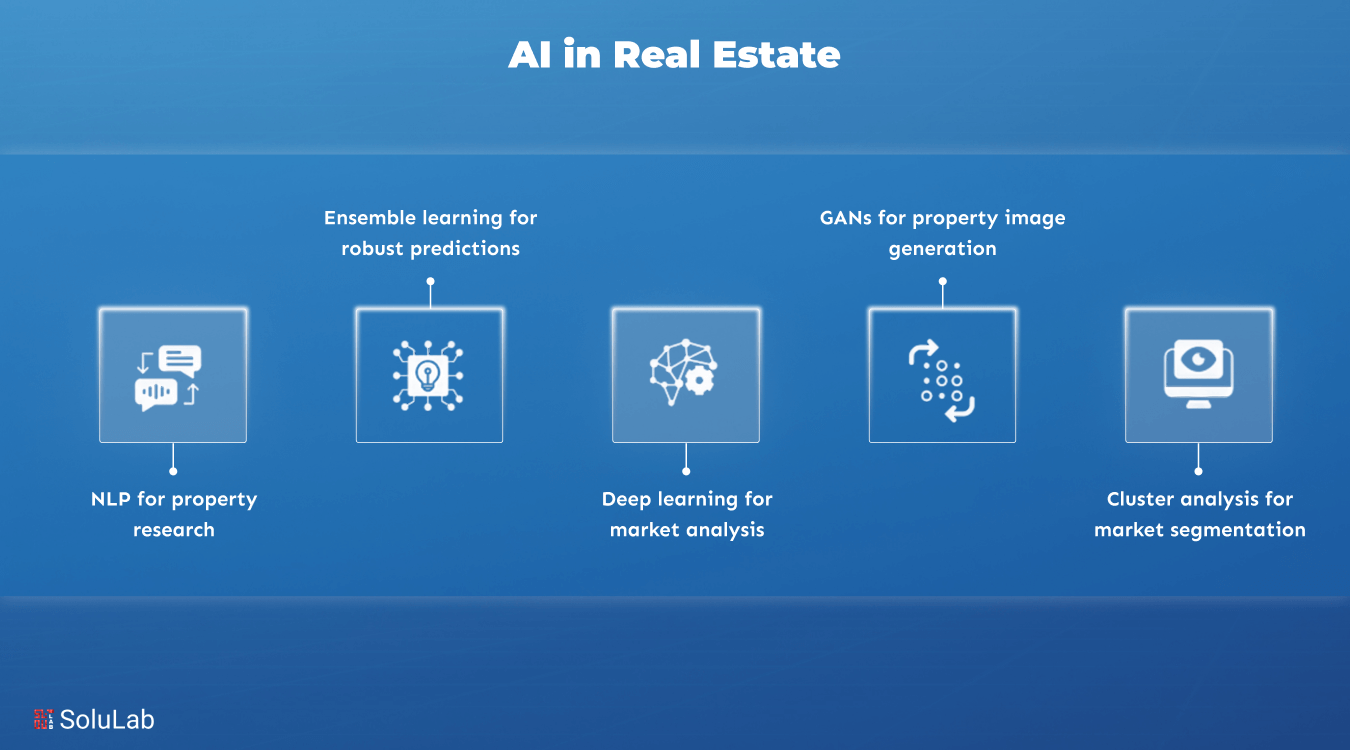
Real estate companies use AI for market forecasting, lead generation, chatbots for customer service, and even for analyzing images or floor plans to extract insights. It’s also being used to evaluate land prices, detect fraud in documentation, and optimize property listings, making the buying, selling, and renting process much more efficient and data-driven.

AI In Real Esatate Global Market Report

How Does AI Work In Real Estate?

1. Property Recommendations: AI analyzes user behavior, preferences, and past searches to offer personalized property suggestions. This helps buyers or renters find suitable options faster, improving the overall experience and reducing time spent on irrelevant listings.

2. Price Prediction & Valuation: Using historical data, market trends, and location-based insights, AI tools can estimate property prices more accurately. This helps buyers avoid overpaying and allows sellers to price their property competitively based on real-time market data.

3. Chatbots & Virtual Assistants: AI-powered chatbots provide instant customer support by answering queries, scheduling site visits, and sharing property details 24/7. They are very helpful for virtual real estate assistants and ensure smoother communication for both buyers and sellers.

4. Fraud Detection: AI systems can scan documents, verify identities, and detect inconsistencies in property listings or transactions. This reduces the risk of fraud and ensures transparency in the real estate buying or renting process.

5. Predictive Maintenance in Smart Buildings: Enabled systems in smart buildings monitor equipment performance and predict maintenance needs. This helps property managers reduce downtime, save costs, and offer a better living or working experience for occupants.

Conventional Property Systems and the Difficulties They Encountered

Conventional Property Systems and its Difficulties in Real estate

The global economy has traditionally relied heavily on the real estate sector, which links buyers and sellers looking to purchase homes, businesses, or assets for investment. Real estate has traditionally been bought, sold, and managed mostly via manual labour that requires human skill and effort. But the incorporation of artificial intelligence (AI) has had a big influence on the real estate industry lately, changing the way properties are looked for, assessed, and maintained.

  • Paperwork and Manual Procedures

Real estate transactions used to need a lot of paperwork and human labour. Administrative duties took up a significant amount of time for real estate agents, ranging from filling up property listings to handling contracts and paperwork. Due to the manual process’s time-consuming nature and increased chance of error, real estate transactions experienced delays and inefficiencies.

  • Restricted ability to Analyze Data

It was common for traditional real estate systems to lack advanced data analysis features. In order to make conclusions about property assessments, market trends, and investment prospects, real estate professionals had to depend on their expertise and intuition. Inadequate data analysis resulted in poor decision-making as important insights from big datasets were not fully exploited.

  • Lengthy Property Searches and Appraisals

Finding the ideal property for a buyer requires either manually perusing listings or physically seeing many houses. Variations in property prices resulted from the subjective and human appraisers who conducted many property appraisals. Inefficiencies in the real estate market were caused by these laborious and arbitrary procedures.

  • Insufficient Customisation

Property searches and suggestions in AI for real estate systems were frequently impersonal. It was difficult for buyers and investors to identify houses that exactly met their requirements and tastes since they had to rely on generic ads and suggestions.

  • Ineffective Property Administration

Managing a property required a lot of work and entailed balancing a number of duties, including upkeep, collecting money, and communicating with tenants. It was difficult to streamline property management procedures with traditional methods, which might have resulted in inefficiencies and higher expenses for managers and owners of real estate.

  • Communication Gaps and Data Silos

Various real estate business stakeholders frequently dealt with disjointed, non-integrated data systems. Property transactions were delayed and complicated as a result of the breakdown in communication and lack of transparency that resulted between buyers, sellers, brokers, and property management firms.

  • Reliance on Local Knowledge

Conventional real estate systems mostly depended on local knowledge and experience. Although local knowledge is vital, it may restrict prospects for investors and companies to thrive by restricting the possibilities for larger industry insights and trends.

These difficulties offer chances for AI integration to rectify these flaws and realize the full potential of the real estate market as it develops. In the real estate sector, artificial intelligence (AI)-powered solutions may boost productivity by streamlining procedures, enhancing data analytic skills, offering personalized experiences, and more. Real estate professionals may more fully recognize the benefits of artificial intelligence (AI) and seize the chances for innovation and expansion by being aware of the shortcomings of conventional methods.

Real Estate Tokenization Services

What Flaws in the Current Real Estate Systems Can AI Fix?

The following are some ways that AI integration can successfully handle the issues raised by conventional real estate systems:

  • Automation and Digitalization:

By digitizing paperwork and automating manual operations, artificial intelligence (AI) lessens the administrative strain on real estate workers. This expedites real estate transactions, reduces mistakes, and simplifies processes.

  • Advanced-Data Analytics:

AI is capable of swiftly and correctly analyzing large datasets, which yields insightful information on market trends, investment prospects, and property appraisals. Decisions about real estate are becoming more educated and data-driven.

  • Improved Property Search:

AI-driven solutions provide effective methods for finding properties, saving time and effort for investors and purchasers. The process of finding a property may be made better by machine learning algorithms, which can recommend properties that fit certain needs and preferences.

  • Personalization:

AI-powered systems have the ability to customize real estate suggestions by adjusting listings based on user preferences. This guarantees that guests locate homes that suit their particular requirements, improving their experience as a whole.

  • Effective Property Management:

By automating processes like rent collecting, maintenance scheduling, and tenant communication, artificial intelligence (AI) may improve property management. Smoother property operations and cost savings result from this.

  • Communication and Data Integration:

AI systems are able to combine data from several sources, which promotes improved stakeholder transparency and communication. As a result, there are fewer misconceptions, hold-ups, and data silos in the real estate industry.

  • Broader Market Insights:

Artificial intelligence goes beyond regional specialization to provide broader market insights. By analyzing data from larger geographic regions and spotting new trends, it enables investors to investigate potential new growth prospects.

By streamlining processes, strengthening data analysis, personalizing interactions, and increasing overall efficiency, AI integration has the potential to completely transform conventional real estate systems. The real estate sector may overcome its past obstacles and open up new avenues for development and innovation by embracing Hybrid AI technology.

Use cases for AI in the Real Estate Sector

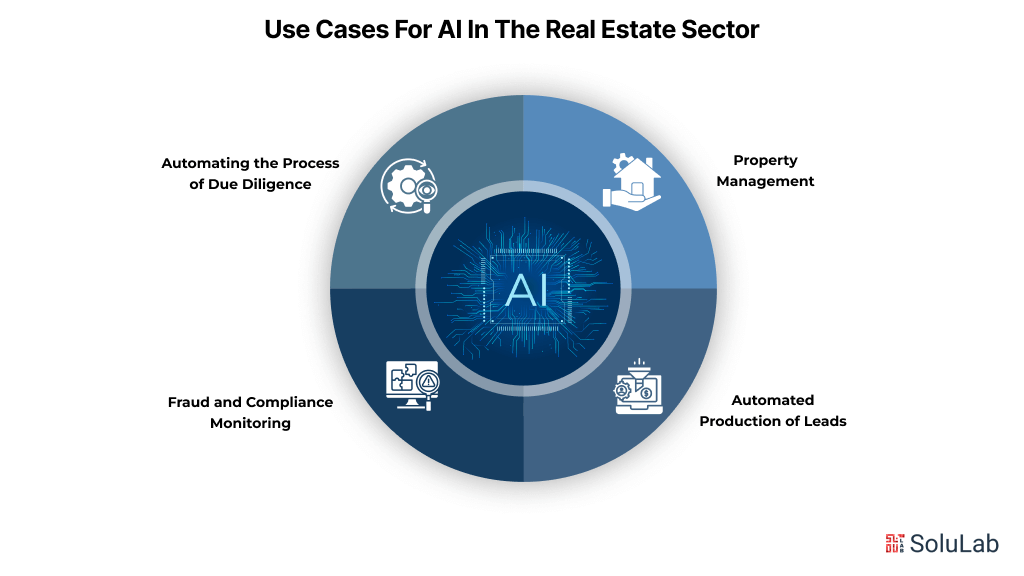
The real estate sector has been greatly influenced by AI, which has produced a variety of use cases that have improved client experiences, reduced procedures, and improved decision-making. Here are a few thorough examples of AI applications in the real estate sector:
Use cases for AI in the Real Estate Sector

1. Property Management

In the real estate market, efficient property management is crucial, especially for complex and rental property managers. However, AI has created a new solution that has improved property management and the real estate business. AI technology can automate many property management operations, reducing property managers’ workloads. Automation reduces their burden and reduces human mistakes, which can cause late rental payments, accounting issues, and tenant conflicts. AI could improve property management in the real estate industry.

2. Automated Production of Leads

AI for real estate lead generation has improved conversion rates and reduced procedures.  Manual lead classification and examination often result in inefficiencies and missed opportunities.  Real estate automates lead generation with machine learning.  AI systems evaluate large databases for leads based on web behavior, property preferences, and demographics.  This lets agents better target prospects and adapt marketing campaigns.  AI’s predictive analytics can help agents prioritize high-potential leads and manage resources.

3. Fraud and Compliance Monitoring

Artificial intelligence and machine learning are being used to address the challenges caused by the rise of AI-generated content and edited images in real estate listings. AI’s ability to detect and assess fraud ensures listing data accuracy and helps brokers, administrators, and MLS providers maintain corporate integrity. By applying AI for fraud detection, real estate agents can proactively address Fair Housing Act compliance issues and reduce the chance of erroneous listings. This use case shows how AI guards against legal issues while maintaining real estate confidence and openness.

4. Automating the Process of Due Diligence

Because human data input is inaccurate, AI offers a solution. It checks loan applications and leasing agreements for flaws using big datasets. The loan approval process relies on AI to identify discrepancies between paper values. By adopting this step, you improve due diligence and reduce loan sanctioning fraud. Automation of due diligence by AI shows its revolutionary potential to improve accuracy and minimize risk in complex real estate deals.

Real World Examples of AI in Real Estate

AI is already improving the real estate industry through platforms that use data-driven insights and automation to improve decision-making, pricing, and customer experiences. Here are some real-world examples:

  • Zillow

Zillow uses AI for its “Zestimate” feature, which provides real-time property valuations by analyzing data from public records, user-submitted information, and market trends. It also uses AI to match buyers with suitable listings based on their behavior.

  • Entera

Entera is a real estate investment platform that uses AI to help institutional investors find, evaluate, and buy residential properties at scale. It analyzes market trends, property data, and investment potential to recommend profitable deals.

  • Trulia

Trulia uses AI to personalize home search experiences by learning user preferences and delivering relevant property recommendations. It also integrates machine learning to provide neighborhood insights, pricing trends, and commute analysis for better decision-making.

AI Development Services

Conclusion

AI is changing the real estate industry by making processes faster, smarter, and more customer-centric. For investors, buyers, and sellers alike, these advancements mean better decision-making and increased efficiency. As the technology evolves, its role in real estate will only grow stronger, making it essential for industry players to use AI tools to stay competitive and meet the demands of a data-driven market.

Digital Quest, a travel business, partnered with SoluLab to develop an AI-powered chatbot using Generative AI. The chatbot enhanced customer engagement by offering real-time, personalized travel recommendations and hassle-free reservations. It also integrated user feedback and multi-language support, resulting in improved user experience and high ROI.

SoluLab, a leading AI development company in the USA, can help your business make smarter real estate decisions and choose the most effective tools for your needs. Get in touch with us today to explore how we can support your goals.

FAQs

1. What are the benefits of AI in real estate?

Discover the advantages of AI for real estate, including improved property valuation accuracy, enhanced customer experience through personalized recommendations, and optimized property management processes.

2. How is AI used in property valuation?

Learn how AI algorithms analyze vast datasets, including market trends, property characteristics, and comparable sales data, to generate accurate property valuations and assist in investment decisions.

3. What are some practical applications of AI in real estate transactions?

Explore the various applications of AI in real estate transactions, such as automated document processing, predictive lead scoring for sales and marketing, and virtual property tours using AI-powered virtual reality (VR) technology.

4. How does AI assist in property management?

Understand how AI tools and platforms help property managers streamline operations, optimize maintenance schedules, predict equipment failures through predictive maintenance, and improve tenant satisfaction through personalized services.

5. What does the future hold for AI in real estate?

Explore future trends and advancements in AI technology that are poised to transform the real estate industry, such as AI-powered real estate investment platforms, predictive analytics for property market forecasting, and AI-driven sustainability solutions for buildings.

[/fusion_text][/fusion_builder_column][/fusion_builder_row][/fusion_builder_container]
How DePIN in Web3 Helps Enterprises Build Smarter Infrastructure?

DePIN in Web3

Despite Web3’s claimed decentralization, centralized corporations still control a large portion of the infrastructure, including computation, storage, and communication. This leads to problems with trust, expenses, and delays. Even as dApps and blockchains grow, they rely on traditional systems that go against Web3’s core values. Centralized servers can fail, censor, or control access. 

DePIN (Decentralized Physical Infrastructure Networks) is changing that. It enables users to build and maintain infrastructure, such as wireless networks, storage, or energy, through blockchain and token incentives. 

In this blog, we’ll explore how DePIN is driving the next phase of decentralization and why it’s key to Web3’s future.

What is DePIN in Web3?

DePIN, short for Decentralized Physical Infrastructure Networks, is a Web3-powered model that uses blockchain and token incentives to build and manage real-world infrastructure. Instead of relying on centralized corporations, DePIN allows communities, businesses, and individuals to contribute resources—like storage, connectivity, or energy—and get rewarded for it.

Messari also anticipates that the DePIN market might be worth approximately $2.2 trillion currently, and that it could grow to $3.5 trillion by 2028. Here’s how it works: 

  • People contribute physical resources (like WiFi routers, storage space, or solar panels).
  • They connect these devices to a blockchain-powered network.

In return, they earn crypto tokens for providing value to the network.

Why DePIN is Important for Blockchain and Web3?

DePINs are crucial to the growth of Web3, as they bridge the gap between the digital and physical sectors. Here’s why it’s important:

  • Enhancing Decentralized Ownership Infrastructure: DePIN eliminates the need for centralized organizations like governments or businesses by enabling individuals to engage in infrastructure ownership and governance. The core principles of Web3, granting people more control rather than depending on centralized authorities, are in line with this decentralization.
  • Linking the Digital and Physical Worlds: DePIN connects blockchain technology to physical assets, including electricity grids, transportation networks, and Internet of Things devices. Web3 apps may run on real-world infrastructure due to this connectivity, enabling solutions like renewable energy marketplaces and decentralized smart cities, among others.
  • Developing Novel Economic Frameworks: Through the tokenization of physical infrastructure, DePIN presents novel economic models in which resource contributions are rewarded. By encouraging involvement and active participation, these tokenized incentives support the upkeep of decentralized networks.
  • Resilience and Scalability: DePIN networks are more secure than conventional centralized systems. By eliminating single points of failure, decentralization strengthens and expands the system. DePIN will assist in satisfying the need for adaptable and effective decentralized infrastructure as Web3 expands.
  • The Trustless and Transparent Ecosystem Vision of Web3: DePIN makes use of the immutability, security, and transparency of blockchain technology. By ensuring that decentralized infrastructure systems are secure, verifiable, and auditable, these characteristics foster participant trust and enable trustless interactions devoid of middlemen.

How DePIN in Web3 Benefits Enterprises?

Enterprises Benefits of DePIN in Web3

Enterprises today demand infrastructure that is not only efficient but also adaptable to fast-changing market needs. DePIN in Web3 introduces a decentralized model that lowers costs, increases agility, and unlocks new growth opportunities—all while ensuring transparency and security. Here’s how it creates real value for businesses:

a. Cost Optimization

By leveraging shared, community-driven infrastructure, enterprises can significantly reduce capital and operational expenses. This decentralized model eliminates vendor lock-ins and minimizes overheads, making infrastructure more cost-efficient.

b. Scalability

DePIN networks grow organically as more participants join, allowing enterprises to expand without heavy upfront investments. This ensures infrastructure can scale seamlessly to match increasing demand.

c. Security & Transparency

Blockchain’s immutable ledger ensures secure data management, transparent transactions, and accountability across stakeholders. Enterprises benefit from reduced risks and higher trust in operations.

d. Real-World Value Creation

From IoT networks and renewable energy to logistics and decentralized storage, DePIN directly connects digital incentives with physical infrastructure. Enterprises can leverage this to enhance efficiency and tap into entirely new service models.

e. Flexibility & Innovation

DePIN empowers enterprises to experiment with decentralized business models—whether launching tokenized services, building peer-to-peer systems, or unlocking new revenue streams—fueling innovation without disrupting existing systems.

CTA1

Top 5 Use Cases of DePIN in Web3 for Enterprises

DePIN (Decentralized Physical Infrastructure Networks) is changing industries by combining blockchain with real-world assets. Let’s explore the top 5 use cases driving innovation and efficiency globally.

  • Telecommunications Infrastructure: DePIN enables community-driven telecom networks where users contribute bandwidth and coverage. This reduces dependency on expensive centralized operators, making internet and mobile connectivity more affordable and accessible in underserved areas.
  • Energy Generation and Distribution: Through DePIN, communities can build decentralized solar and renewable grids. People generate, store, and trade surplus energy locally, ensuring sustainability, cost savings, and reduced reliance on traditional energy monopolies.
  • Data Storage and Computing Power: DePIN allows individuals to share unused storage and computing capacity. This creates affordable, scalable alternatives to centralized cloud providers, ensuring better security, redundancy, and user control over data.
  • Decentralized Healthcare: By leveraging DePIN, healthcare networks can securely store and share patient records across providers. It ensures privacy, reduces duplication, and improves accessibility for patients in remote or resource-limited areas.
  • Web3 Gaming Infrastructure: DePIN powers decentralized gaming ecosystems where users share GPU power, storage, and servers. This makes Web3 gaming smoother, reduces costs, and creates fairer, player-owned infrastructures for immersive online experiences.

Real World Examples of Web3 DePIN

Real World Examples of Web3 DePIN

Several DePIN projects are already making waves across various industries. Here are a few notable examples:

1. Helium:

Helium is a decentralized wireless network where individuals provide LoRaWAN hotspots, enabling IoT devices to connect. Users earn HNT tokens for contributing coverage, creating a community-driven, low-power, wide-area network.

2. Filecoin:

Filecoin is a decentralized storage network. Participants rent out unused storage space, allowing others to store data securely. Miners earn FIL tokens, promoting distributed storage and reducing reliance on centralized cloud providers.

3. Golem:

Golem is a decentralized computing network. Users share idle computing power for tasks like rendering or simulations. Contributors earn GNT tokens, enabling cost-effective, distributed computation without depending on centralized cloud services.

4. Render Network:

Render Network decentralizes GPU-powered rendering for digital content. Users contribute GPU resources to process graphics, animations, and AI workloads. They earn RNDR tokens, offering a scalable, cost-efficient alternative to traditional centralized rendering farms.

The Future of DePIN in Web3

Decentralized Physical Infrastructure Networks (DePIN) are reshaping how real-world infrastructure is built, owned, and operated by leveraging blockchain technology and community incentives, bringing a new level of transparency, efficiency, and decentralization to physical systems.

  • Community-Owned Infrastructure: DePIN shifts control from large corporations to everyday individuals. People can contribute devices such as routers, solar panels, or sensors, and receive rewards for their participation. This promotes wider coverage, reduces costs, and builds trust through community-driven ownership and governance.
  • Token Incentives Drive Growth: DePIN projects reward users with crypto tokens for contributing to and maintaining physical infrastructure. This token-based model fosters a self-sustaining ecosystem where growth is driven by real-world usage and community participation, rather than solely by corporate investment.
  • Solving Infrastructure Gaps in Markets: DePIN can solve rural connectivity, energy distribution, and data-sharing challenges. Local users can deploy low-cost infrastructure and earn rewards, making decentralized models more viable than traditional centralized solutions in underserved areas.
  • Integration with IoT and AI: As Web3 evolves, DePIN will increasingly integrate with IoT and AI technologies. This will enable smarter, more responsive networks—whether in logistics, transport, or urban planning making real-time data more accessible, secure, and user-controlled.

CTA2

Conclusion

DePIN is changing industries and influencing the direction of decentralized apps. It easily fits in with the expanding needs of decentralized finance and other developing Web3 industries by utilizing blockchain technology.

DePIN Blockchain as a Service is positioned to bring about breakthroughs as sectors keep adopting decentralized models, promoting effectiveness, accessibility, and sustainability across industries. DePIN is expected to establish itself as an essential part of the decentralized ecosystem.

SoluLab, a DePIN development company, can help you build scalable, decentralized infrastructure tailored for Web3 gaming, IoT, and beyond. 

FAQs

1. How does DePIN technology in Web3 benefit Web3 infrastructure projects?

DePIN technology Web3 enhances Web3 infrastructure projects by providing decentralized solutions that lower the costs associated with traditional infrastructure. This decentralized approach enables faster scalability, better security, and improved accessibility for developers building on Web3, reducing the need for expensive hardware and centralized control.

2. How do participants earn tokens in DePIN networks?

People who take part in DePin networks get tokens for giving up things like bandwidth, energy, or storage. These resources are turned into tokens, which means they can be traded or used on the network. People who contribute get tokens as payment. These tokens can be used to access network services or sold on secondary marketplaces. 

3. Can DePIN applications in Web3 be integrated into other industries besides gaming?

Yes, DePIN applications Web3 can be integrated into various industries, including decentralized finance (DeFi), healthcare, logistics, and cloud computing. The flexibility of the DePIN blockchain allows businesses to decentralize their physical infrastructure, improve operational efficiency, and reduce costs by distributing workloads across multiple nodes.

4. How does DePIN blockchain enhance security in Web3 infrastructure projects?

DePIN blockchain enhances the security of Web3 infrastructure projects by distributing data and resources across multiple nodes, reducing the risks of centralized failure or data breaches. The decentralized nature of DePIN ensures that no single point of failure exists, providing better resilience and reliability for the overall infrastructure.

5. What is the difference between DeFi and DePIN?

DePIN indicates decentralized physical infrastructure networks, and DeFi represents decentralized finance. DeFi concentrates on financial services like lending and trading using blockchain technology by eliminating middlemen. On the other hand, DePIN improves infrastructure security and efficiency in the real world by using blockchain technology to manage real systems like electrical grids and supply chains.


How to Build a dApp on Avalanche Blockchain?

Build a dApp on Avalanche Blockchain

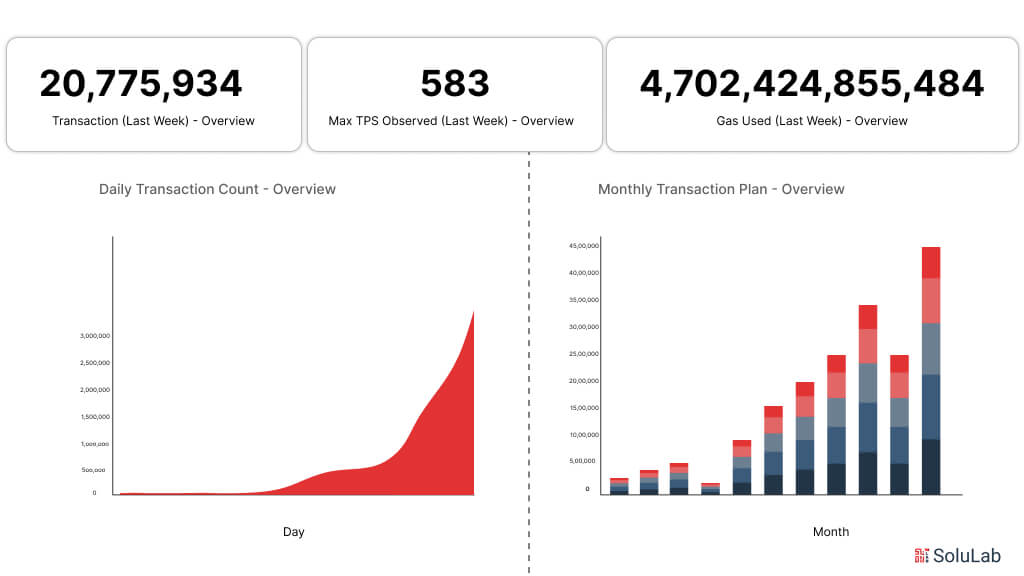
Within the Avalanche platform, developers can create and launch decentralized applications known as dApps, enabling them to leverage the Blockchain’s capabilities to unlock their earning potential. The platform has experienced significant growth, with statistics indicating that 20,952,045 transactions were processed, and this number continues to increase. As a result, more investors have adopted Avalanche Blockchain Dapp development to improve users’ financial experiences.

Avalanche stands out as a unique platform, often referred to as “Blockchains of Blockchains.” Unlike traditional Blockchain networks like Solana or Ethereum, which operate as single chains, Avalanche consists of three interconnected blockchains, each handling specific use cases. This interoperable, open-source, and scalable platform allows for seamless business Blockchain deployments and dApp development.

What is Avalanche?

Avalanche, a blockchain protocol, stands out in the realm of DeFi dApps and corporate blockchain deployments by prioritizing their needs. It sets itself apart as a scalable, interoperable, and open-source solution. Rather than being a single blockchain like Ethereum or Solana, Avalanche is aptly dubbed the “blockchain of blockchains.” Its unique architecture consists of three distinct blockchains, each with its specialized function, delivering a robust and adaptable platform.

The Avalanche ecosystem comprises three interconnected blockchains:

1. Exchange (X) Chain: Responsible for asset creation, management, and transaction processing.

2. Platform (P) Chain: Handles subnet creation, validator coordination, and network governance.

3. Contract (C) Chain: An instance of the Ethereum Virtual Machine (EVM), allowing for seamless integration and execution of smart contracts.

This insight focuses on the Contract (C) Chain, which is crucial for smart contract development on the Avalanche network and particularly relevant for developers building dApps on Avalanche. This chain is fundamental for building and deploying applications on the Avalanche blockchain.

Transaction Data

The Architecture Of Avalanche Blockchain

The Avalanche Blockchain stands out as a unique platform, facilitating smooth deployments of business-focused blockchain solutions and the development of decentralized applications. This exploration will delve into “The Architecture of Avalanche Blockchain.” Understanding this framework is crucial for building robust applications and deploying them effectively on the Avalanche blockchain.

  • Avalanche Network

At the core of the Avalanche ecosystem, the Avalanche Network stands as a central hub, guiding and securing its operations. It serves as the backbone, ensuring seamless functioning and compatibility among all components within the Avalanche platform. Developing decentralized applications on Avalanche (Avalanche dApp development) is essential for harnessing these components to create a scalable, secure, and decentralized platform for building and deploying applications. 

  • Subnets

Avalanche subnets are distinct blockchains designed for specific applications. Developers can leverage the Subnet Builder to craft and personalize these subnets. Among the available options are contract chains, and specialized subnets optimized for executing smart contracts. These contract chains excel in providing quick transactions and security, positioning them as optimal choices for constructing decentralized applications (dApps) and diverse blockchain development solutions.

  • Validator Nodes

In the Avalanche Network, validators are responsible for maintaining transaction validity, preserving network integrity, and facilitating consensus through proof of stake (PoS). They contribute to network security by staking AVAX tokens, earning rewards for their efforts. As part of their role, validators verify transactions before adding them to the blockchain. Factors influencing the selection of validators include the amount of staked AVAX, performance metrics, and uptime duration.

What is the Avalanche Contract (C) Chain?

The C-Chain acts as an Ethereum Virtual Machine (EVM) replica, enabling developers to effortlessly create smart contracts. Avalanche emphasizes that the C-Chain excels by providing superior throughput, increased speeds, rapid transaction confirmation time, and lower fees. This difference occurs from the C-Chain utilizing a Proof-of-Stake (PoS) consensus mechanism based on the Snowman Consensus Protocol, unlike Ethereum’s Proof-of-Work (PoW) consensus mechanism. Importantly, since the C-Chain runs the EVM, developers have unfettered access to the comprehensive Ethereum developer toolset.

Key Features of Avalanche Contract Chain 

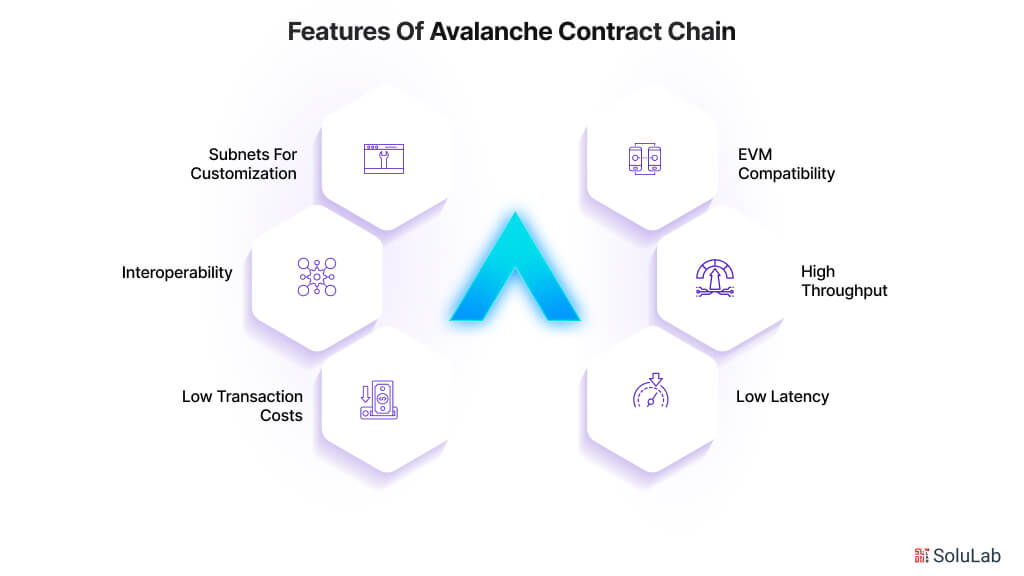
Features of Avalanche Contract Chain

Within the Avalanche blockchain ecosystem, the C-Chain stands as an outstanding platform designed specifically for businesses. It provides the tools and infrastructure necessary for enterprises to construct and launch decentralized applications (dApps) that surpass conventional limitations. The C-Chain’s distinctive characteristics address the stringent demands of contemporary organizations seeking to leverage blockchain technology’s potential within their operations.

  • EVM Compatibility

The C-Chain’s seamless compatibility with the Ethereum Virtual Machine (EVM) gives developers access to a vast array of opportunities. Solidity, the predominant smart contract programming language, is natively supported on the C-Chain, enabling developers to utilize their existing knowledge and tools. This compatibility eliminates the requirement for additional learning or separate development environments, reducing the learning curve significantly. As a result, migrating existing Avalanche smart contract dApps from Ethereum to Avalanche becomes effortless, ensuring a smooth transition.

Within the C-Chain, developers have the advantage of utilizing the widely recognized Solidity programming language and its associated development tools. This seamless integration not only facilitates quick dApp creation and deployment but also provides developers with access to an extensive range of existing Ethereum resources. This includes comprehensive tutorials, detailed documentation, and a supportive community, all of which contribute to an accelerated and efficient development process.

  • High Throughput

With the Snowman Consensus Protocol, Avalanche’s C-Chain can process up to 4,500 transactions per second (TPS), upgrading enterprise applications’ ability to handle large transaction volumes efficiently. 

The C-Chain’s high throughput is ideal for use cases requiring real-time tracking like supply chain management. It can also meet the demanding requirements of payment processing systems, ensuring seamless and instant transactions.

  • Low Latency

On the C-Chain, transaction finality is accomplished in seconds, offering real-time performance that is important for enterprise applications. The C-Chain’s low latency is especially advantageous for industries like financial services and decentralized exchanges, where time-sensitive decisions are made. It ensures that transactions are processed and executed rapidly, minimizing delays and enhancing operational efficiency.

Furthermore, the C-Chain’s low latency enables businesses to develop dApps that provide real-time updates, instant settlements, and seamless user experiences. This can revolutionize industries that require fast and reliable transactions, allowing for streamlined operations, improved decision-making, and enhanced customer satisfaction.

  • Low Transaction Costs

Compared to Ethereum’s fluctuating and potentially exorbitant gas fees, the C-Chain provides considerably lower transaction costs. This cost-effectiveness enables businesses to operate their dApps on Avalanche more affordably, minimizing operational expenses and promoting long-term sustainability.

Moreover, the C-Chain’s low fees open up new opportunities for micro-transactions and micro-services. These small or frequent payments would be impractical on networks with high fees.

  • Interoperability

The C-Chain facilitates seamless asset transfer between Avalanche and Ethereum, enabling developers to access the benefits of both blockchain ecosystems. This interoperability allows for the creation of innovative decentralized applications (dApps) with enhanced functionalities.

For example, dApps developed on the C-Chain can take advantage of the substantial liquidity of Ethereum’s decentralized finance (DeFi) ecosystem while simultaneously taking advantage of Avalanche’s scalability and cost-effectiveness. This facilitates the development of sophisticated dApps that combine the strengths of both platforms, unlocking new possibilities for decentralized applications.

  • Subnets for Customization

Within the C-Chain’s remarkable features lies the ability for businesses to create and operate customized blockchain networks known as subnets. These subnets are independent and sovereign blockchain networks designed to cater to specific requirements related to governance, compliance, and performance.

The flexibility offered by subnets allows businesses to craft and deploy decentralized applications (dApps) that seamlessly align with their unique requirements. For instance, a financial institution might leverage a subnet to ensure regulatory compliance, while a supply chain consortium could utilize a subnet to securely exchange sensitive data among its members.

Steps to Build dApps on Avalanche Blockchain

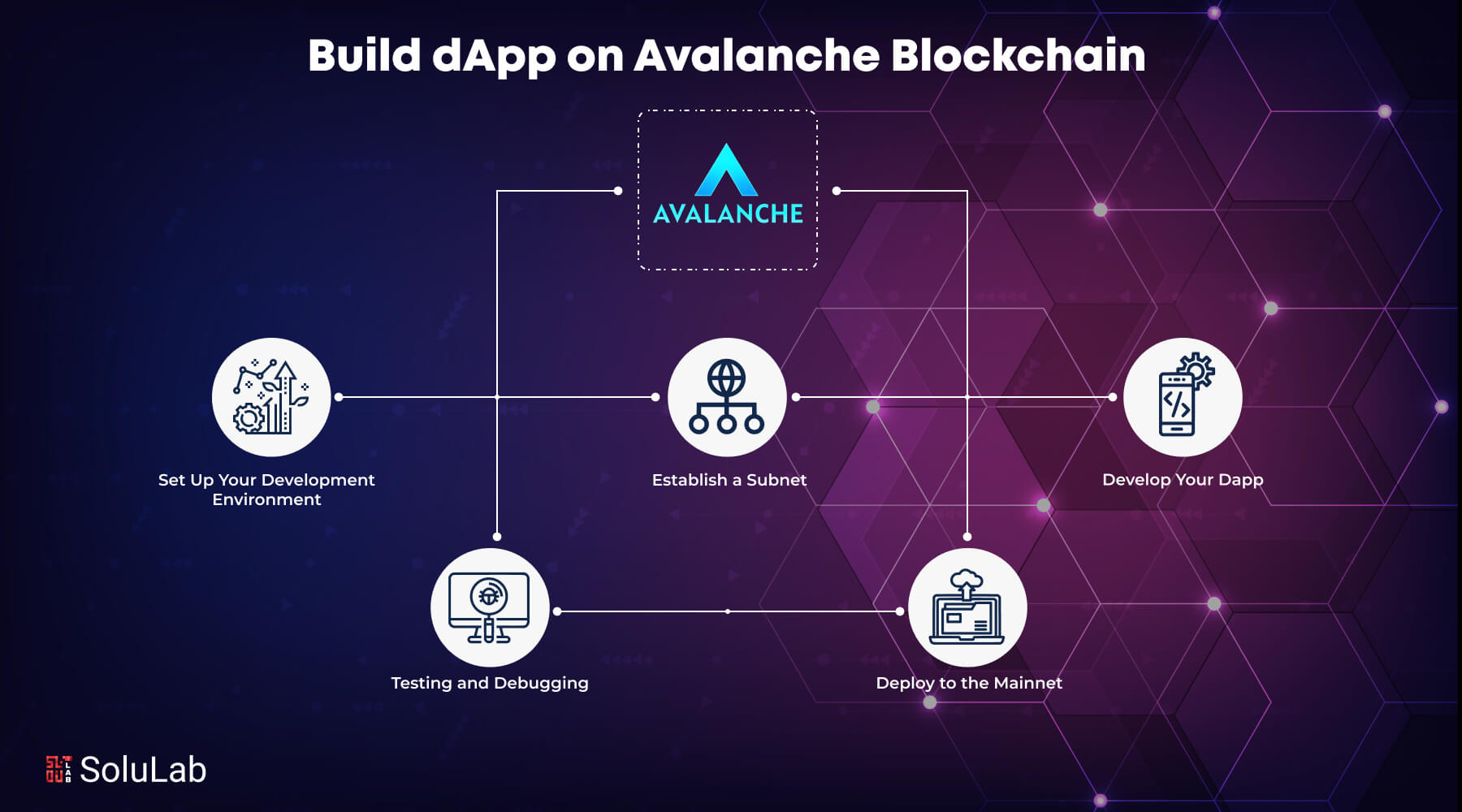
Avalanche Blockchain offers several compelling features that make it an attractive platform for enterprise dApp development. These include EVM compatibility, high throughput, low latency, low transaction costs, interoperability, and customizable subnets. To build dApps on Avalanche, follow these steps:

Step 1: Set Up Your Development Environment

  • Download and Install Avalanche Node Software:

To deploy decentralized applications (dApps) on Avalanche, start by visiting the official Avalanche website. On the downloads page, choose the appropriate installer for your operating system: Windows, macOS, or Linux. For Windows users, download the AvalancheGo executable file. After downloading, follow the setup process to complete the installation. For macOS and Linux users, download the provided installation scripts. To finish the installation process, adhere to the on-screen instructions.

  • Verify Installation:

To verify the successful installation of avalanche-go, launch your terminal or command prompt and input the command “avalanche-go“. Upon successful installation, a list of accessible commands and options will be displayed.

  • Generate a Wallet Address:

To interact with the Avalanche network securely, you’ll need a wallet address. You can use the official Avalanche Wallet or any other compatible wallet to create a wallet. Follow the instructions provided by the wallet provider to set up your wallet and generate a unique wallet address.

  • Purchase AVAX Tokens:

AVAX tokens are the native cryptocurrency of Avalanche and are used to pay transaction fees and stakes for validator nodes. To purchase AVAX tokens, you can use cryptocurrency exchanges such as Binance, Kraken, or Coinbase. Create an account on one of these exchanges and follow the instructions to buy AVAX tokens using your preferred payment method.

dApp Services

Step 2: Establish a Subnet to Enhance Your Dapp’s Functionality

  • Define Subnet Parameters:

Name: Choose a unique name for your subnet. The name should be descriptive of your Dapp’s functionality and easily identifiable; Purpose: Specify the purpose of your subnet. This could include the specific use case or application your Dapp will serve.; Rules: Define the permissions and restrictions for validators on your subnet. These rules determine who can participate as a validator and the actions they can perform.

  • Stake AVAX:

Determine the minimum amount of AVAX required to create your subnet. This amount depends on the subnet’s configuration and the number of validators you plan to have. Stake the required amount of AVAX to the subnet creation contract. This AVAX will be used to secure the subnet and reward validators for their participation.

  • Select Validators:

Choose validators to secure and operate your subnet. Validators are responsible for validating transactions, maintaining the subnet’s security, and ensuring its smooth functioning. You can either run your own validator nodes or delegate your stake to existing validators. Running your own nodes provides greater control and flexibility while delegating your stake allows you to participate in the subnet without managing infrastructure.

  • Receive Subnet ID:

Once your subnet is created, you will receive a unique subnet ID. This ID identifies your subnet on the Avalanche network and is used to distinguish it from other subnets. The subnet ID is essential for configuring your Dapp to interact with the subnet and for managing its resources.

Step 3: Develop Your Dapp

  • Choose a Programming Language:

Avalanche supports various programming languages, including Solidity, Go, Rust, and Python. Research each language’s strengths and weaknesses to determine which one aligns best with your Dapp’s requirements. Consider factors like the language’s popularity, tool support, and the availability of resources and developers. If you’re familiar with Solidity, you can leverage its widespread adoption and large community. If you prefer a language known for its performance, Rust might be a suitable choice. For beginners, Python and Go are appealing alternatives due to their simplicity, straightforwardness, and ease of use.

  • Create Smart Contracts:

Smart contracts are the foundational elements of your Dapp, defining its logic and rules. Use a text editor or an integrated development environment (IDE) to write your smart contracts. Familiarize yourself with the syntax and semantics of the chosen programming language. Clearly define the functions, variables, and data structures used in your smart contracts. Test your smart contracts thoroughly to ensure they behave as expected under various conditions.

  • Deploy Smart Contracts:

Use the Avalanche SDK to deploy your smart contracts to a subnet. Avalanche DeFi dApp developers can benefit from a subnet, which is a private network within the Avalanche network, providing a dedicated environment for your Dapp. Follow the documentation and tutorials provided by Ava Labs to set up and manage your subnet. Use the Avalanche CLI or web interface to interact with your smart contracts and perform transactions.

  • Develop a User Interface:

The user interface is the part of your Dapp that users interact with. Choose a front-end framework that suits your needs and preferences. Popular options include React, Angular, and Vue.js, known for their rich features and ease of use. Avalanche dApp development services can assist in creating a user-friendly and intuitive interface that aligns with your Dapp’s functionality. Incorporate interactive elements, such as buttons, forms, and charts, to enhance the user experience. Implement responsive design principles to ensure your Dapp works well on different devices and screen sizes.

Step 4: Testing and Debugging

  • Leverage Avalanche’s Testnets for Risk-Free Testing:

Utilize Avalanche’s test networks to test your Dapp without jeopardizing real funds. These testnets offer a simulated environment with AVAX tokens dedicated to testing purposes. Avalanche offers multiple testnets, each with its unique features and benefits. Select the testnet that best aligns with your testing requirements. Take advantage of Avalanche’s vibrant community of developers and contributors who often share tips, resources, and insights related to testing on the testnets.

  • Identify and Resolve Smart Contract Issues:

Employ debugging tools and techniques to identify and rectify any problems within your smart contracts. Avalanche blockchain dApps benefit from tools such as the Avalanche CLI and the Avalanche Web3 Console to assist in this process. Understand the concept of gas optimization and how it can impact the performance and cost of your smart contracts. 

  • Measure Performance and Scalability:

Evaluate your Dapp’s performance and scalability to ensure it meets your expectations. Use tools like Avalanche Bench and Apache JMeter to measure these aspects under varying loads. Understand the relationship between transaction volume, block size, and network congestion. Identify bottlenecks in your Dapp’s architecture and implement optimizations to improve performance. Consider the impact of smart contract complexity on scalability. Optimize your smart contracts for efficiency to handle increased transaction volume without compromising security.

Step 5: Deploy to the Mainnet

  • Prepare Your Dapp for Mainnet Deployment:

Ensure your smart contracts are audited by a reputable security firm to identify and fix any vulnerabilities. Avalanche dApp marketplace developers should implement gas optimization techniques, such as batching transactions and using efficient algorithms, to minimize transaction fees. Update your Dapp’s documentation and user interface to reflect the transition to the mainnet. Include clear instructions on how users can interact with your Dapp on the mainnet. Test your Dapp extensively on a staging environment that closely resembles the mainnet. This will help identify and resolve any potential issues before deploying to the mainnet.

  • Transfer Assets to the Mainnet:

Choose a reputable bridge or cross-chain solution that is secure and has a proven track record. Carefully review the bridge’s documentation and follow the instructions to transfer your smart contracts and assets from the testnet to the mainnet. Double-check that all assets and contract addresses are correct before initiating the transfer. Consider using a multi-sig wallet for added security. Monitor the transfer process closely and ensure that all assets are successfully transferred to the mainnet.

  • Update Dapp Configuration:

Update your Dapp’s configuration files to point to the mainnet nodes and smart contract addresses. Ensure that your Dapp connects to the correct endpoints and networks. Test your Dapp thoroughly on the mainnet to verify that it functions as expected. Pay special attention to gas costs and transaction speeds. Monitor your Dapp’s performance and usage metrics to identify any areas for improvement.

  • Market Your Dapp:

Develop a comprehensive marketing strategy that targets your ideal users and aligns with your overall business goals. Create high-quality content, such as blog posts, tutorials, videos, and infographics, to educate potential users about the benefits and features of your Dapp. Utilize social media platforms, online forums, and developer communities to build a community around your Dapp and engage with potential users. To increase the visibility and trustworthiness of your Dapp, partner with influencers and thought leaders in the blockchain community. Additionally, attend industry conferences and events to establish connections with potential users and partners, expanding your network within the blockchain ecosystem.

  • Monitor and Maintain Your Dapp:

Continuously monitor your Dapp’s performance and security using analytics tools and monitoring services. Implement robust security measures, such as access control, encryption, and regular security audits, to protect your Dapp from attacks. How to build dApps on Avalanche involves not only development but also ensuring that you respond to any issues or vulnerabilities reported by users or security researchers. Regularly update your Dapp to incorporate new features, fix bugs, and address security vulnerabilities. Maintain open communication with your community to keep users informed about updates and improvements. Consider establishing a support channel where users can ask questions and report issues.

Blockchain Development Solutions

Conclusion

Building a decentralized application (dApp) on the Avalanche blockchain opens up numerous opportunities for developers, providing them with a scalable, efficient, and highly secure platform to create solutions. By leveraging the Avalanche network’s low fees, high throughput, and customizable subnets, developers can ensure that their dApp meets the needs of a modern, decentralized economy. The process, though technical, is made easier with the support of blockchain development companies that provide expert guidance throughout each phase of development. Additionally, utilizing DePIN Blockchain as a Service further simplifies infrastructure management, allowing creators to focus on innovation without worrying about the backend setup.

We recently published a case study on OBORTECH, where SoluLab helped the company integrate a Blockchain as a Service platform for its SmartHub. OBORTECH’s SmartHub, which seamlessly integrates blockchain with IoT devices, provides real-time data collection and interaction, ensuring transparency and data security for supply chain management. SoluLab developed key features like a staking platform for OBOT tokens and a cryptocurrency payment gateway, both of which enhanced user engagement and streamlined financial transactions. These solutions demonstrate how partnering with an experienced company like SoluLab can enable businesses to overcome complex blockchain challenges, including interoperability and scalability, while also simplifying user interfaces for non-technical users.

SoluLab, one of the leading blockchain development companies, specializes in providing Blockchain as a Service and custom dApp solutions for various industries. Whether you’re looking to launch a dApp on the Avalanche blockchain or explore DePIN Blockchain as a Service, SoluLab can help you accelerate your project’s success. If you’re ready to scale your blockchain solution, Hire a Blockchain Developer from SoluLab and start building the future today.

FAQs

1. What are the key steps to build dApps on Avalanche?

To build dApps on Avalanche, developers follow steps like setting up a development environment, coding the smart contracts using Solidity, deploying them on the Avalanche C-Chain, and creating a user interface that interacts with the smart contracts.

2. Why is Avalanche a good choice for dApp development?

Avalanche dApp development offers high throughput, low transaction fees, and customizable subnets. These features make it ideal for building scalable and fast decentralized applications.

3. How can I deploy dApps on Avalanche?

Developers can deploy dApps on Avalanche using the C-Chain, which supports Ethereum-compatible smart contracts. Tools like Remix and Avalanche’s APIs simplify the deployment process for developers.

4. What services do Avalanche dApp development companies offer?

Avalanche dApp development services include smart contract development, UI/UX design, integration with DeFi protocols, security audits, and dApp deployment on Avalanche’s blockchain network.

5. What industries can benefit from Avalanche blockchain dApps?

Avalanche blockchain dApps are used across finance, supply chain, gaming, and healthcare industries, especially due to the network’s speed, scalability, and low costs.

6. What are Avalanche DeFi dApps, and why are they popular?

Avalanche DeFi dApps are decentralized applications in the finance sector that enable lending, borrowing, staking, and trading without intermediaries. They are popular because of Avalanche’s low fees and high speed, making financial transactions faster and cheaper.

7. How does the Avalanche dApp marketplace function?

The Avalanche dApp marketplace allows developers and users to interact with various dApps built on the network. It acts as a hub for decentralized applications across various sectors like DeFi, NFTs, and more.

How To Create a Telegram Bot? [5 Easy Steps]

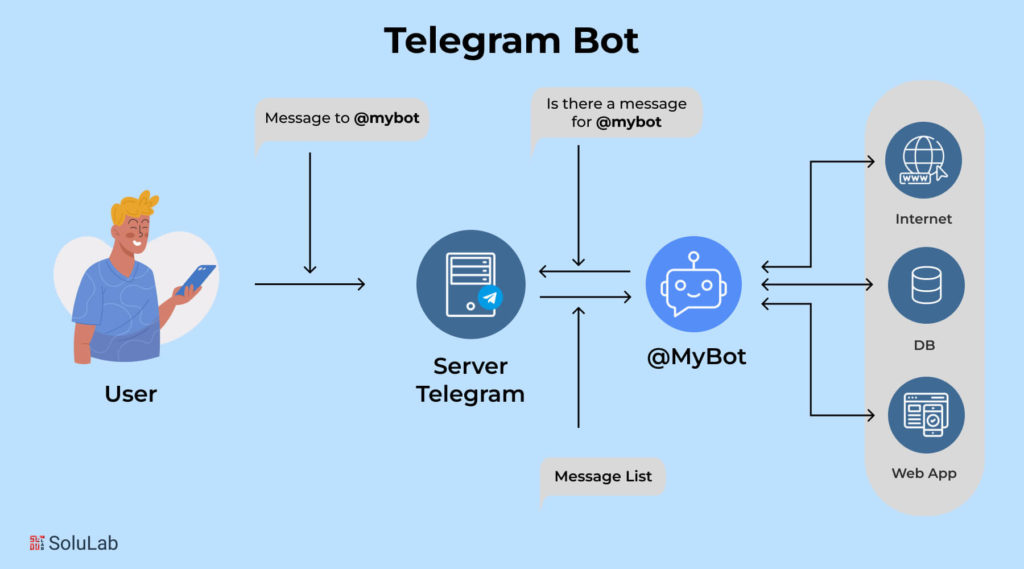
Telegram Bot

On July 23, 2024, Pavel Durov, Telegram’s CEO, announced on his Telegram channel that the app had reached a milestone of 950 million monthly active users, a significant increase from the 900 million users recorded in Spring 2024. This represents a remarkable growth of 150 million monthly active users compared to July 2023. For businesses, it is crucial to understand the behaviors and preferences of these users, including the channels they subscribe to and their texting habits. Telegram is more than just a messaging and media-sharing platform. It distinguishes itself through its creative use of bots to enhance user experiences. 

Notably, Telegram allows users to create their own bots without any coding requirements. These Telegram bots are designed to mimic human-like interactions and perform automated actions based on commands received in the form of HTTP requests. They offer a wide range of functionalities, from providing updates on new albums or movies to displaying users’ favorite shows. One of the key questions businesses may have is how to create a Telegram bot without coding. In the following sections, we will explore this topic in more detail, providing step-by-step guides and insights into the benefits and use cases of Telegram bots.

Telegram user data

How Telegram is Unique?

Telegram stands out from other messaging platforms due to its exceptional ability to seamlessly integrate with bots. Its user-friendly interface and compatibility with various devices, including iOS, Android, Windows, and platforms that support web versions, make it a versatile tool. Unlike WhatsApp Business, Telegram allows you to access chats from multiple platforms simultaneously, thanks to its cloud-based nature and instant synchronization feature.

How to create Telegram bot functionality is straightforward and highly adaptable, enabling businesses to automate tasks and improve efficiency. Telegram’s extensive ecosystem of bots is a key advantage. Businesses can integrate bots for translation, reminders, spam email management, and more. These bots can assist with a wide range of tasks, from automating customer service to providing product information.

Research indicates that Telegram has a higher view rate than other social media platforms, with 20% compared to Facebook’s 4% and Instagram’s 3%. This makes it an attractive platform for social media marketing. Additionally, businesses can utilize Telegram as an internal tool to facilitate communication among employees.

This guide addresses some key questions to help businesses leverage Telegram’s bot capabilities effectively.

  • What is a Telegram bot?
  • How to use Telegram bots?
  • What are the vital steps of creating your Telegram bots?

Don’t worry if you’re not a coder. The process is simple and requires a few steps that you’ll complete in no time.

What is a Telegram Bot?

In messaging, create Telegram bot appears to be a powerful solution, as Telegram bots are computer programs capable of interacting with users via the popular messaging app, Telegram. These versatile bots possess a wide range of abilities, from providing information to booking appointments and even facilitating games. Businesses can leverage Telegram bots to enhance customer service and streamline tasks, as they offer quick and automated responses. To engage with a Telegram bot, simply type its name or command in the chat window and witness its immediate response with the desired data or action. Remarkably, these bots can be effortlessly created without coding expertise, thanks to no-code solutions such as Directional.

Moreover, integrating ChatGPT’s language model into Telegram bots grants them enhanced intelligence and conversational skills. This integration allows bots to engage in witty banter and natural dialogue, elevating the user experience. With their powers combined, Telegram bots, Directual, and ChatGPT become unstoppable multitasking machines. Now, let’s delve deeper into the process of creating a Telegram bot.

What is BotFather?

BotFather, a bot created by Telegram, is not a robot dad but an innovative tool for how to build a Telegram bot. Through simple steps, you can customize your bot’s identity, including its name, profile picture, and description. Custom commands can be added to tailor the bot’s functionality to your specific needs.

But BotFather’s capabilities extend beyond user-friendly create a telegram bot creation. It also offers developers an API, empowering them to design customized bots even with limited coding experience. Developers and businesses alike have lauded BotFather for its ease of use and the power it brings to custom bot creation. 

Telegram’s popularity as a messaging app is not surprising, given the numerous businesses that harness its potential as a customer service tool. BotFather’s accessibility and functionality make it a significant contributor to Telegram’s position as a leading messaging platform.

Related: Top ChatGPT Development Companies 2025

Benefits of Using Telegram Bots

There are many benefits to using Telegram bots:

1. Automating Tasks: Telegram bots can save businesses time and resources by automating various tasks that would otherwise require human input. For instance, a bot can handle customer inquiries, provide product recommendations, or process orders, freeing up human employees to focus on more complex and strategic work. Understanding how to create a bot on Telegram enables businesses to leverage these capabilities effectively.

2. Instant Information: Telegram bots offer users immediate access to information without the need for human research or intervention. This is especially valuable in situations where time is of the essence, such as when customers have urgent questions or need to make quick decisions.

3. Round-the-Clock Support: Telegram bots provide round-the-clock customer support, ensuring that users can get assistance whenever they need it. This can significantly improve customer satisfaction and loyalty, as customers appreciate the convenience of having their issues resolved promptly. Learning how to create a telegram bot enables businesses to implement this valuable feature effectively.

CTA1

4. Reduced Wait Times: By handling routine inquiries and tasks, Telegram bots can help reduce wait times for customers. This is particularly beneficial in high-volume customer service environments, where human agents may be overwhelmed with requests, resulting in long wait times for customers.

5. Personalization: Telegram bots can be programmed to provide personalized recommendations and offers based on each user’s preferences and behavior, addressing the question of what is telegram bot in terms of enhancing the user experience. This enhances the user experience by making interactions with the bot more relevant and engaging.

6. Scalability: Telegram bots are highly scalable, meaning they can handle a large volume of requests without compromising performance. This makes them ideal for businesses that experience fluctuations in customer demand, such as during peak seasons or special promotions.

7. Data Collection and Analysis: Telegram bots can collect valuable data about user interactions, such as frequently asked questions, product preferences, and customer feedback. This data can be analyzed to gain insights into customer behavior and identify areas for improvement, including optimizing the bot for telegram group interactions.

8. Integration with Other Platforms: Telegram bots can be integrated with other platforms, such as e-commerce websites, CRM systems, and social media channels. This integration allows bots to access and leverage data from these platforms, further enhancing their functionality and effectiveness.

Types of Telegram bot development

There are several Telegram bots, including:

  • Chatbots: These automated conversational agents are designed to simulate human-like conversations through text or voice interactions. They are widely used in customer service, providing real-time assistance and resolving queries. AI powered chatbots can also be utilized for entertainment purposes, engaging users in interactive conversations or storytelling. Additionally, they can serve as virtual assistants, scheduling appointments, providing personalized recommendations, or retrieving information from the web. If you’re wondering how do I create a telegram bot, these capabilities can be easily integrated into a Telegram bot to enhance user interaction.
  • News bots: These bots are designed to deliver personalized news updates and articles based on users’ preferences and interests. They leverage natural language processing (NLP) Applications to understand user queries and present relevant news content from various sources. News bots can be integrated into messaging platforms or accessed through standalone apps, ensuring users stay informed on current events and topics they care about.
  • Gaming bots: These bots provide immersive gaming experiences for users, ranging from simple puzzle games to complex multiplayer adventures. They can be designed to offer solo gameplay or facilitate social interactions with other players. By learning how to use bots on Telegram, users can engage with gaming bots that often incorporate artificial intelligence (AI) to create challenging and engaging opponents, allowing them to test their skills and strategies.
  • Utility bots: Utility bots are designed to perform specific tasks that enhance users’ productivity and convenience. They can provide real-time weather updates, currency conversions, language translations, or mathematical calculations. Utility bots can be integrated into various platforms or accessed through dedicated apps, streamlining daily tasks and reducing the need for manual searching or calculations.

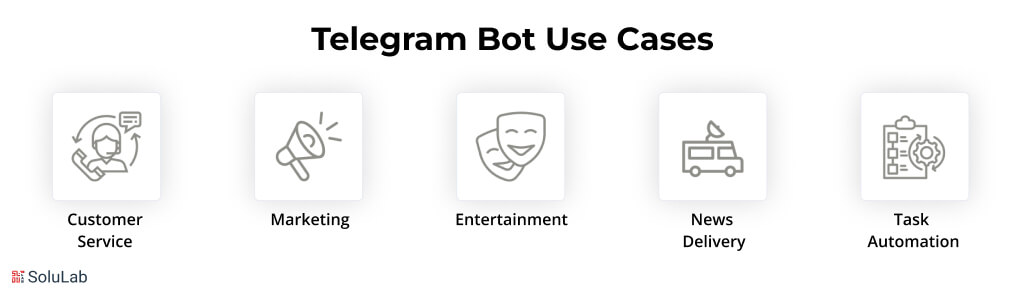
Telegram Bot Use Cases

Telegram Bot Use Cases

Telegram bots can be used for various purposes, including:

  • Customer Service

Bots can respond instantly to customer queries, reducing wait times and improving satisfaction. They can also provide consistent and accurate answers, ensuring that customers receive the help they need quickly and efficiently. Additionally, bots can be programmed to handle multiple conversations simultaneously, allowing businesses to serve more customers in less time. As a result, bots can help businesses improve their customer service automation and build stronger relationships with their customers. This is particularly beneficial for those looking to learn how to create a telegram bot that can effectively manage customer interactions.

  • Marketing

Bots can promote products and services to users in a personalized and engaging way. They can provide users with information about new products, special offers, and upcoming events. Additionally, bots can answer questions about products and services and help users make purchase decisions. By offering users relevant and timely information, bots can help businesses increase sales and improve customer engagement. Understanding how to use bot in Telegram is essential for businesses to leverage this tool effectively in promoting their offerings and enhancing customer interactions.

  • Entertainment

Bots can provide users with a variety of entertainment options, such as games, quizzes, and interactive stories. They can also recommend movies, TV shows, and other forms of entertainment based on users’ preferences. By leveraging API telegram, bots can help users stay entertained and engaged, making them a valuable tool for businesses looking to provide a more enjoyable customer experience.

Related: AI in Media and Entertainment

  • News Delivery

Bots can deliver customized news updates to users based on their interests and preferences. They can also provide users with breaking news alerts and in-depth analysis of current events. Telegram bots can help users stay informed and up-to-date on the latest news, making them a valuable tool for businesses looking to provide their customers with valuable information.

  • Task Automation

Bots can automate repetitive tasks like scheduling appointments, sending reminders, and tracking orders. They can also help users manage their finances, pay bills, and book travel arrangements. By leveraging bots, businesses can significantly improve their operational efficiency. Additionally, for those interested in streamlining these processes, knowing how to create a telegram bot can be an invaluable asset in enhancing productivity and user experience.

DO YOU KNOW? India stands out as the country with the highest number of Telegram users globally, boasting an impressive 83.85 million downloads.

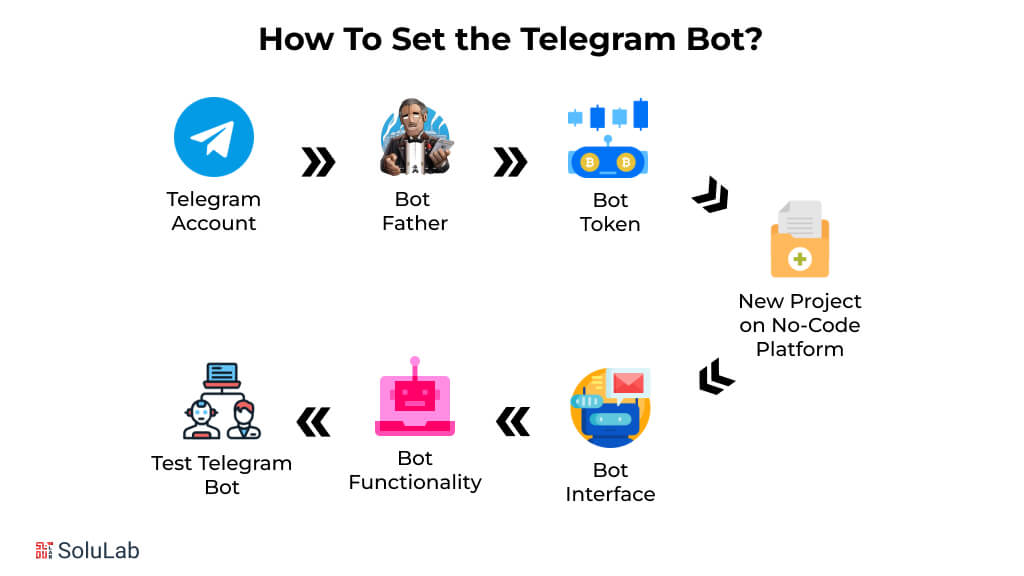
How to Set the Telegram Bot?

Set Telegram Bot

Once you’ve chosen a no-code platform, it’s time to set up your Telegram bot. Here’s how:

1. Telegram Account

To create a Telegram bot, you’ll need a Telegram account. If you don’t have one already, download the Telegram app and follow the prompts to create an account.

2. BotFather

Next, you must create a bot using BotFather, Telegram’s bot creation tool. Here’s how:

  • Open Telegram and search for “BotFather” in the search bar.
  • Click on the BotFather account and select “Start.”
  • Follow the prompts to create your bot, including giving it a name and username.
  • Once your bot is created, BotFather will provide you with a token. Keep this token safe; you’ll need it to connect your bot to the no-code platform.

3. Obtaining the Bot Token

Finally, you’ll need to obtain the bot token from BotFather to connect your bot to the no-code platform. This token is a unique code that identifies your bot to Telegram’s servers. 

Here’s how to obtain the token:

  • Open Telegram and search for “BotFather” in the search bar.
  • Click on the BotFather account and select “Token.”
  • BotFather will provide you with the token. Copy this token and keep it safe.
  • And there you have it! With your no-code platform chosen and your Telegram account and bot set up, you’re ready to start building your no-code Telegram bot.

4. Creating a New Project on the No-Code Platform

The initial step is to start a new project on the no-code platform of your choice. You’ll be able to create your bot from scratch as a result. Here’s how to create a new project:

  • Log in to your no-code platform account.
  • Click “Create New Project” or a similar button to create a new project.
  • Name your project and choose the type of bot you want to make (in this case, a Telegram bot).
  • Follow the prompts to do your project.
  • Configuring the Telegram Bot Settings

Next, you’ll need to configure the settings for your Telegram bot. This will involve linking your Telegram bot to the no-code platform using the bot token you obtained earlier. 

Here’s how to configure the Telegram bot settings:

  • Log in to your no-code platform account and navigate the Telegram bot settings.
  • Enter the bot token that you obtained from BotFather earlier.
  • Choose the settings for your bot, including the bot name, description, and profile picture.

5. Designing the Bot Interface

The next step is to design the interface for your Telegram bot. This will involve creating and customizing the chat interface to match your branding and preferences. 

Here’s how to prepare the bot interface:

  • Log in to your no-code platform account and navigate the chat interface settings.
  • Choose the design and layout of your chat interface, including the colors, fonts, and chat bubbles.
  • Customize the interface to match your branding and preferences.

6. Adding Bot Functionality Using Visual Programming

Now it’s time to add functionality to your Telegram bot using visual programming. 

This will involve using pre-built blocks of code and connecting them to create custom functionality for your bot. Here’s how to add bot functionality using visual programming:

  • Log in to your no-code platform account and navigate to the visual programming editor.
  • Choose the blocks of code you want to use to create custom functionality for your bot.
  • Connect the blocks of code to create custom workflows and responses for your bot.

7. Testing the Telegram Bot

Once you’ve built your no-code Telegram bot, it’s time to test it to ensure it works properly. Here’s how to test your Telegram bot:

  • Log in to your Telegram account and search for your bot.
  • Start a conversation with your bot and test out its functionality.
  • If you encounter any issues, refer to the no-code platform’s documentation or support resources for help.

Common Issues and How to Resolve Them

If you encounter any challenges while creating or testing your no-code Telegram bot, here’s a detailed guide to assist you:

  • Bot Not Responding: Confirm that you properly configured your bot and established a connection to the no-code platform. Double-check your Telegram API token to ensure its validity and authorization. Verify that your bot is online and actively receiving messages from users. Additionally, implement security measures to safeguard your Telegram bot, protecting it from unauthorized access and potential vulnerabilities.
  • Incorrect Responses: Review your visual programming code for any syntax errors or logical mistakes. Ensure that you’re using the correct data types and handling user inputs accurately. Test your bot with different user inputs to identify and fix potential issues with incorrect responses.
  • Slow Performance: Analyze your bot’s performance by measuring response times and identifying bottlenecks. Implement caching mechanisms to store frequently accessed data and improve the efficiency of your bot. Consider optimizing your visual programming code for better performance. For instance, look into using a Telegram bot example to understand best practices and enhance your bot’s performance.
  • Additional Tips: Keep your bot’s code organized and modular to make it easier to maintain and debug. Use descriptive variable names and comments to enhance the readability of your code. Test your bot thoroughly with a variety of user inputs to ensure it functions as expected.

By following these guidelines and troubleshooting tips, you’ll be well on your way to crafting an effective no-code Telegram bot. 

CTA2

How to Create Telegram Bot Commands?

Interacting with your bot and giving users quick access to the features they need can be done easily through bot commands. To create a bot in Telegram, decide on the commands you want to use, create them, program the bot to respond to them and test them to ensure they work correctly. Consider interesting bot commands like “/weather” for a weather app, “/joke” for a joke-telling bot, “/quote” for daily quotes, and “/news” for the latest news. Creating bot commands enhances the interactivity and engagement of your bot for users. Get creative and think about commands that align with your bot’s purpose and users’ needs. With some effort and coding knowledge, you can create fantastic bots that will captivate and entertain your audience.

Conclusion

In conclusion, creating a Telegram bot can significantly enhance user engagement, streamline customer interactions, and provide real-time support across various industries. Whether you’re looking to automate tasks, offer personalized responses, or integrate with other systems, building a Telegram bot can be a game-changer for your business. At SoluLab, a leading Chatbot Development Company, we specialize in helping businesses build AI-powered chatbots that automate customer service and provide personalized user experiences. We recently published a case study on our successful collaboration with Digital Quest, a travel business that partnered with SoluLab to create an AI-powered Chatbot for travel recommendations. The chatbot, powered by Generative AI, extracts relevant data from the Digital Quest website and presents personalized travel suggestions to users. 

The solution solved the challenge of providing real-time information and improving user engagement in the highly competitive travel industry. It offered hassle-free reservations, multi-language support, and a feedback system that continues to enhance the user experience. SoluLab’s expertise in building AI-powered chatbots extends beyond just development; we offer ongoing support, ensure seamless integration with existing systems, and provide cost-effective solutions that guarantee high returns on investment. Whether you are in the travel industry or any other sector, SoluLab can help you solve challenges like delivering real-time, user-friendly solutions that meet your specific business needs. 

FAQs

1. What is a Telegram bot? 

A Telegram bot is an automated program that interacts with users on Telegram, performing tasks like answering queries, sending notifications, and executing commands within a chat or group.

2. How do I create a Telegram bot using BotFather? 

To create a Telegram bot using BotFather, start by opening a chat with BotFather, send the /new bot command, follow the instructions to set a name and username, and you’ll receive a token for your bot.

3. How to create a bot on Telegram without coding? 

You can create a bot on Telegram using no-code platforms like ManyChat, Chatfuel, or other bot-building tools that guide you through the process without needing programming skills.

4. Can you add bots to a Telegram group chat? 

Yes, you can easily add bots to a Telegram group chat by inviting the bot to the group as you would any other user. The bot can perform specific functions like moderating, sending messages, or providing support.

5. What is the API Telegram bot and how is it used? 

The API Telegram bot is the interface provided by Telegram that allows developers to build bots by interacting with Telegram’s servers. It’s used to send messages, retrieve updates, manage groups, and perform various actions programmatically.

6. How to use bots on Telegram effectively? 

To use bots on Telegram, find and interact with bots by searching their usernames or adding them to chats. You can use them for tasks like automation, gaming, notifications, and customer support.


How to Build an AI Agent System?

Build AI Agent System

The combination of work and technology is growing, driven by advancements in artificial intelligence. As businesses and organizations seek to harness the power of AI to increase productivity and efficiency, the development of AI agent systems has become a crucial focus. With the potential to automate a significant portion of tasks—indeed, two-thirds of jobs could be partially automated by AI—these systems are set to transform industries. However, rather than completely replacing human roles, many of these jobs will be complemented by AI, allowing human workers to focus on more complex and creative aspects of their work.

In recent years, the AI industry has witnessed explosive growth. The global AI market size, which was close to $208 billion in 2023, is projected to surge to nearly $2 trillion by 2030. This expansion reflects the increasing integration of AI technologies across various sectors. This shift highlights the importance of developing AI agent systems that can seamlessly work alongside human teams, optimizing performance and driving innovation.

In this blog, we will learn the process of building an AI agent system, exploring key considerations that can help you experience this technology to its fullest potential.

What is an AI Agent?

Artificial Intelligence (AI) agents are software systems programmed to execute tasks autonomously. They make decisions based on their programming and the data they ingest. AI agents can be as simple as repetitive task-performing programs or as sophisticated as machine learning systems that learn and adapt over time through the application of machine learning algorithms.

AI agents find applications in various sectors. In customer service, they manage chat interfaces, providing automated responses. In healthcare, they assist in patient management by scheduling appointments and reminding patients about medication intake. In finance, AI agents monitor markets, execute trades at optimal times, and maximize profits. 

In the corporate context, agents in AI are now considered the most reliable helping hand that businesses can use to perform mundane jobs that consume 62% of a workday. 

Artificial agents offer businesses a valuable opportunity to optimize their workforce by handling tasks such as customer inquiries, data analysis, and standardized actions, thereby freeing up human employees for more complex and creative tasks.

The effectiveness of AI agents depends on their design, the quality of accessible data, and the efficiency of employed algorithms. Their versatility and value make them indispensable in different industries, enhancing efficiency and aiding in sound decision-making. A Twitter user named Patrick Dougherty has defined AI agents like:

It is equally important to highlight that an AI agent is not:

  • Scripted: Agents do not follow a pre-defined sequence of steps or tool calls. Instead, they are responsible for choosing the right tool call to make next.
  • Artificial General Intelligence (AGI): Agents are not AGI. An AGI would not need agents for specific types of work because it would be a single entity with access to all possible inputs, outputs, and tools. Current technology is far from reaching this level of intelligence.
  • Black Box: Agents should demonstrate their work in a manner similar to how a human would if delegated tasks. Transparency and accountability are crucial in understanding and evaluating agents’ actions.

Types Of AI Agents

Types Of AI Agents

Artificial Intelligence (AI) agents have came up as game-changers in various industries, automating repetitive tasks, optimizing workforce efficiency, and enhancing decision-making. These software systems are designed to execute tasks autonomously based on their programming and data ingestion. AI agents can range from simple task-performing programs to sophisticated machine learning systems that learn and adapt over time.

1. Simple Reflex or SR AI Agents 

Artificial intelligence (AI) agents are computer programs that can perform tasks typically requiring human intelligence. AI agents are becoming increasingly prevalent in various industries, including business, healthcare, and finance. Among the different types of AI agents, Simple Reflex (SR) agents are some of the most common and widely used.

SR agents operate based on condition-action rules, which means they take a specific action when a certain condition is met. These rules are typically defined by human experts or derived from data. SR agents are relatively easy to develop and implement, making them accessible to businesses of all sizes.

An SR agent consists of several components:

  • Agents: These are the responsible AI entities for making decisions and taking actions.
  • Actuators: These are the components that allow the agent to interact with its environment, such as motors, wheels, or speakers.
  • Sensors: These are the components that allow the agent to perceive its environment, such as cameras, microphones, or temperature sensors.
  • Environment: This is the physical or virtual world in which the agent operates.

One of the key advantages of SR agents is their ability to discard historic precepts while making decisions. This means that they can make decisions based solely on the current situation, without being influenced by past events. This can be particularly useful in dynamic environments where the conditions can change rapidly.

Here are some examples of how SR agents are being used in businesses today:

  • Customer service chatbots: These chatbots can answer customer questions, provide product recommendations, and resolve complaints. They are typically trained on a large dataset of customer interactions.
  • Fraud detection systems: These systems can identify potentially fraudulent transactions by analyzing purchase patterns and other data. They are often used by banks and credit card companies.
  • Inventory management systems: These systems can track inventory levels and reorder products when necessary. They are used by businesses of all sizes to ensure they have the products their customers want in stock.

Read Also: AI Agent Development on Azure

2. Model-Based AI Agents

Model-based AI agents are a type of AI agent that is known for making quick, rules-driven decisions by incorporating a deeper understanding of the surroundings. These agents are able to do this because they maintain a model of the world in their memory, which they use to reason about the best course of action. One of the key advantages of model-based AI agents is that they are able to learn from their experiences. As they encounter new situations, they update their model of the world to reflect the new information. This allows them to make better decisions in the future, as they are able to take into account the lessons they have learned from the past.

Another advantage of model-based AI agents is that they are able to handle complex tasks. This is because they are able to use their model of the world to reason about the different ways that a task can be completed. This allows them to choose the best course of action, even when the task is complex or unfamiliar. However, One disadvantage is that they can be computationally expensive to run. This is because they need to maintain a model of the world in their memory, which can be a large and complex data structure. Another disadvantage is that model-based AI agents can be brittle. This means that they can make poor decisions if their model of the world is inaccurate.

Here are some specific examples of how model-based AI agents can be used:

  • Self-driving cars: Model-based AI agents can be used to help self-driving cars navigate their environment. The agents can use their model of the world to identify obstacles, such as other cars, pedestrians, and traffic signs. They can then use this information to make decisions about how to navigate around the obstacles safely.
  • Robotics: Model-based AI agents can be used to help robots perform complex tasks, such as assembling products or cleaning up a room. The agents can use their model of the world to understand the environment and the task that needs to be completed. They can then use this information to plan and execute a sequence of actions that will complete the task.
  • Healthcare: Model-based AI agents can be used to help doctors diagnose diseases and develop treatment plans. The agents can use their model of the human body to understand the symptoms of a disease and the different ways that it can be treated. They can then use this information to make recommendations about the best course of treatment for a patient.

3. Goal-Based AI Agents

Goal-based agents are a type of artificial intelligence (AI) that businesses can develop to meet specific objectives. These agents use decision-making algorithms to understand the best course of action based on the information they have learned from their surroundings. One of the best use cases for goal-based agents is to predict future trends. These agents can analyze large amounts of data to identify patterns and relationships that may indicate future events. This information can be used to make informed decisions about product development, marketing, and other business strategies.

Another use case for goal-based agents is to promote optimized resource allocation. These agents can help businesses identify the most efficient way to use their resources, such as time, money, and personnel. This can lead to significant cost savings and improved productivity.

Goal-based agents can also be used for automated designing. These agents can generate creative and innovative designs based on the input they receive. This can save businesses time and money by eliminating the need for human designers. Goal-based agents can be used for personalized marketing. These agents can track individual customer behavior and preferences to create targeted marketing campaigns. This can lead to increased sales and improved customer satisfaction.

Examples of Goal-based agents:

  • Virtual Personal Assistant: A virtual personal assistant, like Amazon’s Alexa or Google Assistant, is a goal-based agent that aims to assist users with their daily tasks. Its goals include; Answering user queries, Setting reminders and calendar events, Controlling smart home devices, Playing music or videos
  • Autonomous Vehicle: An autonomous vehicle, like Waymo or Tesla’s Autopilot, is a goal-based agent that aims to transport passengers safely and efficiently. Its goals include; Reaching the destination, Avoiding obstacles and collisions, Following traffic rules and regulations, Optimizing route planning
  • Customer Service Chatbot: A customer service chatbot, like those used in e-commerce or banking, is a goal-based agent that aims to resolve customer inquiries and issues. Its goals include; Answering customer questions, Resolving customer complaints, Providing product recommendations, Routing complex issues to human representatives

4. Utility-based AI Agents

Utility-based AI agents are highly sophisticated artificial intelligence agents capable of making decisions based on a specific value or utility function. They are designed to make the most advantageous choices for predefined tasks or utilities, such as resource allocation and strategic planning. Their unique ability to ensure optimal decision-making at each repeated step sets them apart from other AI agents. One of the key strengths of utility-based AI agents is their ability to handle a wide range of problems. They can be applied to various domains, including finance, healthcare, and manufacturing. In each of these domains, utility-based AI agents can provide valuable insights and recommendations to help humans make better decisions.

Another advantage of utility-based AI agents is that they offer an objective framework for decision-making. Unlike human decision-makers, utility-based AI agents are not influenced by personal biases or emotions. This objectivity can lead to more rational and consistent decisions. However, it’s important to note that utility-based AI agents are not without limitations. One of the main challenges with utility-based AI agents is that they require additional oversight. This is because utility-based AI agents can only make decisions based on the information they are given. If the information is incomplete or inaccurate, the agent’s decisions may not be optimal. Additionally, utility-based AI agents can be computationally expensive. This is because they often require a large amount of data and processing power to make decisions. This can make them impractical for use in real-time applications.

Here are examples of utility-based agents:

  • Recommendation System: A recommendation system, like Netflix or Amazon’s product recommendations, is a utility-based agent that aims to suggest items that maximize the user’s satisfaction. Its utility function includes; User preferences and ratings, Item attributes and features, and Contextual information (e.g., time of day, location).
  • Resource Allocation Agent: A resource allocation agent, like a cloud computing resource manager, is a utility-based agent that aims to allocate resources to maximize efficiency and minimize costs. Its utility function includes; Resource availability and demand, Task priorities and deadlines, and Cost and performance metrics.
  • Portfolio Optimization Agent: A portfolio optimization agent, like a financial investment manager, is a utility-based agent that aims to optimize investment portfolios to maximize returns and minimize risk. Its utility function includes; Asset prices and returns, Risk tolerance and constraints, Diversification, and portfolio metrics

CTA1

5. Learning AI Agent

In artificial intelligence (AI), learning AI agents have emerged as powerful tools for knowledge acquisition and feedback provision. Equipped with sensors that enable them to observe their surroundings, these agents employ advanced algorithms to analyze collected data and make informed decisions. The four fundamental components of a learning agent in AI are:

  • Learning: This component is responsible for acquiring new knowledge and updating the agent’s existing knowledge base. It enables the agent to continuously improve its performance over time.
  • Critic: The critic component evaluates the agent’s performance and provides feedback. This feedback helps the agent identify areas for improvement and refine its strategies.
  • Performance: The performance component is responsible for executing actions based on the knowledge acquired by the learning component and the feedback provided by the critic component.
  • Problem Generator: This component generates new problems or challenges for the agent to solve. This helps the agent develop a more robust and versatile knowledge base.

Learning artificial intelligence agents offer significant benefits to businesses. As they can evolve with time and effortlessly convert ideas into actions, they can be leveraged to gain valuable insights into customers’ past experiences and evaluate past performance. This information can be instrumental in making informed decisions and developing effective strategies. However, developing and maintaining learning AI agents can be a resource-intensive endeavor. It requires specialized expertise, advanced infrastructure, and significant investment. To mitigate these challenges, businesses can seek the assistance of AI agents consulting services. These services offer a range of expertise, from software development to deployment and maintenance, enabling businesses to optimize their AI agent development costs.

Here are examples of intelligent agents:

  • AlphaGo: A computer program that learned to play the game of Go at a world-class level by using a combination of machine learning and tree search algorithms. AlphaGo learned from a large dataset of human games and improved its performance through self-play and reinforcement learning.
  • Netflix Recommendation System: A learning agent that uses collaborative filtering and machine learning algorithms to recommend movies and TV shows to users based on their viewing history and preferences. The system learns from user behavior and adapts its recommendations over time.
  • Autonomous Vehicle: A self-driving car that uses a combination of sensors, mapping data, and machine learning algorithms to navigate roads and avoid obstacles. The vehicle learns from experience and adapts to new situations through reinforcement learning and deep learning techniques.

Read Also: How Businesses in Every Industry Are Benefiting from AI Agents?

6. Hierarchical AI Agent

Hierarchical agents in AI represent a sophisticated approach to creating intelligent systems capable of handling complex tasks and making informed decisions. These agents are not merely individual AI entities but rather a structured network of multiple AI agents working together in a hierarchical manner. At the core of hierarchical agents is the concept of a top-level AI agent. This agent serves as the central authority, overseeing the operations of other AI agents within the hierarchy. Its primary responsibility is to coordinate and manage the overall workflow, ensuring that all subtasks are executed efficiently and effectively. The lower-level AI agents, on the other hand, are specialized in specific tasks or domains. They operate under the guidance of the top-level agent, carrying out assigned tasks and reporting their progress. 

This division of labor allows hierarchical agents to handle complex problems by breaking them down into smaller, manageable subtasks. One of the key benefits of hierarchical agents is their ability to coordinate between different interlinked departments or modules within a system. Each department or module can be represented by an AI agent, and the top-level agent acts as a central hub for communication and coordination. This enables seamless information exchange and decision-making across various functional areas. Additionally, hierarchical agents are equipped with the ability to identify and address operational bottlenecks. By analyzing data and monitoring the performance of lower-level agents, the top-level agent can detect potential issues that could hinder the overall efficiency of the system. It can then take appropriate actions, such as reallocating tasks or adjusting resource allocation, to mitigate these bottlenecks.

  • Autonomous Robot: A robot that uses a hierarchical control system to perform tasks such as assembly, navigation, and manipulation. The hierarchy consists of; Low-level control: sensorimotor control, and motor control, Mid-level control: task planning, and motion planning, High-level control: goal planning, decision-making
  • Smart Home System: A smart home system that uses a hierarchical AI agent to control and optimize various subsystems such as; Low-level control: temperature control, lighting control, Mid-level control: energy management, security monitoring, High-level control: user preference learning, smart automation
  • Drones for Search and Rescue: A drone that uses a hierarchical artificial intelligence agent to perform search and rescue operations in disaster scenarios. The hierarchy consists of; Low-level control: sensor processing, flight control, Mid-level control: obstacle avoidance, path planning, High-level control: mission planning, decision-making

Forms of AI Agents 

In this section, we will discuss the three primary categories of AI agents:

  • Single AI Agent: Designed to handle specific task scenarios tailored to user needs.
  • Multi-AI Agents: Collaborate with other AI agents, making decisions and taking actions based on mutual communication.
  • Hybrid AI Agent: A high-end category that combines human and computer interaction for decision-making. These agents are capable of performing complex professional activities.

How Does An Agent Work?

Tool call

To create autonomous agents, it’s essential to imitate human cognitive functions and plan task execution strategically. LLM agents can break down complex and intricate tasks into smaller, more manageable parts during this phase. Additionally, these agents can reflect on themselves and learn from previous actions and errors, leading to improved future performance and outcomes.

Let’s start by defining an agent as a software program that carries out tasks on behalf of a user. The ability of Large Language Models (LLMs) to emulate human-like cognitive processes opens up new possibilities for tasks that were previously difficult or impossible.

At its core, an LLM-based agent is a program that combines ChatGPT with a text interface capable of executing tasks like document summarization.

The concept of “agent orchestration” introduces a higher level of complexity. For example, two specialized agents could work together on your code—one focusing on code generation and the other on code review. Alternatively, you could enhance an agent with a tool like an API that provides access to internet search. Or you could improve an agent’s intelligence and reliability by providing additional context through techniques like Retrieval Augmented Generation (RAG).

The most advanced agents are called “autonomous.” These are programs capable of handling sequential tasks, iterating, or pursuing objectives with minimal or no human intervention. Consider fraud detection—an autonomous agent can adapt its behavior to identify intricate and evolving patterns of fraud, significantly reducing false positives and ensuring legitimate transactions are not mistakenly flagged as fraudulent. It can also detect and prevent fraud in real time by determining the appropriate actions to take, thereby saving both time and resources.

The included diagram illustrates a basic framework of an autonomous agent that processes inputs from users or triggers from applications.

The autonomous agent consists of specialized agents that work together. The observer agent assesses incoming information, adds context, and stores it in memory or adds it to a task queue. A task to investigate potential fraud is created when a second transaction within a short time frame and across different continents occurs. The prioritization agent evaluates and ranks the task, and the execution agent carries out the tasks. The execution agent can access additional context and utilize tools to access external services and interact with the customer.

Environments Where AI Agents Can Work Seamlessly 

Prior to hire AI developer and entrusting them with the task of constructing fully customized AI-powered agents, it’s crucial to gain an understanding of the operational environments in which these agents can excel.

1. AI agents can seamlessly operate in virtual environments that mimic real-world scenarios, making them ideal for training and testing tasks.

2. Equipped with sensors, microphones, lidar, and actuators, AI agents excel in physical settings like warehouses, hospitals, airports, and factories.

3. In the retail sector, AI agents can monitor sales, adjust product prices, personalize promotions, notify customers, and analyze customer purchasing patterns.

4. AI agents in the travel industry can assist with trip planning, suggest destinations, optimize itineraries based on budget, and interact with customers in virtual and text-based environments.

5. Advanced AI development techniques enable businesses to create AI agents that perform accurately in various in-game environments, including video games, casino games, and mobile games. They can design game rules, assess player performance, and create diverse game objectives.

6. Social media platforms, such as dating apps, online communities, Facebook, and Twitter, can utilize AI agents to interact and collaborate with humans and other agents.

The finance industry can use autonomous AI agents to analyze stock prices, customer transactions, market risks, and investments, and identify potential threats.

Related: AI Agent in Legal Document Management

How To Build An AI Agent System?

In artificial intelligence, agents are software entities designed to perceive their surroundings and make decisions and actions based on defined rules or algorithms. These agents encompass a spectrum of complexity, from simple reflex agents that respond to immediate inputs to goal-based agents that plan and act toward future outcomes. The most advanced, learning agents, possess the ability to adapt their behavior based on past experiences, akin to how humans learn from mistakes.

The power of agents lies in their capability to automate intricate tasks, make intelligent choices, and interact with their environment in a manner that mirrors human intelligence. The remarkable aspect is that anyone has the potential to create these agents. By harnessing AI agents, a world of possibilities unfolds, allowing for the development of systems that are not only efficient and effective but also capable of continuous learning, adaptation, and evolution.

While creating complex agents might require specialized knowledge, starting on the journey with simple agents provides an excellent opportunity to grasp and progress in this captivating field. The advent of Large Language Models (LLMs) has significantly propelled the development of autonomous agents, leading to the introduction of numerous technologies and frameworks based on this concept. Among these advancements, We hope you’ve gained a solid understanding of the capabilities and potential of artificial agents in AI. As you progress on your journey, it’s crucial to grasp the fundamentals of creating an AI agent tailored to your specific tasks and requirements. Here is a quick overview of building an AI agent:

1. Establish Your Objective 

To commence the development of AI agents, it is crucial for businesses to have a clear understanding of the purpose and objectives behind their implementation. Before embarking on the journey, it is essential to determine the specific needs and requirements of the AI agent.

Consider the following questions:

a. What are the key tasks that you need the AI agent to perform? 

Do you need it to sort and categorize documents, handle customer queries, generate insights from data, or perform other specific functions? Identifying the core responsibilities of the AI agent will help guide the development process.

b. What is the desired outcome or goal of using an AI agent? 

Do you aim to enhance efficiency, improve customer satisfaction, automate repetitive tasks, or achieve other specific objectives? Clearly defining the desired outcome will help measure the success of the AI agent.

c. What data sources will the AI agent leverage? 

Identify the sources of data that the AI agent will use to learn and make decisions. This could include structured data from databases, unstructured data from emails and documents, or real-time data from sensors and IoT devices.

d. What level of autonomy is required? 

Determine the extent to which the AI agent should operate independently. Will it make decisions and take actions on its own, or will it require human oversight and approval?

e. What are the ethical considerations and regulatory requirements? 

Consider the ethical implications and regulatory requirements associated with the use of AI agents. Ensure that the AI agent is designed and developed in a responsible and compliant manner.

If you are having difficulty clarifying the purpose and objectives of the AI agent, it is advisable to seek the assistance of an AI consulting company. These services can provide valuable guidance and expertise, helping you define the scope, identify potential challenges, and develop a comprehensive strategy for the successful implementation of your AI agent.

2. Select the Right Frameworks and Libraries

Training a fundamental AI model to process data and make decisions is a complex task that requires careful consideration of the framework and libraries used. The right tools can streamline the development process, enable faster prototyping, and improve the overall efficiency of the AI model. One of the leading technologies for AI development is TensorFlow. TensorFlow is an open-source machine learning framework developed by Google Brain. It is widely used for a variety of AI tasks, including natural language processing, computer vision, and reinforcement learning. TensorFlow provides a comprehensive set of tools and features that make it easy to build and train AI models.

Another popular technology for AI development is PyTorch. PyTorch is an open-source machine learning framework developed by Facebook AI Research. PyTorch is known for its flexibility and ease of use. It is often used for research and prototyping AI models. PyTorch provides a dynamic computational graph that allows for easy experimentation and debugging. Keras is a high-level neural networks API, written in Python, that can run on top of TensorFlow or Theano. It is designed to make building and training deep learning models easier and faster. Keras provides a user-friendly interface and a wide range of features for building and evaluating neural networks. These tools and frameworks are essential for developing different types of AI agents, including reactive agents, goal-based agents, and learning agents, each suited for various AI applications.

3. Select a Programming Language

Programming languages play a vital role in the development of artificial intelligence (AI) agents. They provide the means to implement complex algorithms and leverage specialized libraries and frameworks that facilitate the creation of AI models. One of the most popular programming languages for AI development is Python. Python’s popularity can be attributed to several factors. Firstly, it is a high-level language, which means that it is easy to read and write, making it accessible to developers of all skill levels. Secondly, Python is highly versatile and can be used for a wide range of AI applications, including natural language processing, machine learning, and computer vision.

Python has a large and active community, which contributes to its extensive library of open-source tools and frameworks. This makes it easier for AI developers to find and use pre-built components, saving time and effort. Additionally, Python is compatible with popular AI libraries such as TensorFlow, PyTorch, and Keras, enabling seamless integration and collaboration with these frameworks. The simplicity and ease of use of Python make it an ideal choice for rapid prototyping and experimentation. This allows AI developers to quickly test and validate their ideas and iterate on them efficiently. Additionally, Python’s extensive documentation and tutorials make it easy for developers to learn and apply the language effectively. When exploring AI agents use cases, Python’s versatility becomes even more evident, as it supports various applications, from chatbots to autonomous systems, highlighting its crucial role in AI development.

4. Collect Data for Training 

In artificial intelligence (AI), your agents rely heavily on data for processing and analysis. The quality of this data plays a pivotal role in effectively training machine learning models, ultimately determining the accuracy and dependability of your AI agents. Therefore, collecting high-quality data is of paramount importance. There are various methods you can employ to gather suitable data. Crowdsourcing, for instance, involves obtaining data from a large group of people, often through online platforms. This approach can yield a diverse and extensive dataset but may come with challenges related to data consistency and reliability. Alternatively, you can utilize off-the-shelf datasets, which are readily available and often well-curated. However, it’s crucial to assess the quality and relevance of such datasets to your specific AI application. AI agents use cases highlight how these data-driven systems excel in tasks such as fraud detection, personalized recommendations, and autonomous vehicle navigation, all of which depend on high-quality data inputs.

Regardless of the data collection method, ensuring the data’s quality is paramount. Here are some key characteristics of high-quality data:

  • High Quality: The data should be accurate, complete, and consistent. This means it should be free from errors, missing values, and inconsistencies. High-quality data leads to more accurate and reliable AI models.
  • Unbiased: The data should not be biased towards any particular outcome or group. Unbiased data ensures that your AI models are fair and equitable.
  • Error-free and Well-cleaned: The data should be cleaned and processed to remove any errors or inconsistencies. This process involves identifying and correcting data entry mistakes, removing duplicate data points, and handling missing values. Clean and error-free data leads to more efficient and effective AI models.

Achieving high-quality data can be a tedious and highly skill-demanding task. If you lack the resources or expertise to handle this process effectively, consider outsourcing to professional data science services. These service providers specialize in collecting, cleaning, and preparing data for AI and machine learning applications.

5. Design the Fundamental Architecture 

Designing a powerful architecture for AI agents involves key considerations such as scalability, modularity, performance optimization, openness for integration, resilience, security, privacy, and ethical considerations. Scalability enables handling increasing data and computational demands. Modularity allows for easy maintenance and updates. Performance optimization involves leveraging parallel processing and specialized hardware. Openness for integration ensures seamless communication between components. Resilience protects against failures and errors. Security safeguards against unauthorized access and data breaches. Privacy mechanisms protect sensitive data and user information. Ethical considerations ensure responsible and transparent AI operations. For better understanding, AI agents examples include autonomous drones, intelligent virtual assistants, and predictive analytics tools, all designed to operate efficiently within robust architectures that account for these considerations.

6. Start the Model Training

Once adequate data is collected and the basic architecture of the AI agent application is ready, the next crucial step is to train the model. This training process is where the AI agent learns to make decisions and perform tasks. AI developers engage in various activities during this stage to ensure the model’s effectiveness. One key task is data feeding, where the model is provided with labeled data from which to learn. The data should be carefully curated and preprocessed to ensure its quality and relevance. The AI agent’s environment is also created, which defines the context in which the model will operate. This environment can be simulated or real-world, depending on the application. Implementing the learning experience involves selecting appropriate algorithms and techniques to train the model. Common methods include supervised learning, unsupervised learning, and reinforcement learning. The model’s decision-making abilities are optimized by adjusting hyperparameters and fine-tuning the model’s architecture. For more clarity, AI agents examples can include virtual assistants, autonomous systems, and recommendation engines across industries like finance, healthcare, and retail.

To achieve perfection at this stage, several considerations are essential:

1. Model Selection: Choosing the right model architecture is crucial. Options such as random forests, neural networks, and decision trees have different strengths and weaknesses. Factors like data type, problem complexity, and desired accuracy influence the selection.

2. Model Validation: Once the model is trained, its performance is evaluated using validation data. This data is distinct from the training data and helps identify any overfitting or underfitting issues. The model’s accuracy, precision, recall, and other metrics are analyzed to assess its effectiveness.

3. Continuous Learning: Ensuring the model can learn continuously is vital for adapting to changing environments and improving performance over time. Techniques like transfer learning and online learning allow the model to incorporate new data and knowledge as they become available. This is especially important for AI agents in Healthcare, where evolving data and medical advancements require the system to adapt continuously to ensure accurate diagnosis and treatment plans.

7. Deployment of AI Agent Model 

After successfully training an AI model, the next step is to deploy it into production so that it can be used by end-users. There are several tools and platforms available for deploying AI models, including serverless platforms, Docker, WebAssembly, and Kubernetes. The choice of deployment ecosystem depends on factors such as the scale of the application, the required level of security, and the desired level of control. One of the key steps in deploying an AI model is containerization. Containerization involves packaging the model and its associated components into a container, which is a lightweight and portable execution environment. Containers make it easier to deploy and manage AI models across different environments, such as on-premises servers, cloud platforms, and edge devices. This is particularly beneficial for AI agents in supply chain applications, where real-time data processing and scalability are crucial for optimizing operations and improving efficiency.

In addition to containerization, AI developers need to perform several other tasks to prepare a model for deployment. These tasks include refining and optimizing the model to improve its performance and efficiency, creating APIs to facilitate communication between the model and other components of the application, and ensuring that the deployment environment is secure and compliant with privacy regulations. AI developers also need to set up the user interfaces and interaction mechanisms that will allow users to interact with the deployed model. This may involve creating web applications, mobile apps, or other interfaces that are tailored to the specific use case, including what are AI agents to help streamline user interaction.

CTA2

8. Test The Model 

To achieve optimal performance and decision-making capabilities in your AI agents, it’s imperative to ensure the functional model is flawless and operates as intended. This involves rigorous testing to identify and eliminate any bugs, errors, or inappropriate behaviors that could compromise the model’s integrity. One crucial step in this process is unit testing, where individual components of the model are tested in isolation to verify their functionality and adherence to specifications. This helps to pinpoint specific issues early on and enables prompt resolution. Additionally, integration testing is essential to assess how different components interact and work together as a cohesive system. This ensures that the model’s overall behavior aligns with its intended design and that there are no unintended consequences or conflicts arising from the integration of various components.

Conducting system testing is vital to evaluate the model’s performance under real-world conditions. This involves simulating user interactions and scenarios to assess how the model responds and makes decisions in different contexts. System testing helps to identify potential issues that may not be apparent during unit or integration testing. To ensure that the model meets user needs and expectations, user acceptance testing is crucial. This involves involving actual users or user representatives in the testing process to gather feedback on the model’s usability, functionality, and overall satisfaction. This step helps to validate that the model aligns with user requirements and that it delivers a positive user experience. you can build confidence in the functional model’s reliability, accuracy, and appropriateness, laying the foundation for successful AI agent performance and decision-making. 

9. Monitoring and Optimization 

After deploying your artificial intelligence (AI) agents, it is crucial to continuously monitor their performance to ensure they operate optimally. Regular observation allows you to identify any potential issues or areas for improvement and make necessary adjustments. One way to enhance the performance of your AI agents is by feeding them new data. This data can come from various sources such as sensors, user interactions, or external databases. By incorporating new data, you can help your agents learn and adapt to changing environments, making them more effective in their tasks. Additionally, creating extra user interaction points can provide valuable feedback for your AI agents. This feedback can help them understand user needs and preferences better, leading to more personalized and efficient interactions. For example, you could incorporate chatbots, voice assistants, or other interactive elements to facilitate communication between users and what are AI agents.

Regularly updating the underlying structure of your AI agents is essential. AI technology is constantly evolving, and new advancements can significantly impact your agents’ performance. By staying up-to-date with the latest developments, you can ensure that your agents leverage the most advanced techniques and algorithms. Scaling your AI agents according to your business needs is also crucial. As your business grows and changes, the demands on your AI agents may also evolve. By scaling your agents, you can ensure they have the resources to handle increased workloads and maintain optimal performance. Following these steps will help you establish a smooth AI agent development process and create fully customized AI agents tailored to your specific business requirements. These agents can support your operations on multiple fronts, enhancing efficiency, productivity, and customer satisfaction. By continually observing, updating, and scaling your AI agents, you can ensure that they remain effective and valuable assets to your organization.

Start Your AI Agent Development Journey With SoluLab

Building an AI agent application requires a strategic approach, from integrating the right AI models to ensuring data security and seamless workflows. Recently, we published a case study on InfuseNet, which uses AI for data-driven decision-making and operational efficiency. It utilizes advanced AI models like GPT-4 and FLAN, enabling real-time data processing from multiple sources while ensuring data security. Businesses can fine-tune AI models with their own data, driving innovation and process optimization. InfuseNet demonstrates how AI can transform industries.SoluLab is the perfect partner to help you kickstart your AI agent development journey.

With years of experience in AI and machine learning, SoluLab offers solutions that guide you through the entire AI agent development process, from ideation to deployment. AI Agent Development Company has a team of experts who utilize tools and platforms like Microsoft Azure, GPT models, and custom machine learning frameworks to design AI agents for your needs. You Should Hire AI Developers because SoluLab focuses on delivering scalable, secure, and efficient AI solutions that integrate seamlessly with your existing systems. SoluLab aligns AI agents with strategic objectives to provide a competitive advantage. With a client-centric approach and success across various industries, they harness the full potential of AI and automation for businesses.

FAQs

1. What is an AI agent system?

An AI agent system is a combination of algorithms and data-driven models that enable machines to perform tasks autonomously, making decisions based on the data they process.

2. How do AI agents work in different industries?

AI agents can be applied across various sectors, such as healthcare, retail, and manufacturing, to automate tasks, improve efficiency, and enhance decision-making.

3. How can AI agents improve business operations?

AI agents help businesses streamline operations, from optimizing supply chain processes to improving customer service interactions and automating HR tasks.

4. What are the benefits of using AI agents?

AI agents improve accuracy, reduce human error, and provide valuable insights in industries like healthcare, finance, retail, and manufacturing by analyzing large volumes of data in real time.

5. How can AI agents be used in customer service?

AI agents for customer service can handle repetitive tasks, answer common queries, and provide personalized recommendations, improving response times and customer satisfaction.

6. How do AI agents help in industries like sales and marketing?

AI agents in sales and marketing can analyze customer behavior, predict trends, and assist with lead generation, helping businesses create targeted campaigns and close deals more efficiently.

7. What is the future of AI agents in enterprises?

AI agents will continue to transform enterprises by automating processes in areas like finance, HR, and supply chain management, driving innovation and operational efficiency.


Top 10 Generative AI Consulting Companies 2025

[fusion_builder_container hundred_percent=”no” hundred_percent_height=”no” hundred_percent_height_scroll=”no” hundred_percent_height_center_content=”yes” equal_height_columns=”no” menu_anchor=”” hide_on_mobile=”small-visibility,medium-visibility,large-visibility” status=”published” publish_date=”” class=”” id=”” border_size=”” border_color=”” border_style=”solid” margin_top=”” margin_bottom=”” padding_top=”” padding_right=”” padding_bottom=”” padding_left=”” gradient_start_color=”” gradient_end_color=”” gradient_start_position=”0″ gradient_end_position=”100″ gradient_type=”linear” radial_direction=”center” linear_angle=”180″ background_color=”” background_image=”” background_position=”center center” background_repeat=”no-repeat” fade=”no” background_parallax=”none” enable_mobile=”no” parallax_speed=”0.3″ background_blend_mode=”none” video_mp4=”” video_webm=”” video_ogv=”” video_url=”” video_aspect_ratio=”16:9″ video_loop=”yes” video_mute=”yes” video_preview_image=”” filter_hue=”0″ filter_saturation=”100″ filter_brightness=”100″ filter_contrast=”100″ filter_invert=”0″ filter_sepia=”0″ filter_opacity=”100″ filter_blur=”0″ filter_hue_hover=”0″ filter_saturation_hover=”100″ filter_brightness_hover=”100″ filter_contrast_hover=”100″ filter_invert_hover=”0″ filter_sepia_hover=”0″ filter_opacity_hover=”100″ filter_blur_hover=”0″][fusion_builder_row][fusion_builder_column type=”1_1″ layout=”1_1″ spacing=”” center_content=”no” link=”” target=”_self” min_height=”” hide_on_mobile=”small-visibility,medium-visibility,large-visibility” class=”” id=”” hover_type=”none” border_size=”0″ border_color=”” border_style=”solid” border_position=”all” border_radius=”” box_shadow=”no” dimension_box_shadow=”” box_shadow_blur=”0″ box_shadow_spread=”0″ box_shadow_color=”” box_shadow_style=”” padding_top=”” padding_right=”” padding_bottom=”” padding_left=”” margin_top=”” margin_bottom=”” background_type=”single” gradient_start_color=”” gradient_end_color=”” gradient_start_position=”0″ gradient_end_position=”100″ gradient_type=”linear” radial_direction=”center” linear_angle=”180″ background_color=”” background_image=”” background_image_id=”” background_position=”left top” background_repeat=”no-repeat” background_blend_mode=”none” animation_type=”” animation_direction=”left” animation_speed=”0.3″ animation_offset=”” filter_type=”regular” filter_hue=”0″ filter_saturation=”100″ filter_brightness=”100″ filter_contrast=”100″ filter_invert=”0″ filter_sepia=”0″ filter_opacity=”100″ filter_blur=”0″ filter_hue_hover=”0″ filter_saturation_hover=”100″ filter_brightness_hover=”100″ filter_contrast_hover=”100″ filter_invert_hover=”0″ filter_sepia_hover=”0″ filter_opacity_hover=”100″ filter_blur_hover=”0″ last=”true” first=”true”][fusion_text columns=”” column_min_width=”” column_spacing=”” rule_style=”default” rule_size=”” rule_color=”” hide_on_mobile=”small-visibility,medium-visibility,large-visibility” class=”” id=”” animation_type=”” animation_direction=”left” animation_speed=”0.3″ animation_offset=””]

The global AI market, valued at $136.55 billion in 2022, is balanced for significant growth in the coming years. With a projected compound annual growth rate (CAGR) of 37.3% from 2023 to 2030, it’s anticipated to reach USD 1,811.8 billion by 2030.

In a world where artificial intelligence is changing industries, generative AI stands out as a unique tech. Generative AI is allowing businesses to create, optimize, and personalize content, products, and services like never before. As more companies recognize the power of generative AI, the demand for specialized consulting services has skyrocketed. In this blog, we’ll explore the top consulting companies that are at the forefront of generative AI, helping businesses unlock new opportunities.

How Did We Compile The List of Top Generative AI Consulting Companies?

We were able to identify and highlight the top Generative AI consulting companies by evaluating the following criteria:

1. Years of experience in the market

2. Client testimonials

3. Quality of delivered products and services

4. The size of the team

5. Industries the company serves

6. Flexibility

7. Reviews by customers and references by media and other companies

8. Their understanding of industries and markets

9. The technology stack used for development

What Are The Top Generative AI Consulting Companies?

To help you find the right fit, we have compiled a list of top Generative AI consulting companies based on factors such as experience, portfolio, and development capabilities.

[/fusion_text][/fusion_builder_column][/fusion_builder_row][/fusion_builder_container][fusion_builder_container hundred_percent=”no” hundred_percent_height=”no” hundred_percent_height_scroll=”no” hundred_percent_height_center_content=”yes” equal_height_columns=”no” menu_anchor=”” hide_on_mobile=”small-visibility,medium-visibility,large-visibility” status=”published” publish_date=”” class=”” id=”” border_size=”” border_color=”” border_style=”solid” margin_top=”” margin_bottom=”” padding_top=”” padding_right=”0px” padding_bottom=”” padding_left=”0px” gradient_start_color=”” gradient_end_color=”” gradient_start_position=”0″ gradient_end_position=”100″ gradient_type=”linear” radial_direction=”center” linear_angle=”180″ background_color=”” background_image=”” background_position=”center center” background_repeat=”no-repeat” fade=”no” background_parallax=”none” enable_mobile=”no” parallax_speed=”0.3″ background_blend_mode=”none” video_mp4=”” video_webm=”” video_ogv=”” video_url=”” video_aspect_ratio=”16:9″ video_loop=”yes” video_mute=”yes” video_preview_image=”” filter_hue=”0″ filter_saturation=”100″ filter_brightness=”100″ filter_contrast=”100″ filter_invert=”0″ filter_sepia=”0″ filter_opacity=”100″ filter_blur=”0″ filter_hue_hover=”0″ filter_saturation_hover=”100″ filter_brightness_hover=”100″ filter_contrast_hover=”100″ filter_invert_hover=”0″ filter_sepia_hover=”0″ filter_opacity_hover=”100″ filter_blur_hover=”0″ admin_toggled=”no”][fusion_builder_row][fusion_builder_column type=”1_1″ layout=”1_1″ spacing=”” center_content=”no” link=”” target=”_self” min_height=”” hide_on_mobile=”small-visibility,medium-visibility,large-visibility” class=”” id=”” hover_type=”none” border_size=”0″ border_color=”” border_style=”solid” border_position=”all” box_shadow=”no” box_shadow_blur=”0″ box_shadow_spread=”0″ box_shadow_color=”” box_shadow_style=”” background_type=”single” gradient_start_position=”0″ gradient_end_position=”100″ gradient_type=”linear” radial_direction=”center” linear_angle=”180″ background_color=”” background_image=”” background_image_id=”” background_position=”left top” background_repeat=”no-repeat” background_blend_mode=”none” animation_type=”” animation_direction=”left” animation_speed=”0.3″ animation_offset=”” filter_type=”regular” filter_hue=”0″ filter_saturation=”100″ filter_brightness=”100″ filter_contrast=”100″ filter_invert=”0″ filter_sepia=”0″ filter_opacity=”100″ filter_blur=”0″ filter_hue_hover=”0″ filter_saturation_hover=”100″ filter_brightness_hover=”100″ filter_contrast_hover=”100″ filter_invert_hover=”0″ filter_sepia_hover=”0″ filter_opacity_hover=”100″ filter_blur_hover=”0″ first=”true” last=”true” padding_right=”30px” padding_left=”30px”][fusion_code]PHN0eWxlPgogIC5ib3gtc2VjdGlvbiB7CiAgICBwYWRkaW5nOiAyNXB4IDBweCAhaW1wb3J0YW50OwogIH0KCiAgLmJveC1zZWN0aW9uLWNvbnRhaW5lciB7CiAgICBtYXgtd2lkdGg6IDEwMjBweDsKICAgIG1hcmdpbjogYXV0bzsKICB9CgogIC5maXJzdC1yb3csCiAgLnNlY29uZC1yb3cgewogICAgYm9yZGVyOiAxcHggc29saWQgI2UyZTJlMjsKICB9CgogIC5ib3gtc2VjdGlvbiAuY29sLTEgewogICAgd2lkdGg6IDcwLjYyNSU7CiAgICBwYWRkaW5nOiAwcHggMHB4IDBweCAyMHB4OwogIH0KCiAgLmJveC1zZWN0aW9uIC5jb2wtMiB7CiAgICB3aWR0aDogMjguODc1JTsKICAgIGRpc3BsYXk6IGZsZXg7CiAgICBhbGlnbi1pdGVtczogY2VudGVyOwogICAganVzdGlmeS1jb250ZW50OiBjZW50ZXI7CiAgfQoKICAuYm94LXNlY3Rpb24gLnJvdyB7CiAgICBkaXNwbGF5OiBmbGV4OwogIH0KCiAgLmJveC1zZWN0aW9uIC5oZWFkaW5nLWJveCB7CiAgICBkaXNwbGF5OiBmbGV4OwogIH0KCiAgLmJveC1zZWN0aW9uIC5oZWFkaW5nLWJveCBpbWcgewogICAgd2lkdGg6IDU5cHg7CiAgICBoZWlnaHQ6IGZpdC1jb250ZW50OwogIH0KCiAgLmhlYWRpbmctYm94IGg0IHsKICAgIHBhZGRpbmctbGVmdDogMTVweCAhaW1wb3J0YW50OwogICAgZm9udC1zaXplOiAyNHB4ICFpbXBvcnRhbnQ7CiAgICBmb250LWZhbWlseTogIkhlbHZldGljYSBOZXVlIiwgSGVsdmV0aWNhLCBBcmlhbCwgc2Fucy1zZXJpZiAhaW1wb3J0YW50OwogICAgZm9udC13ZWlnaHQ6IDcwMCAhaW1wb3J0YW50OwogICAgY29sb3I6ICMwMDAgIWltcG9ydGFudDsKICB9CgogIC5oZWFkaW5nLWJveCB7CiAgICBkaXNwbGF5OiBmbGV4ICFpbXBvcnRhbnQ7CiAgICBhbGlnbi1pdGVtczogY2VudGVyICFpbXBvcnRhbnQ7CiAgfQoKICAuZmlyc3Qtcm93IC5oZWFkaW5nLWJ0biBhIHsKICAgIGNvbG9yOiAjZmZmOwogICAgYm9yZGVyLXJhZGl1czogNHB4OwogICAgZm9udC1zaXplOiAxN3B4OwogICAgcGFkZGluZzogMTBweCAyMHB4OwogICAgYmFja2dyb3VuZC1jb2xvcjogI2UwMzQzNCAhaW1wb3J0YW50OwogICAgdGV4dC1kZWNvcmF0aW9uOiBub25lOwogICAgZm9udC1mYW1pbHk6ICJIZWx2ZXRpY2EgTmV1ZSIsIEhlbHZldGljYSwgQXJpYWwsIHNhbnMtc2VyaWYgIWltcG9ydGFudDsKICB9CgogIC5wYXJhZ3JhcGgtY29udGVudCBwIHsKICAgIGZvbnQtd2VpZ2h0OiA0MDAgIWltcG9ydGFudDsKICAgIGZvbnQtZmFtaWx5OiAiSGVsdmV0aWNhIE5ldWUiLCBIZWx2ZXRpY2EsIEFyaWFsLCBzYW5zLXNlcmlmICFpbXBvcnRhbnQ7CiAgICBjb2xvcjogIzAwMCAhaW1wb3J0YW50OwogICAgcGFkZGluZy1sZWZ0OiAxNXB4ICFpbXBvcnRhbnQ7CiAgICBmb250LXNpemU6IDE4cHggIWltcG9ydGFudDsKICB9CgogIC5wYXJhZ3JhcGgtY29udGVudCB7CiAgICBwYWRkaW5nOiAyMHB4IDMwcHggMHB4IDBweCAhaW1wb3J0YW50OwogIH0KCiAgLmJveC1zZWN0aW9uIC5pY29uLWxpc3QgewogICAgcGFkZGluZzogMTdweCAxMHB4IDBweCAxMHB4OwogICAgYm9yZGVyLWxlZnQ6IDFweCBzb2xpZCAjZTJlMmUyOwogIH0KCiAgLmljb24tbGlzdCBwIHsKICAgIGRpc3BsYXk6IGZsZXggIWltcG9ydGFudDsKICAgIHBhZGRpbmctYm90dG9tOiAxZW0gIWltcG9ydGFudDsKICAgIG1hcmdpbjogOHB4IDBweCAhaW1wb3J0YW50OwogICAgYWxpZ24taXRlbXM6IGZsZXgtc3RhcnQ7CiAgfQoKICAuaWNvbi1saXN0IHAgc3BhbiB7CiAgICBwYWRkaW5nLWxlZnQ6IDEycHggIWltcG9ydGFudDsKICAgIGZvbnQtc2l6ZTogMThweCAhaW1wb3J0YW50OwogIH0KCiAgLnNlY29uZC1yb3cgLmNvbC0yIHsKICAgIGp1c3RpZnktY29udGVudDogbGVmdCAhaW1wb3J0YW50OwogICAgYWxpZ24taXRlbXM6IHN0YXJ0ICFpbXBvcnRhbnQ7CiAgfQoKICAuaWNvbi1saXN0IGltZyB7CiAgICB3aWR0aDogMjVweCAhaW1wb3J0YW50OwogIH0KCiAgLmZpcnN0LXJvdyAucm93IHsKICAgIHBhZGRpbmc6IDEwcHggIWltcG9ydGFudDsKICB9CgogIC5oZWFkaW5nLWJveCBpbWcgewogICAgbWFyZ2luOiAwcHggIWltcG9ydGFudDsKICB9CgogIC5wYXJhZ3JhcGgtY29udGVudC1saXN0IHsKICAgIG1hcmdpbjogMTBweCAyMHB4ICFpbXBvcnRhbnQ7CiAgfQoKICAucGFyYWdyYXBoLWNvbnRlbnQtbGlzdCBsaSB7CiAgICBmb250LXNpemU6IDE4cHggIWltcG9ydGFudDsKICB9CgogIEBtZWRpYSBzY3JlZW4gYW5kIChtYXgtd2lkdGg6IDc2OHB4KSBhbmQgKG1pbi13aWR0aDogNDI1cHgpIHsKICAgIC5ib3gtc2VjdGlvbiAucm93IHsKICAgICAgZGlzcGxheTogYmxvY2sgIWltcG9ydGFudDsKICAgIH0KCiAgICAuYm94LXNlY3Rpb24gLmNvbC0xLAogICAgLmJveC1zZWN0aW9uIC5jb2wtMiB7CiAgICAgIHdpZHRoOiAxMDAlICFpbXBvcnRhbnQ7CiAgICB9CgogICAgLmJveC1zZWN0aW9uIC5pY29uLWxpc3QgewogICAgICBib3JkZXItbGVmdDogMHB4IHNvbGlkICNlMmUyZTIgIWltcG9ydGFudDsKICAgICAgbWFyZ2luLWxlZnQ6IDIwcHggIWltcG9ydGFudDsKICAgIH0KICB9CgogIEBtZWRpYSBzY3JlZW4gYW5kIChtYXgtd2lkdGg6IDQyNHB4KSBhbmQgKG1pbi13aWR0aDogMzIwcHgpIHsKICAgIC5ib3gtc2VjdGlvbiAucm93IHsKICAgICAgZGlzcGxheTogYmxvY2sgIWltcG9ydGFudDsKICAgIH0KCiAgICAuYm94LXNlY3Rpb24gLmNvbC0xLAogICAgLmJveC1zZWN0aW9uIC5jb2wtMiB7CiAgICAgIHdpZHRoOiAxMDAlICFpbXBvcnRhbnQ7CiAgICB9CgogICAgLmJveC1zZWN0aW9uIC5pY29uLWxpc3QgewogICAgICBib3JkZXItbGVmdDogMHB4IHNvbGlkICNlMmUyZTIgIWltcG9ydGFudDsKICAgICAgbWFyZ2luLWxlZnQ6IDIwcHggIWltcG9ydGFudDsKICAgIH0KCiAgICAuaGVhZGluZy1ib3ggaDQgewogICAgICBmb250LXNpemU6IDIwcHggIWltcG9ydGFudDsKICAgIH0KCiAgICAuaGVhZGluZy1ib3ggaW1nIHsKICAgICAgd2lkdGg6IDQwcHggIWltcG9ydGFudDsKICAgIH0KCiAgICAuaGVhZGluZy1idG4gewogICAgICBtYXJnaW46IDE1cHggMHB4ICFpbXBvcnRhbnQ7CiAgICB9CgogICAgLmJveC1zZWN0aW9uIC5jb2wtMSB7CiAgICAgIHBhZGRpbmc6IDBweCAhaW1wb3J0YW50OwogICAgfQoKICAgIC5oZWFkaW5nLWJveCB7CiAgICAgIGp1c3RpZnktY29udGVudDogY2VudGVyICFpbXBvcnRhbnQ7CiAgICB9CgogICAgLnBhcmFncmFwaC1jb250ZW50IHsKICAgICAgcGFkZGluZzogMjBweCAzMHB4IDBweCAyMHB4ICFpbXBvcnRhbnQ7CiAgICB9CiAgfQo8L3N0eWxlPgoKPHNlY3Rpb24gY2xhc3M9ImJveC1zZWN0aW9uIj4KICA8ZGl2IGNsYXNzPSJib3gtc2VjdGlvbi1jb250YWluZXIiPgogICAgPGRpdiBjbGFzcz0ibWFpbi1ib3giPgogICAgICA8ZGl2IGNsYXNzPSJmaXJzdC1yb3ciPgogICAgICAgIDxkaXYgY2xhc3M9InJvdyI+CiAgICAgICAgICA8ZGl2IGNsYXNzPSJjb2wgY29sLTEiPgogICAgICAgICAgICA8ZGl2IGNsYXNzPSJoZWFkaW5nLWJveCI+CiAgICAgICAgICAgICAgPGltZyBzcmM9Imh0dHBzOi8vd3d3LnNvbHVsYWIuY29tL3dwLWNvbnRlbnQvdXBsb2Fkcy8yMDIzLzA1L0dyb3VwLTExMTY2MDAxNDctbmV3LnBuZyIgYWx0PSJTb2x1TGFiIj4KICAgICAgICAgICAgICA8aDQ+PHNwYW4+MS4gU29sdUxhYjwvc3Bhbj48L2g0PgogICAgICAgICAgICA8L2Rpdj4KICAgICAgICAgIDwvZGl2PgogICAgICAgICAgPGRpdiBjbGFzcz0iY29sIGNvbC0yIj4KICAgICAgICAgICAgPGRpdiBjbGFzcz0iaGVhZGluZy1idG4iPgogICAgICAgICAgICAgIDxhIGhyZWY9Imh0dHBzOi8vd3d3LnNvbHVsYWIuY29tL2dlbmVyYXRpdmUtYWktY29uc3VsdGluZy1jb21wYW55LyI+VmlzaXQKICAgICAgICAgICAgICAgIFdlYnNpdGU8L2E+CiAgICAgICAgICAgIDwvZGl2PgogICAgICAgICAgPC9kaXY+CiAgICAgICAgPC9kaXY+CiAgICAgIDwvZGl2PgogICAgICA8ZGl2IGNsYXNzPSJzZWNvbmQtcm93Ij4KICAgICAgICA8ZGl2IGNsYXNzPSJyb3ciPgogICAgICAgICAgPGRpdiBjbGFzcz0iY29sIGNvbC0xIj4KICAgICAgICAgICAgPGRpdiBjbGFzcz0icGFyYWdyYXBoLWNvbnRlbnQiPgogICAgICAgICAgICAgPHA+U29sdUxhYiwgYSBsZWFkaW5nIEFJIGNvbnN1bHRpbmcgY29tcGFueSwgaGVhZHMgb3VyIGxpc3Qgb2YgdGhlIHRvcCAxMCBnZW5lcmF0aXZlIEFJIGNvbnN1bHRpbmcgY29tcGFuaWVzLiBBcyBhIGRlY2VudHJhbGl6ZWQgZGV2ZWxvcG1lbnQgc2VydmljZSBwcm92aWRlciwgU29sdUxhYiBleGNlbHMgaW4gZGVsaXZlcmluZyBzb2x1dGlvbnMgdG8gYnVzaW5lc3NlcyBhY3Jvc3MgZGl2ZXJzZSBpbmR1c3RyaWVzLiBTdXBwb3J0ZWQgYnkgYSB0ZWFtIG9mIGhpZ2hseSBza2lsbGVkIEFJIGNvbnN1bHRhbnRzLCBTb2x1TGFiIG9mZmVycyBjb21wcmVoZW5zaXZlIHNlcnZpY2VzIGVuY29tcGFzc2luZyBleHBlcnRpc2UgaW4gbWFjaGluZSBsZWFybmluZywgbmF0dXJhbCBsYW5ndWFnZSBwcm9jZXNzaW5nLCBhbmQgY29tcHV0ZXIgdmlzaW9uLjwvcD4KCjxwPlNvbHVMYWIgaGFzIHNob3djYXNlZCBpdHMgcHJvd2VzcyB0aHJvdWdoIG5vdGFibGUgcHJvamVjdHMgc3VjaCBhcyBpbXBsZW1lbnRpbmcgQUktcG93ZXJlZCBwZXJzb25hbGl6YXRpb24gYWxnb3JpdGhtcyBmb3IgYW4gZS1jb21tZXJjZSBjb21wYW55LCByZXN1bHRpbmcgaW4gZW5oYW5jZWQgY29udmVyc2lvbiByYXRlcyBhbmQgaW1wcm92ZWQgY3VzdG9tZXIgc2F0aXNmYWN0aW9uLiBUaGVpciBjdXN0b21lci1jZW50cmljIGFwcHJvYWNoIGFuZCBjb21taXRtZW50IHRvIHRhbmdpYmxlIGJ1c2luZXNzIG91dGNvbWVzIHBvc2l0aW9uIFNvbHVMYWIgYXMgYSB0cnVzdGVkIEFJIGNvbnN1bHRpbmcgcGFydG5lciBmb3IgMjAyNSBhbmQgYmV5b25kLiBXaXRoIGV4cGVydGlzZSBhbmQgZGVkaWNhdGlvbiB0byBpbm5vdmF0aW9uLCBTb2x1TGFiIHN0YW5kcyBhcyB0aGUgZ28tdG8gY2hvaWNlIGZvciBidXNpbmVzc2VzIHNlZWtpbmcgdG8gaGFybmVzcyB0aGUgcG93ZXIgb2YgQUkgc3VjY2Vzc2Z1bGx5LjwvcD4KICAgICAgICAgICA8L2Rpdj4KICAgICAgICAgIDwvZGl2PgogICAgICAgICAgPGRpdiBjbGFzcz0iY29sIGNvbC0yIj4KICAgICAgICAgICAgPGRpdiBjbGFzcz0iaWNvbi1saXN0Ij4KCiAgICAgICAgICAgICAgPHA+CiAgICAgICAgICAgICAgICA8aW1nIHNyYz0iaHR0cHM6Ly93d3cuc29sdWxhYi5jb20vd3AtY29udGVudC91cGxvYWRzLzIwMjMvMDUvdGFibGVyLWljb24tY29pbi5zdmciIHdpZHRoPSIyNXB4IgogICAgICAgICAgICAgICAgICBoZWlnaHQ9IjI1cHgiPgogICAgICAgICAgICAgICAgPHNwYW4+JDI1LSQ0OTwvc3Bhbj4KICAgICAgICAgICAgICA8L3A+CgogICAgICAgICAgICAgIDxwPgogICAgICAgICAgICAgICAgPGltZyBzcmM9Imh0dHBzOi8vd3d3LnNvbHVsYWIuY29tL3dwLWNvbnRlbnQvdXBsb2Fkcy8yMDIzLzA1L3RhYmxlci1pY29uLXVzZXJzLTEuc3ZnIiB3aWR0aD0iMjVweCIKICAgICAgICAgICAgICAgICAgaGVpZ2h0PSIyNXB4Ij4KICAgICAgICAgICAgICAgIDxzcGFuPjUwLTI0OTwvc3Bhbj4KICAgICAgICAgICAgICA8L3A+CgogICAgICAgICAgICAgIDxwPgogICAgICAgICAgICAgICAgPGltZyBzcmM9Imh0dHBzOi8vd3d3LnNvbHVsYWIuY29tL3dwLWNvbnRlbnQvdXBsb2Fkcy8yMDIzLzA1L3RhYmxlci1pY29uLWNhbGVuZGFyLWR1ZS0xLnN2ZyIKICAgICAgICAgICAgICAgICAgd2lkdGg9IjI1cHgiIGhlaWdodD0iMjVweCI+CiAgICAgICAgICAgICAgICA8c3Bhbj4yMDE0CiAgICAgICAgICAgICAgICA8L3NwYW4+CiAgICAgICAgICAgICAgPC9wPgoKICAgICAgICAgICAgICA8cD4KICAgICAgICAgICAgICAgIDxpbWcgc3JjPSJodHRwczovL3d3dy5zb2x1bGFiLmNvbS93cC1jb250ZW50L3VwbG9hZHMvMjAyMy8wNS90YWJsZXItaWNvbi1tYXAtcGluLnN2ZyIgd2lkdGg9IjI1cHgiCiAgICAgICAgICAgICAgICAgIGhlaWdodD0iMjVweCI+CiAgICAgICAgICAgICAgICA8c3Bhbj5Mb3MgQW5nZWxlcywgQ0EsIFVTQTwvc3Bhbj4KICAgICAgICAgICAgICA8L3A+CgogICAgICAgICAgICAgIDxwPgogICAgICAgICAgICAgICAgPGltZyBzcmM9Imh0dHBzOi8vd3d3LnNvbHVsYWIuY29tL3dwLWNvbnRlbnQvdXBsb2Fkcy8yMDIzLzA1L3RhYmxlci1pY29uLWJyaWVmY2FzZS0yLnN2ZyIgd2lkdGg9IjI1cHgiCiAgICAgICAgICAgICAgICAgIGhlaWdodD0iMjVweCI+CiAgICAgICAgICAgICAgICA8c3Bhbj48YSBocmVmID0gImh0dHBzOi8vd3d3LnNvbHVsYWIuY29tL2Nhc2Utc3R1ZGllcy9kaWdpdGFsLXF1ZXN0LyI+RGlnaXRhbCBRdWVzdDwvYT4sIDxhIGhyZWYgPSAiaHR0cHM6Ly93d3cuc29sdWxhYi5jb20vY2FzZS1zdHVkaWVzL2dyYWRpZW50LWNhc2Utc3R1ZHkvIj5HcmFkaWVudDwvYT4KICAgICAgICAgICAgICAgIDwvc3Bhbj4KICAgICAgICAgICAgICA8L3A+CgogICAgICAgICAgICA8L2Rpdj4KICAgICAgICAgIDwvZGl2PgogICAgICAgIDwvZGl2PgogICAgICA8L2Rpdj4KICAgIDwvZGl2PgogIDwvZGl2Pgo8L3NlY3Rpb24+[/fusion_code][fusion_code]PHNlY3Rpb24gY2xhc3M9ImJveC1zZWN0aW9uIj4KICA8ZGl2IGNsYXNzPSJib3gtc2VjdGlvbi1jb250YWluZXIiPgogICAgPGRpdiBjbGFzcz0ibWFpbi1ib3giPgogICAgICA8ZGl2IGNsYXNzPSJmaXJzdC1yb3ciPgogICAgICAgIDxkaXYgY2xhc3M9InJvdyI+CiAgICAgICAgICA8ZGl2IGNsYXNzPSJjb2wgY29sLTEiPgogICAgICAgICAgICA8ZGl2IGNsYXNzPSJoZWFkaW5nLWJveCI+CiAgICAgICAgICAgICAgPGltZyBzcmM9Imh0dHBzOi8vd3d3LnNvbHVsYWIuY29tL3dwLWNvbnRlbnQvdXBsb2Fkcy8yMDIzLzA1L0dyb3VwLTExMTY1OTk5NzUucG5nIiBhbHQ9IkJDRyI+CiAgICAgICAgICAgICAgPGg0PjxzcGFuPjIuIEJvc3RvbiBDb25zdWx0aW5nIEdyb3VwPC9zcGFuPjwvaDQ+CiAgICAgICAgICAgIDwvZGl2PgogICAgICAgICAgPC9kaXY+CiAgICAgICAgICA8ZGl2IGNsYXNzPSJjb2wgY29sLTIiPgogICAgICAgICAgICA8ZGl2IGNsYXNzPSJoZWFkaW5nLWJ0biI+CiAgICAgICAgICAgICAgPGEgaHJlZj0iaHR0cHM6Ly93d3cuYmNnLmNvbS8iIHRhcmdldCA9ICJfYmxhbmsiIHJlbCA9ICJub2ZvbGxvdyI+VmlzaXQgV2Vic2l0ZTwvYT4KICAgICAgICAgICAgPC9kaXY+CiAgICAgICAgICA8L2Rpdj4KICAgICAgICA8L2Rpdj4KICAgICAgPC9kaXY+CiAgICAgIDxkaXYgY2xhc3M9InNlY29uZC1yb3ciPgogICAgICAgIDxkaXYgY2xhc3M9InJvdyI+CiAgICAgICAgICA8ZGl2IGNsYXNzPSJjb2wgY29sLTEiPgogICAgICAgICAgICA8ZGl2IGNsYXNzPSJwYXJhZ3JhcGgtY29udGVudCI+CiAgICAgICAgICAgICAgPHA+Qm9zdG9uIENvbnN1bHRpbmcgR3JvdXAgKEJDRyksIGEgcHJlZW1pbmVudCBtYW5hZ2VtZW50IGNvbnN1bHRpbmcgZmlybSwgb2ZmZXJzIGEgY29tcHJlaGVuc2l2ZSBzdWl0ZSBvZiBBSSBjb25zdWx0YW5jeSBzZXJ2aWNlcyB0aGF0IGVtcG93ZXIgb3JnYW5pemF0aW9ucyB0byBoYXJuZXNzIHRoZSB0cmFuc2Zvcm1hdGl2ZSBwb3RlbnRpYWwgb2YgYXJ0aWZpY2lhbCBpbnRlbGxpZ2VuY2UuIEFzIG9uZSBvZiB0aGUgdG9wIGdlbmVyYXRpdmUgQUkgY29uc3VsdGluZyBjb21wYW5pZXMsIEJDRydzIEFJIHJlcGVydG9pcmUgZXh0ZW5kcyBmYXIgYmV5b25kIG1lcmUgc3RyYXRlZ3kgZm9ybXVsYXRpb24uIFRoZWlyIHNlcnZpY2VzIGVuY29tcGFzcyBldmVyeSBhc3BlY3Qgb2YgQUkgaW1wbGVtZW50YXRpb24sIGZyb20gbWV0aWN1bG91c2x5IGlkZW50aWZ5aW5nIGhpZ2gtaW1wYWN0IHVzZSBjYXNlcyB0byBwcm92aWRpbmcgdW5wYXJhbGxlbGVkIGltcGxlbWVudGF0aW9uIHN1cHBvcnQuPC9wPgoKPHA+QkNHJ3MgQUkgY29uc3VsdGFudHMgcG9zc2VzcyBhIGRlZXAgdW5kZXJzdGFuZGluZyBvZiB0aGUgbGF0ZXN0IGFkdmFuY2VtZW50cyBpbiBhcnRpZmljaWFsIGludGVsbGlnZW5jZSwgZW5hYmxpbmcgdGhlbSB0byB0YWlsb3IgcHJhY3RpY2FsIHNvbHV0aW9ucy4gVGhleSB3b3JrIGNsb3NlbHkgd2l0aCBjbGllbnRzIHRvIGRldmVsb3AgYSBjb21wcmVoZW5zaXZlIEFJIHN0cmF0ZWd5IHRoYXQgYWxpZ25zIHdpdGggdGhlIG9yZ2FuaXphdGlvbidzIG92ZXJhbGwgYnVzaW5lc3Mgb2JqZWN0aXZlcy4gVGhpcyBzdHJhdGVneSBlbmNvbXBhc3NlcyBub3Qgb25seSB0aGUgaWRlbnRpZmljYXRpb24gb2YgcG90ZW50aWFsIHVzZSBjYXNlcyBidXQgYWxzbyB0aGUgY3JlYXRpb24gb2YgYSByb2FkbWFwIGZvciBpbXBsZW1lbnRhdGlvbi48L3A+CiAgICAgICAgICAgIDwvZGl2PgogICAgICAgICAgPC9kaXY+CiAgICAgICAgICA8ZGl2IGNsYXNzPSJjb2wgY29sLTIiPgogICAgICAgICAgICA8ZGl2IGNsYXNzPSJpY29uLWxpc3QiPgogICAgICAgICAgICAgICAgICAgICAgICAgICAgPHA+CjxpbWcgc3JjPSJodHRwczovL3d3dy5zb2x1bGFiLmNvbS93cC1jb250ZW50L3VwbG9hZHMvMjAyMy8wNS90YWJsZXItaWNvbi1jb2luLnN2ZyIgd2lkdGg9IjI1cHgiIGhlaWdodD0iMjVweCI+CiAgICA8c3Bhbj4kNTAtJDEwMC9zcGFuPgo8L3A+Cgo8cD4KPGltZyBzcmM9Imh0dHBzOi8vd3d3LnNvbHVsYWIuY29tL3dwLWNvbnRlbnQvdXBsb2Fkcy8yMDIzLzA1L3RhYmxlci1pY29uLXVzZXJzLTEuc3ZnIiB3aWR0aD0iMjVweCIgaGVpZ2h0PSIyNXB4Ij4KICAgIDxzcGFuPjUwMDAtNzAwMDwvc3Bhbj4KPC9wPgoKPHA+CjxpbWcgc3JjPSJodHRwczovL3d3dy5zb2x1bGFiLmNvbS93cC1jb250ZW50L3VwbG9hZHMvMjAyMy8wNS90YWJsZXItaWNvbi1jYWxlbmRhci1kdWUtMS5zdmciIHdpZHRoPSIyNXB4IiBoZWlnaHQ9IjI1cHgiPgogICAgPHNwYW4+MTk4NDwvc3Bhbj4KPC9wPgoKPHA+CjxpbWcgc3JjPSJodHRwczovL3d3dy5zb2x1bGFiLmNvbS93cC1jb250ZW50L3VwbG9hZHMvMjAyMy8wNS90YWJsZXItaWNvbi1tYXAtcGluLnN2ZyIgd2lkdGg9IjI1cHgiIGhlaWdodD0iMjVweCI+CiAgICAgPHNwYW4+V2lzY29uc2luLCBVU0E8L3NwYW4+CjwvcD4KICAgICAgICAgICAgPC9kaXY+CiAgICAgICAgICA8L2Rpdj4KICAgICAgICA8L2Rpdj4KICAgICAgPC9kaXY+CiAgICA8L2Rpdj4KICA8L2Rpdj4KPC9zZWN0aW9uPg==[/fusion_code][fusion_code]PHNlY3Rpb24gY2xhc3M9ImJveC1zZWN0aW9uIj4KICAgIDxkaXYgY2xhc3M9ImJveC1zZWN0aW9uLWNvbnRhaW5lciI+CiAgICAgIDxkaXYgY2xhc3M9Im1haW4tYm94Ij4KICAgICAgICA8ZGl2IGNsYXNzPSJmaXJzdC1yb3ciPgogICAgICAgICAgPGRpdiBjbGFzcz0icm93Ij4KICAgICAgICAgICAgPGRpdiBjbGFzcz0iY29sIGNvbC0xIj4KICAgICAgICAgICAgICA8ZGl2IGNsYXNzPSJoZWFkaW5nLWJveCI+CiAgICAgICAgICAgICAgICA8aW1nIHNyYz0iaHR0cHM6Ly93d3cuc29sdWxhYi5jb20vd3AtY29udGVudC91cGxvYWRzLzIwMjUvMDYvSGFja2V0dC1Hcm91cC5wbmciIGFsdD0iSGFja2V0dCBHcm91cCI+CiAgICAgICAgICAgICAgICA8aDQ+PHNwYW4+My4gVGhlIEhhY2tldHQgR3JvdXDCrjwvc3Bhbj48L2g0PgogICAgICAgICAgICAgIDwvZGl2PgogICAgICAgICAgICA8L2Rpdj4KICAgICAgICAgICAgPGRpdiBjbGFzcz0iY29sIGNvbC0yIj4KICAgICAgICAgICAgICA8ZGl2IGNsYXNzPSJoZWFkaW5nLWJ0biI+CiAgICAgICAgICAgICAgICA8YSBocmVmPSJodHRwczovL3d3dy50aGVoYWNrZXR0Z3JvdXAuY29tLyIgdGFyZ2V0ID0gIl9ibGFuayIgcmVsID0gIm5vb3BlbmVyIj5WaXNpdCBXZWJzaXRlPC9hPgogICAgICAgICAgICAgIDwvZGl2PgogICAgICAgICAgICA8L2Rpdj4KICAgICAgICAgIDwvZGl2PgogICAgICAgIDwvZGl2PgogICAgICAgIDxkaXYgY2xhc3M9InNlY29uZC1yb3ciPgogICAgICAgICAgPGRpdiBjbGFzcz0icm93Ij4KICAgICAgICAgICAgPGRpdiBjbGFzcz0iY29sIGNvbC0xIj4KICAgICAgICAgICAgICA8ZGl2IGNsYXNzPSJwYXJhZ3JhcGgtY29udGVudCI+CjxwPlRoZSBIYWNrZXR0IEdyb3Vwwq4gaXMgYSBsZWFkaW5nIGdlbmVyYXRpdmUgQUkgY29uc3VsdGluZyBjb21wYW55IGFuZCBhbiBleHBlcnQtZHJpdmVuIGFkdmlzb3J5IGZpcm0gdGhhdCBkcml2ZXMgYnVzaW5lc3MgdHJhbnNmb3JtYXRpb24gdGhyb3VnaCBkaWdpdGFsIGlubm92YXRpb24uIEhhcm5lc3NpbmcgYWR2YW5jZWQgZ2VuZXJhdGl2ZSBBSSB0ZWNobm9sb2d5LCBpdCBkZWxpdmVycyBjb21wcmVoZW5zaXZlIEFJIHN0cmF0ZWd5IGRldmVsb3BtZW50LCBndWlkZXMgZnVsbC1zY2FsZSBBSSBpbXBsZW1lbnRhdGlvbiwgYW5kIHByb3ZpZGVzIG9uZ29pbmcgQUkgY29uc3VsdGFuY3kgc2VydmljZXMgdG8gZW5zdXJlIGxvbmctdGVybSBzdWNjZXNzLiBUaGUgSGFja2V0dCBHcm91cOKAmXMgZXhwZXJ0IEFJIGNvbnN1bHRhbnRzIGNvbWJpbmUgZGVlcCBpbmR1c3RyeSBiZW5jaG1hcmtpbmcgaW5zaWdodHMgd2l0aCBjdXR0aW5nLWVkZ2UgdG9vbHMgYW5kIGRhdGEtZHJpdmVuIG1ldGhvZG9sb2dpZXMgdG8gZW5zdXJlIGVhY2ggQUkgc3RyYXRlZ3kgYWxpZ25zIHdpdGggYnVzaW5lc3Mgb2JqZWN0aXZlcyBhbmQgeWllbGRzIG1lYXN1cmFibGUgcmVzdWx0cy48L3A+Cgo8cD5CeSBpbnRlZ3JhdGluZyBpbm5vdmF0aXZlIGdlbmVyYXRpdmUgQUkgc29sdXRpb25zIGludG8gY29yZSBvcGVyYXRpb25zLCBUaGUgSGFja2V0dCBHcm91cMKuIGhlbHBzIG9yZ2FuaXphdGlvbnMgc3RyZWFtbGluZSBwcm9jZXNzZXMsIGVuaGFuY2UgcHJvZHVjdGl2aXR5LCBhbmQgYWNoaWV2ZSBzdXN0YWluYWJsZSBncm93dGggYW5kIGEgbGFzdGluZyBjb21wZXRpdGl2ZSBhZHZhbnRhZ2UuIFdpdGggYSBmb2N1cyBvbiBzdHJhdGVnaWMgZ3VpZGFuY2UgYW5kIGV4ZWN1dGlvbiwgVGhlIEhhY2tldHQgR3JvdXDCriBlbXBvd2VycyBlbnRlcnByaXNlcyB0byByZWFsaXplIHRoZSBmdWxsIHBvdGVudGlhbCBvZiBBSS1kcml2ZW4gdHJhbnNmb3JtYXRpb24uPC9wPgogICAgICAgICAgICAgIDwvZGl2PgogICAgICAgICAgICA8L2Rpdj4KICAgICAgICAgICAgPGRpdiBjbGFzcz0iY29sIGNvbC0yIj4KICAgICAgICAgICAgICA8ZGl2IGNsYXNzPSJpY29uLWxpc3QiPgogICAgICAgICAgICAgICAgPHA+CjxpbWcgc3JjPSJodHRwczovL3d3dy5zb2x1bGFiLmNvbS93cC1jb250ZW50L3VwbG9hZHMvMjAyMy8wNS90YWJsZXItaWNvbi1jb2luLnN2ZyIgd2lkdGg9IjI1cHgiIGhlaWdodD0iMjVweCI+CiAgICA8c3Bhbj4kMTAwLSQxNTA8L3NwYW4+CjwvcD4KCjxwPgo8aW1nIHNyYz0iaHR0cHM6Ly93d3cuc29sdWxhYi5jb20vd3AtY29udGVudC91cGxvYWRzLzIwMjMvMDUvdGFibGVyLWljb24tdXNlcnMtMS5zdmciIHdpZHRoPSIyNXB4IiBoZWlnaHQ9IjI1cHgiPgogICAgPHNwYW4+MTUwMCs8L3NwYW4+CjwvcD4KCjxwPgo8aW1nIHNyYz0iaHR0cHM6Ly93d3cuc29sdWxhYi5jb20vd3AtY29udGVudC91cGxvYWRzLzIwMjMvMDUvdGFibGVyLWljb24tY2FsZW5kYXItZHVlLTEuc3ZnIiB3aWR0aD0iMjVweCIgaGVpZ2h0PSIyNXB4Ij4KICAgIDxzcGFuPjE5OTE8L3NwYW4+CjwvcD4KCjxwPgo8aW1nIHNyYz0iaHR0cHM6Ly93d3cuc29sdWxhYi5jb20vd3AtY29udGVudC91cGxvYWRzLzIwMjMvMDUvdGFibGVyLWljb24tbWFwLXBpbi5zdmciIHdpZHRoPSIyNXB4IiBoZWlnaHQ9IjI1cHgiPgogICAgIDxzcGFuPkZsb3JpZGEsIFVTPC9zcGFuPgo8L3A+CiAgICAgICAgICAgICAgPC9kaXY+CiAgICAgICAgICAgIDwvZGl2PgogICAgICAgICAgPC9kaXY+CiAgICAgICAgPC9kaXY+CiAgICAgIDwvZGl2PgogICAgPC9kaXY+CiAgPC9zZWN0aW9uPg==[/fusion_code][fusion_code]PHNlY3Rpb24gY2xhc3M9ImJveC1zZWN0aW9uIj4KICAgIDxkaXYgY2xhc3M9ImJveC1zZWN0aW9uLWNvbnRhaW5lciI+CiAgICAgIDxkaXYgY2xhc3M9Im1haW4tYm94Ij4KICAgICAgICA8ZGl2IGNsYXNzPSJmaXJzdC1yb3ciPgogICAgICAgICAgPGRpdiBjbGFzcz0icm93Ij4KICAgICAgICAgICAgPGRpdiBjbGFzcz0iY29sIGNvbC0xIj4KICAgICAgICAgICAgICA8ZGl2IGNsYXNzPSJoZWFkaW5nLWJveCI+CiAgICAgICAgICAgICAgICA8aW1nIHNyYz0iaHR0cHM6Ly93d3cuc29sdWxhYi5jb20vd3AtY29udGVudC91cGxvYWRzLzIwMjIvMDMvQ2FwZ2VtaW5pLmpwZyIgYWx0PSJDYXBnZW1pbmkiPgogICAgICAgICAgICAgICAgPGg0PjxzcGFuPjQuIENhcGdlbWluaSA8L3NwYW4+PC9oND4KICAgICAgICAgICAgICA8L2Rpdj4KICAgICAgICAgICAgPC9kaXY+CiAgICAgICAgICAgIDxkaXYgY2xhc3M9ImNvbCBjb2wtMiI+CiAgICAgICAgICAgICAgPGRpdiBjbGFzcz0iaGVhZGluZy1idG4iPgogICAgICAgICAgICAgICAgPGEgaHJlZj0iaHR0cHM6Ly93d3cuY2FwZ2VtaW5pLmNvbS8iIHRhcmdldCA9ICJfYmxhbmsiIHJlbCA9ICJub2ZvbGxvdyI+VmlzaXQgV2Vic2l0ZTwvYT4KICAgICAgICAgICAgICA8L2Rpdj4KICAgICAgICAgICAgPC9kaXY+CiAgICAgICAgICA8L2Rpdj4KICAgICAgICA8L2Rpdj4KICAgICAgICA8ZGl2IGNsYXNzPSJzZWNvbmQtcm93Ij4KICAgICAgICAgIDxkaXYgY2xhc3M9InJvdyI+CiAgICAgICAgICAgIDxkaXYgY2xhc3M9ImNvbCBjb2wtMSI+CiAgICAgICAgICAgICAgPGRpdiBjbGFzcz0icGFyYWdyYXBoLWNvbnRlbnQiPgogICAgICAgICAgICAgICAgPHA+Q2FwZ2VtaW5pLCBhIGdsb2JhbGx5IHJlY29nbml6ZWQgbGVhZGVyIGluIGNvbnN1bHRpbmcsIHRlY2hub2xvZ3kgc2VydmljZXMsIGFuZCBkaWdpdGFsIHRyYW5zZm9ybWF0aW9uLCBzdGFuZHMgYXQgdGhlIGZvcmVmcm9udCBvZiBBcnRpZmljaWFsIEludGVsbGlnZW5jZSAoQUkpLiBUaGVpciBleHRlbnNpdmUgcG9ydGZvbGlvIG9mIEFJIHNlcnZpY2VzIGVuY29tcGFzc2VzIGEgZGl2ZXJzZSBzcGVjdHJ1bSBvZiBhcmVhcywgZW5hYmxpbmcgY2xpZW50cyBhY3Jvc3MgbXVsdGlwbGUgaW5kdXN0cmllcyB0byBzZWFtbGVzc2x5IGludGVncmF0ZSBBSSBpbnRvIHRoZWlyIG9wZXJhdGlvbnMuIEFzIG9uZSBvZiB0aGUgbGVhZGluZyBnZW5lcmF0aXZlIEFJIGNvbnN1bHRpbmcgY29tcGFuaWVzIGluIHRoZSBVU0EsIENhcGdlbWluaSBzcGVjaWFsaXplcyBpbiBpbnRlbGxpZ2VudCBhdXRvbWF0aW9u4oCUYSBnYW1lLWNoYW5naW5nIHRlY2hub2xvZ3kgdGhhdCBpbXByb3ZlcyBidXNpbmVzcyBwcm9jZXNzZXMuIEJ5IHVzaW5nIGludGVsbGlnZW50IGF1dG9tYXRpb24gc29sdXRpb25zLCBvcmdhbml6YXRpb25zIGNhbiBhdXRvbWF0ZSByZXBldGl0aXZlIGFuZCB0aW1lLWNvbnN1bWluZyB0YXNrcywgYWxsb3dpbmcgZW1wbG95ZWVzIHRvIGZvY3VzIG9uIG1vcmUgc3RyYXRlZ2ljIGFuZCB2YWx1ZS1hZGRlZCBhY3Rpdml0aWVzLjwvcD4KICAgICAgICAgICAgICAgCiAgICAgICAgICAgICAgPC9kaXY+CiAgICAgICAgICAgIDwvZGl2PgogICAgICAgICAgICA8ZGl2IGNsYXNzPSJjb2wgY29sLTIiPgogICAgICAgICAgICAgIDxkaXYgY2xhc3M9Imljb24tbGlzdCI+CiAgICAgICAgICAgICAgICA8cD4KPGltZyBzcmM9Imh0dHBzOi8vd3d3LnNvbHVsYWIuY29tL3dwLWNvbnRlbnQvdXBsb2Fkcy8yMDIzLzA1L3RhYmxlci1pY29uLWNvaW4uc3ZnIiB3aWR0aD0iMjVweCIgaGVpZ2h0PSIyNXB4Ij4KICAgIDxzcGFuPiQxMDAtJDE1MDwvc3Bhbj4KPC9wPgoKPHA+CjxpbWcgc3JjPSJodHRwczovL3d3dy5zb2x1bGFiLmNvbS93cC1jb250ZW50L3VwbG9hZHMvMjAyMy8wNS90YWJsZXItaWNvbi11c2Vycy0xLnN2ZyIgd2lkdGg9IjI1cHgiIGhlaWdodD0iMjVweCI+CiAgICA8c3Bhbj4xMDAwMSs8L3NwYW4+CjwvcD4KCjxwPgo8aW1nIHNyYz0iaHR0cHM6Ly93d3cuc29sdWxhYi5jb20vd3AtY29udGVudC91cGxvYWRzLzIwMjMvMDUvdGFibGVyLWljb24tY2FsZW5kYXItZHVlLTEuc3ZnIiB3aWR0aD0iMjVweCIgaGVpZ2h0PSIyNXB4Ij4KICAgIDxzcGFuPjE5Njc8L3NwYW4+CjwvcD4KCjxwPgo8aW1nIHNyYz0iaHR0cHM6Ly93d3cuc29sdWxhYi5jb20vd3AtY29udGVudC91cGxvYWRzLzIwMjMvMDUvdGFibGVyLWljb24tbWFwLXBpbi5zdmciIHdpZHRoPSIyNXB4IiBoZWlnaHQ9IjI1cHgiPgogICAgIDxzcGFuPkZyYW5jZTwvc3Bhbj4KPC9wPgogICAgICAKICAgICAgICAgICAgICA8L2Rpdj4KICAgICAgICAgICAgPC9kaXY+CiAgICAgICAgICA8L2Rpdj4KICAgICAgICA8L2Rpdj4KICAgICAgPC9kaXY+CiAgICA8L2Rpdj4KICA8L3NlY3Rpb24+[/fusion_code][fusion_code]PHNlY3Rpb24gY2xhc3M9ImJveC1zZWN0aW9uIj4KICAgIDxkaXYgY2xhc3M9ImJveC1zZWN0aW9uLWNvbnRhaW5lciI+CiAgICAgIDxkaXYgY2xhc3M9Im1haW4tYm94Ij4KICAgICAgICA8ZGl2IGNsYXNzPSJmaXJzdC1yb3ciPgogICAgICAgICAgPGRpdiBjbGFzcz0icm93Ij4KICAgICAgICAgICAgPGRpdiBjbGFzcz0iY29sIGNvbC0xIj4KICAgICAgICAgICAgICA8ZGl2IGNsYXNzPSJoZWFkaW5nLWJveCI+CiAgICAgICAgICAgICAgICA8aW1nIHNyYz0iaHR0cHM6Ly93d3cuc29sdWxhYi5jb20vd3AtY29udGVudC91cGxvYWRzLzIwMjQvMTAvdGVsc3RyYS1wdXJwbGUucG5nIiBhbHQ9IlRlbHN0cmEtUHVycGxlIj4KICAgICAgICAgICAgICAgIDxoND48c3Bhbj41LiBUZWxzdHJhIFB1cnBsZSA8L3NwYW4+PC9oND4KICAgICAgICAgICAgICA8L2Rpdj4KICAgICAgICAgICAgPC9kaXY+CiAgICAgICAgICAgIDxkaXYgY2xhc3M9ImNvbCBjb2wtMiI+CiAgICAgICAgICAgICAgPGRpdiBjbGFzcz0iaGVhZGluZy1idG4iPgogICAgICAgICAgICAgICAgPGEgaHJlZj0iaHR0cHM6Ly9wdXJwbGUudGVsc3RyYS5jb20vIiB0YXJnZXQgPSAiX2JsYW5rIiByZWwgPSAibm9mb2xsb3ciPlZpc2l0IFdlYnNpdGU8L2E+CiAgICAgICAgICAgICAgPC9kaXY+CiAgICAgICAgICAgIDwvZGl2PgogICAgICAgICAgPC9kaXY+CiAgICAgICAgPC9kaXY+CiAgICAgICAgPGRpdiBjbGFzcz0ic2Vjb25kLXJvdyI+CiAgICAgICAgICA8ZGl2IGNsYXNzPSJyb3ciPgogICAgICAgICAgICA8ZGl2IGNsYXNzPSJjb2wgY29sLTEiPgogICAgICAgICAgICAgIDxkaXYgY2xhc3M9InBhcmFncmFwaC1jb250ZW50Ij4KICAgICAgICAgICAgICAgIDxwPkluIDIwMTYsIHRoZSBjb21wYW55IGZvcmdlZCBhIHN0cmF0ZWdpYyBhbGxpYW5jZSB3aXRoIFRlbHN0cmEsIGEgbGVhZGluZyB0ZWxlY29tbXVuaWNhdGlvbnMgYW5kIHRlY2hub2xvZ3kgcHJvdmlkZXIuIFRoaXMgY29sbGFib3JhdGlvbiBmdXJ0aGVyIHNvbGlkaWZpZWQgdGhlaXIgZ2xvYmFsIHN0YW5kaW5nIGFuZCByZWNvZ25pdGlvbiBhcyBhIHRvcCBnZW5lcmF0aXZlIEFJIGNvbnN1bHRpbmcgY29tcGFueSBmb3IgdGhlaXIgb3V0c3RhbmRpbmcgc29mdHdhcmUgZGV2ZWxvcG1lbnQgcHJvY2Vzc2VzIGFuZCBoaWdobHkgc2tpbGxlZCBkZXZlbG9wZXJzLiBDbGllbnRzIGFpbWVkIHRvIHVzZSBUZWxzdHJhJ3MgZXh0ZW5zaXZlIG5ldHdvcmsgaW5mcmFzdHJ1Y3R1cmUsIGNsb3VkIGNvbXB1dGluZyBjYXBhYmlsaXRpZXMsIGFuZCBpbmR1c3RyeSBleHBlcnRpc2UgdG8gZW5oYW5jZSB0aGUgY29tcGFueSdzIHNlcnZpY2Ugb2ZmZXJpbmdzIGFuZCBleHBhbmQgaXRzIHJlYWNoIGludG8gbmV3IG1hcmtldHMuPC9wPgogPC9kaXY+CiAgICAgICAgICAgIDwvZGl2PgogICAgICAgICAgICA8ZGl2IGNsYXNzPSJjb2wgY29sLTIiPgogICAgICAgICAgICAgIDxkaXYgY2xhc3M9Imljb24tbGlzdCI+CiAgICAgICAgICAgICAgIDxwPgo8aW1nIHNyYz0iaHR0cHM6Ly93d3cuc29sdWxhYi5jb20vd3AtY29udGVudC91cGxvYWRzLzIwMjMvMDUvdGFibGVyLWljb24tY29pbi5zdmciIHdpZHRoPSIyNXB4IiBoZWlnaHQ9IjI1cHgiPgogICAgPHNwYW4+JDEwMC0kMTIwPC9zcGFuPgo8L3A+Cgo8cD4KPGltZyBzcmM9Imh0dHBzOi8vd3d3LnNvbHVsYWIuY29tL3dwLWNvbnRlbnQvdXBsb2Fkcy8yMDIzLzA1L3RhYmxlci1pY29uLXVzZXJzLTEuc3ZnIiB3aWR0aD0iMjVweCIgaGVpZ2h0PSIyNXB4Ij4KICAgIDxzcGFuPjEwMDEtNTAwMDwvc3Bhbj4KPC9wPgoKPHA+CjxpbWcgc3JjPSJodHRwczovL3d3dy5zb2x1bGFiLmNvbS93cC1jb250ZW50L3VwbG9hZHMvMjAyMy8wNS90YWJsZXItaWNvbi1jYWxlbmRhci1kdWUtMS5zdmciIHdpZHRoPSIyNXB4IiBoZWlnaHQ9IjI1cHgiPgogICAgPHNwYW4+MTkwMTwvc3Bhbj4KPC9wPgoKPHA+CjxpbWcgc3JjPSJodHRwczovL3d3dy5zb2x1bGFiLmNvbS93cC1jb250ZW50L3VwbG9hZHMvMjAyMy8wNS90YWJsZXItaWNvbi1tYXAtcGluLnN2ZyIgd2lkdGg9IjI1cHgiIGhlaWdodD0iMjVweCI+CiAgICAgPHNwYW4+QXVzdHJhbGlhPC9zcGFuPgo8L3A+CiAgICAgICAgICAgICAgPC9kaXY+CiAgICAgICAgICAgIDwvZGl2PgogICAgICAgICAgPC9kaXY+CiAgICAgICAgPC9kaXY+CiAgICAgIDwvZGl2PgogICAgPC9kaXY+CiAgPC9zZWN0aW9uPg==[/fusion_code][fusion_code]PHNlY3Rpb24gY2xhc3M9ImJveC1zZWN0aW9uIj4KICAgIDxkaXYgY2xhc3M9ImJveC1zZWN0aW9uLWNvbnRhaW5lciI+CiAgICAgIDxkaXYgY2xhc3M9Im1haW4tYm94Ij4KICAgICAgICA8ZGl2IGNsYXNzPSJmaXJzdC1yb3ciPgogICAgICAgICAgPGRpdiBjbGFzcz0icm93Ij4KICAgICAgICAgICAgPGRpdiBjbGFzcz0iY29sIGNvbC0xIj4KICAgICAgICAgICAgICA8ZGl2IGNsYXNzPSJoZWFkaW5nLWJveCI+CiAgICAgICAgICAgICAgICA8aW1nIHNyYz0iaHR0cHM6Ly93d3cuc29sdWxhYi5jb20vd3AtY29udGVudC91cGxvYWRzLzIwMjMvMDUvRnJhbWUtMy5wbmciIGFsdD0iRGVlcGVyIEluc2lnaHRzIj4KICAgICAgICAgICAgICAgIDxoND48c3Bhbj42LiBEZWVwZXIgSW5zaWdodHMgPC9zcGFuPjwvaDQ+CiAgICAgICAgICAgICAgPC9kaXY+CiAgICAgICAgICAgIDwvZGl2PgogICAgICAgICAgICA8ZGl2IGNsYXNzPSJjb2wgY29sLTIiPgogICAgICAgICAgICAgIDxkaXYgY2xhc3M9ImhlYWRpbmctYnRuIj4KICAgICAgICAgICAgICAgIDxhIGhyZWY9Imh0dHBzOi8vZGVlcGVyaW5zaWdodHMuY29tLyIgdGFyZ2V0ID0gIl9ibGFuayIgcmVsID0gIm5vZm9sbG93Ij5WaXNpdCBXZWJzaXRlPC9hPgogICAgICAgICAgICAgIDwvZGl2PgogICAgICAgICAgICA8L2Rpdj4KICAgICAgICAgIDwvZGl2PgogICAgICAgIDwvZGl2PgogICAgICAgIDxkaXYgY2xhc3M9InNlY29uZC1yb3ciPgogICAgICAgICAgPGRpdiBjbGFzcz0icm93Ij4KICAgICAgICAgICAgPGRpdiBjbGFzcz0iY29sIGNvbC0xIj4KICAgICAgICAgICAgICA8ZGl2IGNsYXNzPSJwYXJhZ3JhcGgtY29udGVudCI+CiAgICAgICAgICAgICAgICA8cD5EZWVwZXIgSW5zaWdodHPihKIgKERJKSBpcyBhIHRyYWlsYmxhemluZyBjb21wYW55IHRoYXQgdHJhbnNmb3JtcyB0aGUgaW50cmljYXRlIHdvcmxkIG9mIGRpZ2l0YWwgdHJhbnNmb3JtYXRpb24gYW5kIHByb2R1Y3QgaW5ub3ZhdGlvbiBpbnRvIGEgdGFuZ2libGUgcmVhbGl0eSBmb3IgYnVzaW5lc3Nlcy4gQXMgb25lIG9mIHRoZSB0b3AgZ2VuZXJhdGl2ZSBBSSBjb25zdWx0aW5nIGNvbXBhbmllcywgREkncyBleHBlcnRpc2UgaXMgZGVyaXZlZCBmcm9tIGFuIGVsaXRlIHRlYW0gb2YgaGlnaGx5IHNraWxsZWQgUGguRC4gRGF0YSBTY2llbmNlIGFuZCBNYWNoaW5lIExlYXJuaW5nIHByb2Zlc3Npb25hbHMgc3ByZWFkIGFjcm9zcyBFdXJvcGUgYW5kIHRoZSBVSywgYWxsb3cgY29tcGFuaWVzIHNlZWtpbmcgdG8gdW5sb2NrIHRoZSBmdWxsIHBvdGVudGlhbCBvZiB0aGVpciBkYXRhLjwvcD4KICAgICAgICAgICAgICA8L2Rpdj4KICAgICAgICAgICAgPC9kaXY+CiAgICAgICAgICAgIDxkaXYgY2xhc3M9ImNvbCBjb2wtMiI+CiAgICAgICAgICAgICAgPGRpdiBjbGFzcz0iaWNvbi1saXN0Ij4KICAgICAgICAgICAgICAgIDxwPgo8aW1nIHNyYz0iaHR0cHM6Ly93d3cuc29sdWxhYi5jb20vd3AtY29udGVudC91cGxvYWRzLzIwMjMvMDUvdGFibGVyLWljb24tY29pbi5zdmciIHdpZHRoPSIyNXB4IiBoZWlnaHQ9IjI1cHgiPgogICAgPHNwYW4+JDA1LSQ5MDwvc3Bhbj4KPC9wPgoKPHA+CjxpbWcgc3JjPSJodHRwczovL3d3dy5zb2x1bGFiLmNvbS93cC1jb250ZW50L3VwbG9hZHMvMjAyMy8wNS90YWJsZXItaWNvbi11c2Vycy0xLnN2ZyIgd2lkdGg9IjI1cHgiIGhlaWdodD0iMjVweCI+CiAgICA8c3Bhbj4xMC00OTwvc3Bhbj4KPC9wPgoKPHA+CjxpbWcgc3JjPSJodHRwczovL3d3dy5zb2x1bGFiLmNvbS93cC1jb250ZW50L3VwbG9hZHMvMjAyMy8wNS90YWJsZXItaWNvbi1jYWxlbmRhci1kdWUtMS5zdmciIHdpZHRoPSIyNXB4IiBoZWlnaHQ9IjI1cHgiPgogICAgPHNwYW4+MjAxNTwvc3Bhbj4KPC9wPgoKPHA+CjxpbWcgc3JjPSJodHRwczovL3d3dy5zb2x1bGFiLmNvbS93cC1jb250ZW50L3VwbG9hZHMvMjAyMy8wNS90YWJsZXItaWNvbi1tYXAtcGluLnN2ZyIgd2lkdGg9IjI1cHgiIGhlaWdodD0iMjVweCI+CiAgICAgPHNwYW4+TlksIFVTQTwvc3Bhbj4KPC9wPgogICAgICAgICAgICAgIDwvZGl2PgogICAgICAgICAgICA8L2Rpdj4KICAgICAgICAgIDwvZGl2PgogICAgICAgIDwvZGl2PgogICAgICA8L2Rpdj4KICAgIDwvZGl2PgogIDwvc2VjdGlvbj4=[/fusion_code][fusion_code]PHNlY3Rpb24gY2xhc3M9ImJveC1zZWN0aW9uIj4KICAgIDxkaXYgY2xhc3M9ImJveC1zZWN0aW9uLWNvbnRhaW5lciI+CiAgICAgIDxkaXYgY2xhc3M9Im1haW4tYm94Ij4KICAgICAgICA8ZGl2IGNsYXNzPSJmaXJzdC1yb3ciPgogICAgICAgICAgPGRpdiBjbGFzcz0icm93Ij4KICAgICAgICAgICAgPGRpdiBjbGFzcz0iY29sIGNvbC0xIj4KICAgICAgICAgICAgICA8ZGl2IGNsYXNzPSJoZWFkaW5nLWJveCI+CiAgICAgICAgICAgICAgICA8aW1nIHNyYz0iaHR0cHM6Ly93d3cuc29sdWxhYi5jb20vd3AtY29udGVudC91cGxvYWRzLzIwMjQvMTAvU2lyaXVzLnBuZyIgYWx0PSJTaXJpdXMiPgogICAgICAgICAgICAgICAgPGg0PjxzcGFuPjcuIFNpcml1cyAgPC9zcGFuPjwvaDQ+CiAgICAgICAgICAgICAgPC9kaXY+CiAgICAgICAgICAgIDwvZGl2PgogICAgICAgICAgICA8ZGl2IGNsYXNzPSJjb2wgY29sLTIiPgogICAgICAgICAgICAgIDxkaXYgY2xhc3M9ImhlYWRpbmctYnRuIj4KICAgICAgICAgICAgICAgIDxhIGhyZWY9Imh0dHBzOi8vd3d3LmNkdy5jb20vIiB0YXJnZXQgPSAiX2JsYW5rIiByZWwgPSAibm9mb2xsb3ciPlZpc2l0IFdlYnNpdGU8L2E+CiAgICAgICAgICAgICAgPC9kaXY+CiAgICAgICAgICAgIDwvZGl2PgogICAgICAgICAgPC9kaXY+CiAgICAgICAgPC9kaXY+CiAgICAgICAgPGRpdiBjbGFzcz0ic2Vjb25kLXJvdyI+CiAgICAgICAgICA8ZGl2IGNsYXNzPSJyb3ciPgogICAgICAgICAgICA8ZGl2IGNsYXNzPSJjb2wgY29sLTEiPgogICAgICAgICAgICAgIDxkaXYgY2xhc3M9InBhcmFncmFwaC1jb250ZW50Ij4KICAgICAgICAgICAgICAgIDxwPk9wZXJhdGluZyBhdCB0aGUgZm9yZWZyb250IG9mIHRoZSBJVCBpbmR1c3RyeSBmb3IgdGhyZWUgZGVjYWRlcywgU2lyaXVzIGhhcyBzb2xpZGlmaWVkIGl0cyByZXB1dGF0aW9uIGFzIGEgZ2xvYmFsbHkgcmVjb2duaXplZCB0b3AgZ2VuZXJhdGl2ZSBBSSBjb25zdWx0aW5nIGNvbXBhbnkuIFRoZWlyIGNvbW1pdG1lbnQgdG8gZXhjZWxsZW5jZSBpcyBwcmVzZW50ZWQgYnkgYSB0ZWFtIG9mIGNlcnRpZmllZCBzYWxlcyBhbmQgdGVjaG5pY2FsIHByb2Zlc3Npb25hbHMgd2hvIHBvc3Nlc3MgYW4gdW5wYXJhbGxlbGVkIGRlcHRoIG9mIGtub3dsZWRnZSwgZXhjZXB0aW9uYWwgc2tpbGxzLCBhbmQgYSBkZWRpY2F0aW9uIHRvIGNsaWVudCBzYXRpc2ZhY3Rpb24uIFRoZXkgY29sbGFib3JhdGUgc2VhbWxlc3NseSB0byBkZWxpdmVyIEFJLWRyaXZlbiBzb2x1dGlvbnMgdG8gYWRkcmVzcyB0aGUgdW5pcXVlIGJ1c2luZXNzIGNoYWxsZW5nZXMgZmFjZWQgYnkgdGhlaXIgY2xpZW50cy4gU2lyaXVzJ3MgY29tbWl0bWVudCB0byBhbGxvd2luZyBidXNpbmVzc2VzIHRvIHN1Y2NlZWQgaW4gdGhlIGRpZ2l0YWwgYWdlIGlzIG5vdGljZWFibGUgaW4gaXRzIGRlZGljYXRpb24gdG8gcHJvdmlkaW5nIHNvbHV0aW9ucyB0aGF0IGRyaXZlIG9wZXJhdGlvbmFsIGVmZmljaWVuY3ksIGltcHJvdmUgcHJvZHVjdGl2aXR5LCBhbmQgZm9zdGVyIGdyb3d0aC48L3A+CiAgICAgICAgICAgICAgPC9kaXY+CiAgICAgICAgICAgIDwvZGl2PgogICAgICAgICAgICA8ZGl2IGNsYXNzPSJjb2wgY29sLTIiPgogICAgICAgICAgICAgIDxkaXYgY2xhc3M9Imljb24tbGlzdCI+CiAgICAgICAgICAgICAgICA8cD4KPGltZyBzcmM9Imh0dHBzOi8vd3d3LnNvbHVsYWIuY29tL3dwLWNvbnRlbnQvdXBsb2Fkcy8yMDIzLzA1L3RhYmxlci1pY29uLWNvaW4uc3ZnIiB3aWR0aD0iMjVweCIgaGVpZ2h0PSIyNXB4Ij4KICAgIDxzcGFuPiQyNSwwMDArPC9zcGFuPgo8L3A+Cgo8cD4KPGltZyBzcmM9Imh0dHBzOi8vd3d3LnNvbHVsYWIuY29tL3dwLWNvbnRlbnQvdXBsb2Fkcy8yMDIzLzA1L3RhYmxlci1pY29uLXVzZXJzLTEuc3ZnIiB3aWR0aD0iMjVweCIgaGVpZ2h0PSIyNXB4Ij4KICAgIDxzcGFuPjEwMDEtNTAwMDwvc3Bhbj4KPC9wPgoKPHA+CjxpbWcgc3JjPSJodHRwczovL3d3dy5zb2x1bGFiLmNvbS93cC1jb250ZW50L3VwbG9hZHMvMjAyMy8wNS90YWJsZXItaWNvbi1jYWxlbmRhci1kdWUtMS5zdmciIHdpZHRoPSIyNXB4IiBoZWlnaHQ9IjI1cHgiPgogICAgPHNwYW4+MTk4MAo8L3NwYW4+CjwvcD4KCjxwPgo8aW1nIHNyYz0iaHR0cHM6Ly93d3cuc29sdWxhYi5jb20vd3AtY29udGVudC91cGxvYWRzLzIwMjMvMDUvdGFibGVyLWljb24tbWFwLXBpbi5zdmciIHdpZHRoPSIyNXB4IiBoZWlnaHQ9IjI1cHgiPgogICAgIDxzcGFuPlNhbiBBbnRvbmlvPC9zcGFuPgo8L3A+CiAgICAgICAgICAgICAgPC9kaXY+CiAgICAgICAgICAgIDwvZGl2PgogICAgICAgICAgPC9kaXY+CiAgICAgICAgPC9kaXY+CiAgICAgIDwvZGl2PgogICAgPC9kaXY+CiAgPC9zZWN0aW9uPg==[/fusion_code][fusion_code]PHNlY3Rpb24gY2xhc3M9ImJveC1zZWN0aW9uIj4KICAgIDxkaXYgY2xhc3M9ImJveC1zZWN0aW9uLWNvbnRhaW5lciI+CiAgICAgIDxkaXYgY2xhc3M9Im1haW4tYm94Ij4KICAgICAgICA8ZGl2IGNsYXNzPSJmaXJzdC1yb3ciPgogICAgICAgICAgPGRpdiBjbGFzcz0icm93Ij4KICAgICAgICAgICAgPGRpdiBjbGFzcz0iY29sIGNvbC0xIj4KICAgICAgICAgICAgICA8ZGl2IGNsYXNzPSJoZWFkaW5nLWJveCI+CiAgICAgICAgICAgICAgICA8aW1nIHNyYz0iaHR0cHM6Ly93d3cuc29sdWxhYi5jb20vd3AtY29udGVudC91cGxvYWRzLzIwMjQvMTAvRmF5cml4LnBuZyIgYWx0PSJmYXlyaXgiPgogICAgICAgICAgICAgICAgPGg0PjxzcGFuPjguIEZheXJpeCAgPC9zcGFuPjwvaDQ+CiAgICAgICAgICAgICAgPC9kaXY+CiAgICAgICAgICAgIDwvZGl2PgogICAgICAgICAgICA8ZGl2IGNsYXNzPSJjb2wgY29sLTIiPgogICAgICAgICAgICAgIDxkaXYgY2xhc3M9ImhlYWRpbmctYnRuIj4KICAgICAgICAgICAgICAgIDxhIGhyZWY9Imh0dHBzOi8vZmF5cml4LmNvbS8iIHRhcmdldCA9ICJfYmxhbmsiIHJlbCA9ICJub2ZvbGxvdyI+VmlzaXQgV2Vic2l0ZTwvYT4KICAgICAgICAgICAgICA8L2Rpdj4KICAgICAgICAgICAgPC9kaXY+CiAgICAgICAgICA8L2Rpdj4KICAgICAgICA8L2Rpdj4KICAgICAgICA8ZGl2IGNsYXNzPSJzZWNvbmQtcm93Ij4KICAgICAgICAgIDxkaXYgY2xhc3M9InJvdyI+CiAgICAgICAgICAgIDxkaXYgY2xhc3M9ImNvbCBjb2wtMSI+CiAgICAgICAgICAgICAgPGRpdiBjbGFzcz0icGFyYWdyYXBoLWNvbnRlbnQiPgogICAgICAgICAgICAgICAgPHA+RmF5cml4IGlzIGtub3duIGFzIGEgc29mdHdhcmUgZGV2ZWxvcG1lbnQgc29sdXRpb24uIEFzIG9uZSBvZiB0aGUgdG9wIDEwIGdlbmVyYXRpdmUgQUkgY29uc3VsdGluZyBjb21wYW5pZXMsIHRoZWlyIHVuY29tcHJvbWlzaW5nIGNvbW1pdG1lbnQgdG8gZXhjZWxsZW5jZSBoYXMgYWxsb3dlZCB0aGVtIHRvIGJ1aWxkIGEgc2Vhc29uZWQgYW5kIGNvbXBldGVudCB0ZWFtIG9mIG92ZXIgMTUwMCBza2lsbGVkIGRldmVsb3BlcnMuIFdpdGggMTIgeWVhcnMgb2YgZXhwZXJpZW5jZSBpbiB1bmRlcnRha2luZyBwcm9qZWN0cyBvZiBhbnkgbWFnbml0dWRlLCBGYXlyaXggaGFzIGNvbnNpc3RlbnRseSBkZWxpdmVyZWQgZXhjZXB0aW9uYWwgcmVzdWx0cy4gVG8gZW5zdXJlIHRoZWlyIGNsaWVudHMgcmVjZWl2ZSB0aGUgaGlnaGVzdCBxdWFsaXR5IG9mIHNlcnZpY2UsIEZheXJpeCBoYXMgc3RyYXRlZ2ljYWxseSBwbGFjZWQgaXRzIFImRCBjZW50ZXJzIGluIGtleSBFYXN0ZXJuIEV1cm9wZWFuIElUIGh1YnMuPC9wPgogICAgICAgICAgICAgIDwvZGl2PgogICAgICAgICAgICA8L2Rpdj4KICAgICAgICAgICAgPGRpdiBjbGFzcz0iY29sIGNvbC0yIj4KICAgICAgICAgICAgICA8ZGl2IGNsYXNzPSJpY29uLWxpc3QiPgogICAgICAgICAgICAgICAgPHA+CjxpbWcgc3JjPSJodHRwczovL3d3dy5zb2x1bGFiLmNvbS93cC1jb250ZW50L3VwbG9hZHMvMjAyMy8wNS90YWJsZXItaWNvbi1jb2luLnN2ZyIgd2lkdGg9IjI1cHgiIGhlaWdodD0iMjVweCI+CiAgICA8c3Bhbj4kMTAwLSQxNTA8L3NwYW4+CjwvcD4KCjxwPgo8aW1nIHNyYz0iaHR0cHM6Ly93d3cuc29sdWxhYi5jb20vd3AtY29udGVudC91cGxvYWRzLzIwMjMvMDUvdGFibGVyLWljb24tdXNlcnMtMS5zdmciIHdpZHRoPSIyNXB4IiBoZWlnaHQ9IjI1cHgiPgogICAgPHNwYW4+MTAwMS01MDAwPC9zcGFuPgo8L3A+Cgo8cD4KPGltZyBzcmM9Imh0dHBzOi8vd3d3LnNvbHVsYWIuY29tL3dwLWNvbnRlbnQvdXBsb2Fkcy8yMDIzLzA1L3RhYmxlci1pY29uLWNhbGVuZGFyLWR1ZS0xLnN2ZyIgd2lkdGg9IjI1cHgiIGhlaWdodD0iMjVweCI+CiAgICA8c3Bhbj4yMDA4Cjwvc3Bhbj4KPC9wPgoKPHA+CjxpbWcgc3JjPSJodHRwczovL3d3dy5zb2x1bGFiLmNvbS93cC1jb250ZW50L3VwbG9hZHMvMjAyMy8wNS90YWJsZXItaWNvbi1tYXAtcGluLnN2ZyIgd2lkdGg9IjI1cHgiIGhlaWdodD0iMjVweCI+CiAgICAgPHNwYW4+SXNyYWVsPC9zcGFuPgo8L3A+CiAgICAgICAgICAgICAgPC9kaXY+CiAgICAgICAgICAgIDwvZGl2PgogICAgICAgICAgPC9kaXY+CiAgICAgICAgPC9kaXY+CiAgICAgIDwvZGl2PgogICAgPC9kaXY+CiAgPC9zZWN0aW9uPg==[/fusion_code][fusion_code]PHNlY3Rpb24gY2xhc3M9ImJveC1zZWN0aW9uIj4KICAgIDxkaXYgY2xhc3M9ImJveC1zZWN0aW9uLWNvbnRhaW5lciI+CiAgICAgIDxkaXYgY2xhc3M9Im1haW4tYm94Ij4KICAgICAgICA8ZGl2IGNsYXNzPSJmaXJzdC1yb3ciPgogICAgICAgICAgPGRpdiBjbGFzcz0icm93Ij4KICAgICAgICAgICAgPGRpdiBjbGFzcz0iY29sIGNvbC0xIj4KICAgICAgICAgICAgICA8ZGl2IGNsYXNzPSJoZWFkaW5nLWJveCI+CiAgICAgICAgICAgICAgICA8aW1nIHNyYz0iaHR0cHM6Ly93d3cuc29sdWxhYi5jb20vd3AtY29udGVudC91cGxvYWRzLzIwMjQvMTAvZXhhd2l6YXJkcy5wbmciIGFsdD0iRXhhV2l6YXJkcyI+CiAgICAgICAgICAgICAgICA8aDQ+PHNwYW4+OS4gRXhhV2l6YXJkcyA8L3NwYW4+PC9oND4KICAgICAgICAgICAgICA8L2Rpdj4KICAgICAgICAgICAgPC9kaXY+CiAgICAgICAgICAgIDxkaXYgY2xhc3M9ImNvbCBjb2wtMiI+CiAgICAgICAgICAgICAgPGRpdiBjbGFzcz0iaGVhZGluZy1idG4iPgogICAgICAgICAgICAgICAgPGEgaHJlZj0iaHR0cHM6Ly9leGF3aXphcmRzLmNvbS8iIHRhcmdldCA9ICJfYmxhbmsiIHJlbCA9ICJub2ZvbGxvdyI+VmlzaXQgV2Vic2l0ZTwvYT4KICAgICAgICAgICAgICA8L2Rpdj4KICAgICAgICAgICAgPC9kaXY+CiAgICAgICAgICA8L2Rpdj4KICAgICAgICA8L2Rpdj4KICAgICAgICA8ZGl2IGNsYXNzPSJzZWNvbmQtcm93Ij4KICAgICAgICAgIDxkaXYgY2xhc3M9InJvdyI+CiAgICAgICAgICAgIDxkaXYgY2xhc3M9ImNvbCBjb2wtMSI+CiAgICAgICAgICAgICAgPGRpdiBjbGFzcz0icGFyYWdyYXBoLWNvbnRlbnQiPgogICAgICAgICAgICAgICA8cD5FeGFXaXphcmRzIEluYy4sIGEgcmVub3duZWQgZ2VuZXJhdGl2ZSBBSSBjb25zdWx0aW5nIGNvbXBhbnksIHN0YW5kcyBhcyBhIGJlYWNvbiBvZiBpbm5vdmF0aW9uIGluIHRoZSB0ZWNobm9sb2d5LiBPcGVyYXRpbmcgYXMgYW4gaW5ub3ZhdGlvbiBjcmVhdGlvbiBlbnRpdHksIEV4YVdpemFyZHMgb2ZmZXJzIGEgY29tcGxldGUgc3VpdGUgb2Ygc2VydmljZXMgdGhhdCBjYXRlciB0byB0aGUgbmVlZHMgb2YgYnVzaW5lc3NlcyBhbmQgb3JnYW5pemF0aW9ucy4gQ2VudHJhbCB0byBFeGFXaXphcmRzJyBvZmZlcmluZ3MgaXMgYXJ0aWZpY2lhbCBpbnRlbGxpZ2VuY2UgY29uc3VsdGluZy4gV2l0aCBhIHRlYW0gb2Ygc2Vhc29uZWQgQUkgZXhwZXJ0cywgdGhlIGNvbXBhbnkgcHJvdmlkZXMgc3RyYXRlZ2ljIGd1aWRhbmNlIHRvIGNsaWVudHMgc2Vla2luZyB0byBoYXJuZXNzIHRoZSBwb3dlciBvZiBBSSBpbiB0aGVpciBvcGVyYXRpb25zLjwvcD4KICAgICAgICAgICAgICA8L2Rpdj4KICAgICAgICAgICAgPC9kaXY+CiAgICAgICAgICAgIDxkaXYgY2xhc3M9ImNvbCBjb2wtMiI+CiAgICAgICAgICAgICAgPGRpdiBjbGFzcz0iaWNvbi1saXN0Ij4KICAgICAgICAgICAgICAgIDxwPgo8aW1nIHNyYz0iaHR0cHM6Ly93d3cuc29sdWxhYi5jb20vd3AtY29udGVudC91cGxvYWRzLzIwMjMvMDUvdGFibGVyLWljb24tY29pbi5zdmciIHdpZHRoPSIyNXB4IiBoZWlnaHQ9IjI1cHgiPgogICAgPHNwYW4+JDUwLSQ5OTwvc3Bhbj4KPC9wPgoKPHA+CjxpbWcgc3JjPSJodHRwczovL3d3dy5zb2x1bGFiLmNvbS93cC1jb250ZW50L3VwbG9hZHMvMjAyMy8wNS90YWJsZXItaWNvbi11c2Vycy0xLnN2ZyIgd2lkdGg9IjI1cHgiIGhlaWdodD0iMjVweCI+CiAgICA8c3Bhbj41MS0yMDA8L3NwYW4+CjwvcD4KCjxwPgo8aW1nIHNyYz0iaHR0cHM6Ly93d3cuc29sdWxhYi5jb20vd3AtY29udGVudC91cGxvYWRzLzIwMjMvMDUvdGFibGVyLWljb24tY2FsZW5kYXItZHVlLTEuc3ZnIiB3aWR0aD0iMjVweCIgaGVpZ2h0PSIyNXB4Ij4KICAgIDxzcGFuPjIwMTY8L3NwYW4+CjwvcD4KCjxwPgo8aW1nIHNyYz0iaHR0cHM6Ly93d3cuc29sdWxhYi5jb20vd3AtY29udGVudC91cGxvYWRzLzIwMjMvMDUvdGFibGVyLWljb24tbWFwLXBpbi5zdmciIHdpZHRoPSIyNXB4IiBoZWlnaHQ9IjI1cHgiPgogICAgIDxzcGFuPlRva3lvPC9zcGFuPgo8L3A+CiAgICAgICAgICAgICAgPC9kaXY+CiAgICAgICAgICAgIDwvZGl2PgogICAgICAgICAgPC9kaXY+CiAgICAgICAgPC9kaXY+CiAgICAgIDwvZGl2PgogICAgPC9kaXY+CiAgPC9zZWN0aW9uPg==[/fusion_code][fusion_code]PHNlY3Rpb24gY2xhc3M9ImJveC1zZWN0aW9uIj4KICAgIDxkaXYgY2xhc3M9ImJveC1zZWN0aW9uLWNvbnRhaW5lciI+CiAgICAgIDxkaXYgY2xhc3M9Im1haW4tYm94Ij4KICAgICAgICA8ZGl2IGNsYXNzPSJmaXJzdC1yb3ciPgogICAgICAgICAgPGRpdiBjbGFzcz0icm93Ij4KICAgICAgICAgICAgPGRpdiBjbGFzcz0iY29sIGNvbC0xIj4KICAgICAgICAgICAgICA8ZGl2IGNsYXNzPSJoZWFkaW5nLWJveCI+CiAgICAgICAgICAgICAgICA8aW1nIHNyYz0iaHR0cHM6Ly93d3cuc29sdWxhYi5jb20vd3AtY29udGVudC91cGxvYWRzLzIwMjQvMTAvN2VkZ2UucG5nIiBhbHQ9IjdFREdFICI+CiAgICAgICAgICAgICAgICA8aDQ+PHNwYW4+MTAuIDdFREdFICA8L3NwYW4+PC9oND4KICAgICAgICAgICAgICA8L2Rpdj4KICAgICAgICAgICAgPC9kaXY+CiAgICAgICAgICAgIDxkaXYgY2xhc3M9ImNvbCBjb2wtMiI+CiAgICAgICAgICAgICAgPGRpdiBjbGFzcz0iaGVhZGluZy1idG4iPgogICAgICAgICAgICAgICAgPGEgaHJlZj0iaHR0cHM6Ly83ZWRnZS5jb20vIiB0YXJnZXQgPSAiX2JsYW5rIiByZWwgPSAibm9mb2xsb3ciPlZpc2l0IFdlYnNpdGU8L2E+CiAgICAgICAgICAgICAgPC9kaXY+CiAgICAgICAgICAgIDwvZGl2PgogICAgICAgICAgPC9kaXY+CiAgICAgICAgPC9kaXY+CiAgICAgICAgPGRpdiBjbGFzcz0ic2Vjb25kLXJvdyI+CiAgICAgICAgICA8ZGl2IGNsYXNzPSJyb3ciPgogICAgICAgICAgICA8ZGl2IGNsYXNzPSJjb2wgY29sLTEiPgogICAgICAgICAgICAgIDxkaXYgY2xhc3M9InBhcmFncmFwaC1jb250ZW50Ij4KICAgICAgICAgICAgICAgIDxwPjdFZGdlLCBhIHByb21pbmVudCBBSSBjb25zdWx0aW5nIGNvbXBhbnksIG9mZmVycyBhbiBhcnJheSBvZiBzZXJ2aWNlcyB0byBhc3Npc3QgY2xpZW50cyBpbiB0aGVpciBxdWVzdCBmb3IgZGlnaXRhbCB0cmFuc2Zvcm1hdGlvbi4gQXMgb25lIG9mIHRoZSBiZXN0IGdlbmVyYXRpdmUgQUkgY29uc3VsdGluZyBjb21wYW5pZXMsIDdFZGdlIGVuc3VyZXMgdGhlIGhpZ2hlc3QgcXVhbGl0eSBpbiBBSS1lbmFibGVkIHByb2R1Y3QgZGV2ZWxvcG1lbnQuIFRoZWlyIHRlYW0gb2YgZXhwZXJ0cyBwb3NzZXNzZXMgZXh0ZW5zaXZlIGtub3dsZWRnZSBhbmQgZXhwZXJpZW5jZSBpbiBhIHJhbmdlIG9mIGluZHVzdHJpZXMsIGluY2x1ZGluZyBtYW51ZmFjdHVyaW5nLCBiYW5raW5nLCBhdmlhdGlvbiwgZGVmZW5zZSwgYW5kIHRoZSBtaWxpdGFyeS4gVGhpcyBhbGxvd3MgdGhlbSB0byBwcm92aWRlIGNvbXByZWhlbnNpdmUgc29sdXRpb25zIHRvIHRoZSBzcGVjaWZpYyBuZWVkcyBvZiBlYWNoIGNsaWVudC48L3A+CiAgICAgICAgICAgICAgPC9kaXY+CiAgICAgICAgICAgIDwvZGl2PgogICAgICAgICAgICA8ZGl2IGNsYXNzPSJjb2wgY29sLTIiPgogICAgICAgICAgICAgIDxkaXYgY2xhc3M9Imljb24tbGlzdCI+CiAgICAgICAgICAgICAgICA8cD4KPGltZyBzcmM9Imh0dHBzOi8vd3d3LnNvbHVsYWIuY29tL3dwLWNvbnRlbnQvdXBsb2Fkcy8yMDIzLzA1L3RhYmxlci1pY29uLWNvaW4uc3ZnIiB3aWR0aD0iMjVweCIgaGVpZ2h0PSIyNXB4Ij4KICAgIDxzcGFuPiAkMjUtJDQ5L2hyPC9zcGFuPgo8L3A+Cgo8cD4KPGltZyBzcmM9Imh0dHBzOi8vd3d3LnNvbHVsYWIuY29tL3dwLWNvbnRlbnQvdXBsb2Fkcy8yMDIzLzA1L3RhYmxlci1pY29uLXVzZXJzLTEuc3ZnIiB3aWR0aD0iMjVweCIgaGVpZ2h0PSIyNXB4Ij4KICAgIDxzcGFuPjUxLTIwMDwvc3Bhbj4KPC9wPgoKPHA+CjxpbWcgc3JjPSJodHRwczovL3d3dy5zb2x1bGFiLmNvbS93cC1jb250ZW50L3VwbG9hZHMvMjAyMy8wNS90YWJsZXItaWNvbi1jYWxlbmRhci1kdWUtMS5zdmciIHdpZHRoPSIyNXB4IiBoZWlnaHQ9IjI1cHgiPgogICAgPHNwYW4+MjAxMDwvc3Bhbj4KPC9wPgoKPHA+CjxpbWcgc3JjPSJodHRwczovL3d3dy5zb2x1bGFiLmNvbS93cC1jb250ZW50L3VwbG9hZHMvMjAyMy8wNS90YWJsZXItaWNvbi1tYXAtcGluLnN2ZyIgd2lkdGg9IjI1cHgiIGhlaWdodD0iMjVweCI+CiAgICAgPHNwYW4+QmVuZ2FsdXJ1LCBJbmRpYTwvc3Bhbj4KPC9wPgogICAgICAgICAgICAgIDwvZGl2PgogICAgICAgICAgICA8L2Rpdj4KICAgICAgICAgIDwvZGl2PgogICAgICAgIDwvZGl2PgogICAgICA8L2Rpdj4KICAgIDwvZGl2PgogIDwvc2VjdGlvbj4=[/fusion_code][fusion_imageframe image_id=”104702|full” max_width=”” style_type=”” blur=”” stylecolor=”” hover_type=”none” bordersize=”” bordercolor=”” borderradius=”” align=”none” lightbox=”no” gallery_id=”” lightbox_image=”” lightbox_image_id=”” alt=”Generative AI Consulting Services” link=”https://staging.solulab.com/generative-ai-consulting-company/?utm_source=SoluLabBlogs&utm_medium=GenerativeAIConsultingCompanies_CTA1″ linktarget=”_self” hide_on_mobile=”small-visibility,medium-visibility,large-visibility” class=”” id=”” animation_type=”” animation_direction=”left” animation_speed=”0.3″ animation_offset=””]https://staging.solulab.com/wp-content/uploads/2024/09/Generative-AI-Consulting-Services.png[/fusion_imageframe][/fusion_builder_column][/fusion_builder_row][/fusion_builder_container][fusion_builder_container hundred_percent=”no” hundred_percent_height=”no” hundred_percent_height_scroll=”no” hundred_percent_height_center_content=”yes” equal_height_columns=”no” menu_anchor=”” hide_on_mobile=”small-visibility,medium-visibility,large-visibility” status=”published” publish_date=”” class=”” id=”” border_size=”” border_color=”” border_style=”solid” margin_top=”” margin_bottom=”” padding_top=”” padding_right=”” padding_bottom=”” padding_left=”” gradient_start_color=”” gradient_end_color=”” gradient_start_position=”0″ gradient_end_position=”100″ gradient_type=”linear” radial_direction=”center” linear_angle=”180″ background_color=”” background_image=”” background_position=”center center” background_repeat=”no-repeat” fade=”no” background_parallax=”none” enable_mobile=”no” parallax_speed=”0.3″ background_blend_mode=”none” video_mp4=”” video_webm=”” video_ogv=”” video_url=”” video_aspect_ratio=”16:9″ video_loop=”yes” video_mute=”yes” video_preview_image=”” filter_hue=”0″ filter_saturation=”100″ filter_brightness=”100″ filter_contrast=”100″ filter_invert=”0″ filter_sepia=”0″ filter_opacity=”100″ filter_blur=”0″ filter_hue_hover=”0″ filter_saturation_hover=”100″ filter_brightness_hover=”100″ filter_contrast_hover=”100″ filter_invert_hover=”0″ filter_sepia_hover=”0″ filter_opacity_hover=”100″ filter_blur_hover=”0″][fusion_builder_row][fusion_builder_column type=”1_1″ layout=”1_1″ spacing=”” center_content=”no” link=”” target=”_self” min_height=”” hide_on_mobile=”small-visibility,medium-visibility,large-visibility” class=”” id=”” hover_type=”none” border_size=”0″ border_color=”” border_style=”solid” border_position=”all” border_radius=”” box_shadow=”no” dimension_box_shadow=”” box_shadow_blur=”0″ box_shadow_spread=”0″ box_shadow_color=”” box_shadow_style=”” padding_top=”” padding_right=”” padding_bottom=”” padding_left=”” margin_top=”” margin_bottom=”” background_type=”single” gradient_start_color=”” gradient_end_color=”” gradient_start_position=”0″ gradient_end_position=”100″ gradient_type=”linear” radial_direction=”center” linear_angle=”180″ background_color=”” background_image=”” background_image_id=”” background_position=”left top” background_repeat=”no-repeat” background_blend_mode=”none” animation_type=”” animation_direction=”left” animation_speed=”0.3″ animation_offset=”” filter_type=”regular” filter_hue=”0″ filter_saturation=”100″ filter_brightness=”100″ filter_contrast=”100″ filter_invert=”0″ filter_sepia=”0″ filter_opacity=”100″ filter_blur=”0″ filter_hue_hover=”0″ filter_saturation_hover=”100″ filter_brightness_hover=”100″ filter_contrast_hover=”100″ filter_invert_hover=”0″ filter_sepia_hover=”0″ filter_opacity_hover=”100″ filter_blur_hover=”0″ last=”true” first=”true”][fusion_text columns=”” column_min_width=”” column_spacing=”” rule_style=”default” rule_size=”” rule_color=”” hide_on_mobile=”small-visibility,medium-visibility,large-visibility” class=”” id=”” animation_type=”” animation_direction=”left” animation_speed=”0.3″ animation_offset=””]

Conclusion

In artificial intelligence, choosing the right partner is crucial for harnessing the power of AI effectively. The top 10 generative AI consulting companies highlighted in this blog represent the pinnacle of innovation and expertise in the field. These top generative AI consulting companies are not only at the forefront of AI technology but also offer bespoke solutions to the unique needs of their clients.

Selecting a leading generative AI consulting company ensures that businesses benefit from technologies and strategic guidance that drive growth and efficiency. Whether you’re looking for the best generative AI consulting companies or top-tier generative AI consulting companies in the USA, the firms featured here are well-equipped to deliver exceptional results. By collaborating with these industry leaders, organizations can navigate the complexities of AI and unlock its full potential, positioning themselves for success in the digital age.

[/fusion_text][/fusion_builder_column][/fusion_builder_row][/fusion_builder_container][fusion_builder_container hundred_percent=”no” hundred_percent_height=”no” hundred_percent_height_scroll=”no” hundred_percent_height_center_content=”yes” equal_height_columns=”no” menu_anchor=”” hide_on_mobile=”small-visibility,medium-visibility,large-visibility” status=”published” publish_date=”” class=”” id=”” border_size=”” border_color=”” border_style=”solid” margin_top=”” margin_bottom=”” padding_top=”” padding_right=”” padding_bottom=”” padding_left=”” gradient_start_color=”” gradient_end_color=”” gradient_start_position=”0″ gradient_end_position=”100″ gradient_type=”linear” radial_direction=”center” linear_angle=”180″ background_color=”” background_image=”” background_position=”center center” background_repeat=”no-repeat” fade=”no” background_parallax=”none” enable_mobile=”no” parallax_speed=”0.3″ background_blend_mode=”none” video_mp4=”” video_webm=”” video_ogv=”” video_url=”” video_aspect_ratio=”16:9″ video_loop=”yes” video_mute=”yes” video_preview_image=”” filter_hue=”0″ filter_saturation=”100″ filter_brightness=”100″ filter_contrast=”100″ filter_invert=”0″ filter_sepia=”0″ filter_opacity=”100″ filter_blur=”0″ filter_hue_hover=”0″ filter_saturation_hover=”100″ filter_brightness_hover=”100″ filter_contrast_hover=”100″ filter_invert_hover=”0″ filter_sepia_hover=”0″ filter_opacity_hover=”100″ filter_blur_hover=”0″][fusion_builder_row][fusion_builder_column type=”1_1″ layout=”1_1″ spacing=”” center_content=”no” link=”” target=”_self” min_height=”” hide_on_mobile=”small-visibility,medium-visibility,large-visibility” class=”” id=”” hover_type=”none” border_size=”0″ border_color=”” border_style=”solid” border_position=”all” border_radius=”” box_shadow=”no” dimension_box_shadow=”” box_shadow_blur=”0″ box_shadow_spread=”0″ box_shadow_color=”” box_shadow_style=”” padding_top=”” padding_right=”” padding_bottom=”” padding_left=”” margin_top=”” margin_bottom=”” background_type=”single” gradient_start_color=”” gradient_end_color=”” gradient_start_position=”0″ gradient_end_position=”100″ gradient_type=”linear” radial_direction=”center” linear_angle=”180″ background_color=”” background_image=”” background_image_id=”” background_position=”left top” background_repeat=”no-repeat” background_blend_mode=”none” animation_type=”” animation_direction=”left” animation_speed=”0.3″ animation_offset=”” filter_type=”regular” filter_hue=”0″ filter_saturation=”100″ filter_brightness=”100″ filter_contrast=”100″ filter_invert=”0″ filter_sepia=”0″ filter_opacity=”100″ filter_blur=”0″ filter_hue_hover=”0″ filter_saturation_hover=”100″ filter_brightness_hover=”100″ filter_contrast_hover=”100″ filter_invert_hover=”0″ filter_sepia_hover=”0″ filter_opacity_hover=”100″ filter_blur_hover=”0″ last=”true” first=”true”][fusion_text columns=”” column_min_width=”” column_spacing=”” rule_style=”default” rule_size=”” rule_color=”” hide_on_mobile=”small-visibility,medium-visibility,large-visibility” class=”” id=”” animation_type=”” animation_direction=”left” animation_speed=”0.3″ animation_offset=””]

FAQs

1. What are the top 10 generative AI consulting companies?

The top 10 generative AI consulting companies are recognized for their exceptional expertise and creative solutions in the field of AI. These companies offer a range of services including AI strategy development, implementation, and support to help businesses leverage AI technologies effectively.

2. How do I choose the best generative AI consulting company?

When selecting a generative AI consulting company, consider factors such as their industry experience, range of services, client testimonials, and expertise in AI technologies. Look for companies with a proven track record of delivering successful AI projects and providing solutions to meet your specific needs.

3. What services do top generative AI consulting companies offer?

Top generative AI consulting companies typically offer services such as AI strategy development, data analysis, machine learning model creation, natural language processing, and AI system integration. They provide end-to-end solutions to help businesses implement and optimize AI technologies.

4. How can generative AI consulting companies in the USA benefit my business?

Generative AI consulting companies in the USA can provide valuable insights and expertise in implementing AI solutions that drive business growth. They offer strategies and technologies to help businesses improve efficiency, enhance decision-making, and stay competitive in the digital.

5. What makes a generative AI consulting company the best in the industry?

The best generative AI consulting companies are distinguished by their deep expertise in AI technologies, successful track record of delivering impactful solutions, and ability to customize their services to meet client-specific needs. They also stay at the forefront of technological advancements and offer comprehensive support throughout the AI implementation process.

6. How do generative AI consulting companies support digital transformation?

Generative AI consulting companies support digital transformation by providing AI-driven solutions that streamline business processes, enhance data analytics, and automate tasks. They help organizations integrate AI technologies into their operations, enabling them to adapt to changes and achieve strategic goals more efficiently.

7. What should I look for in a generative AI consulting company’s client portfolio?

When evaluating a generative AI consulting company’s client portfolio, look for a diverse range of projects and industries that demonstrate their ability to handle various challenges. Success stories and case studies showcasing their expertise and the impact of their solutions can provide valuable insights into their capabilities and reliability.

[/fusion_text][/fusion_builder_column][/fusion_builder_row][/fusion_builder_container]
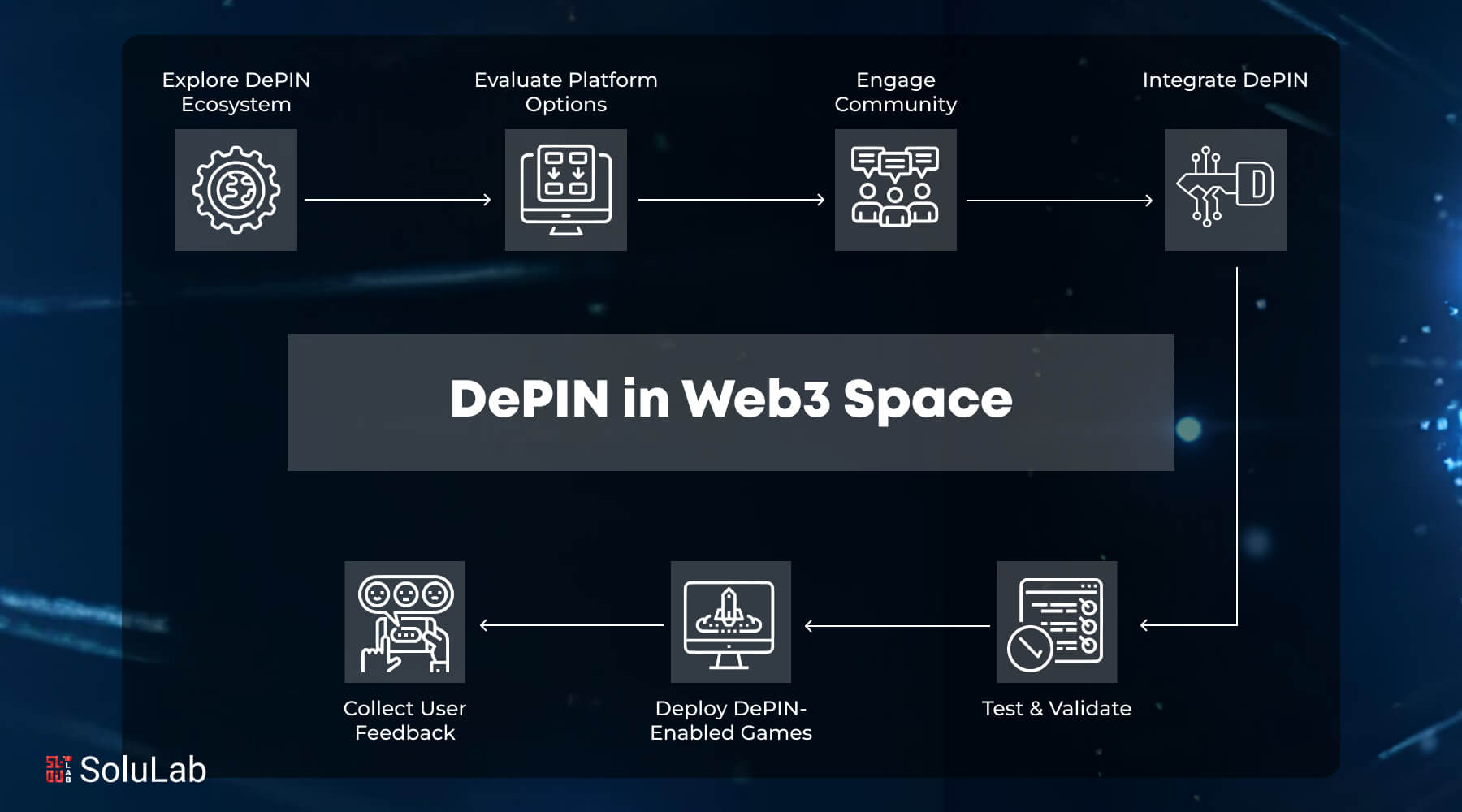
AI in Business Process Automation: Benefits & Use Cases

[fusion_builder_container hundred_percent=”no” equal_height_columns=”no” menu_anchor=”” hide_on_mobile=”small-visibility,medium-visibility,large-visibility” class=”” id=”” background_color=”” background_image=”” background_position=”center center” background_repeat=”no-repeat” fade=”no” background_parallax=”none” parallax_speed=”0.3″ video_mp4=”” video_webm=”” video_ogv=”” video_url=”” video_aspect_ratio=”16:9″ video_loop=”yes” video_mute=”yes” overlay_color=”” video_preview_image=”” border_size=”” border_color=”” border_style=”solid” padding_top=”” padding_bottom=”” padding_left=”” padding_right=””][fusion_builder_row][fusion_builder_column type=”1_1″ layout=”1_1″ background_position=”left top” background_color=”” border_size=”” border_color=”” border_style=”solid” border_position=”all” spacing=”yes” background_image=”” background_repeat=”no-repeat” padding_top=”” padding_right=”” padding_bottom=”” padding_left=”” margin_top=”0px” margin_bottom=”0px” class=”” id=”” animation_type=”” animation_speed=”0.3″ animation_direction=”left” hide_on_mobile=”small-visibility,medium-visibility,large-visibility” center_content=”no” last=”no” min_height=”” hover_type=”none” link=””][fusion_text columns=”” column_min_width=”” column_spacing=”” rule_style=”default” rule_size=”” rule_color=”” hide_on_mobile=”small-visibility,medium-visibility,large-visibility” class=”” id=”” animation_type=”” animation_direction=”left” animation_speed=”0.3″ animation_offset=””]AI in Business Process Automation

AI in business process automation makes monotonous operations easy, freeing up employees to concentrate on more strategic tasks and improving efficiency, accuracy, processing speed, decision-making, and cost savings.

Business process automation (BPA) and artificial intelligence (AI) are two technologies that are changing the face of contemporary business. The integration of these technologies is becoming more and more important as businesses aim for clarity, efficiency, and creativity. 

Implementing AI in BPA can lead to substantial cost savings. Amazon’s investment in AI and robotics has reduced operational costs by 25% in its Shreveport fulfillment center. In this blog, we’ll explore AI in business process automation use cases, benefits, challenges, and more.

AI and BPA: Complementary Technologies

While Artificial Intelligence (AI) and Business Process Automation (BPA) have distinct applications and capabilities, they converge in several key areas. These technologies intersect at various points, sharing goals such as business enhancement, automation, data dependency, integration, scalability, continuous evolution, and decision-making support. However, it is crucial to acknowledge their unique characteristics. BPA focuses on rule-based automation, while AI encompasses more advanced capabilities like machine learning and computer vision. Nonetheless, when combined, these technologies can create a synergistic effect, optimizing business potential and driving innovation.

Use Cases Of AI In Business Automation

Use Cases Of AI In Business Automation

In contemporary business, Artificial Intelligence (AI) and Business Process Automation (BPA) can be harnessed to achieve several crucial AI use cases, including:

1. Research And Development:

AI plays a crucial role in automating R&D automate business processes across sectors. It aids in idea generation and innovation by analyzing market trends, consumer behavior, and competition. AI can automate project management tasks like scheduling, resource allocation, and progress tracking, ensuring efficient team coordination. Additionally, AI automates the collection and analysis of market data, customer feedback, and competitor information, providing valuable insights for strategic decision-making in R&D.

2. Recruitment And HR:

Automating business processes using AI can change HR processes by streamlining tasks such as onboarding, job advertisement, compliance checks, timesheet tracking, exit interviews, and performance management. This not only saves time but also allows HR teams to focus on critical aspects like employee training, culture development, and wellness programs. Key use cases of AI agent in HR include automating resume screening, enhancing the employee onboarding experience, and utilizing predictive analytics to identify potential indicators of turnover and proactively improve employee retention. By suing AI, organizations can enhance their HR capabilities, streamline processes, improve efficiency, and foster a better employee experience.

3. Invoice Processing:

Automated business process automated invoice processing, reducing manual errors and improving efficiency. BPA systems can extract relevant invoice information, automate approval workflows, integrate AI with ERP systems, perform three-way matching, handle exceptions, and provide an audit trail. Automating invoice processing allows the accounts team to focus on high-priority tasks, enhances overall financial accuracy, and simplifies audits and compliance.

4. Purchase Orders:

AI powered RFx and automated business process software significantly enhance the procurement process by digitizing purchase order forms and connecting them to databases. This eliminates manual data entry, reducing repetitive tasks and improving the accuracy and speed of the procurement process. Key benefits include automated data entry, real-time inventory updates, streamlined vendor communication, expense tracking, and budget management. BPA software enables organizations to optimize their procurement operations, minimize errors, enhance transparency, and foster stronger relationships with suppliers, ultimately resulting in cost savings and improved supply chain efficiency.

5. Expense Claims:

Business process automation software expense management system simplifies expense reporting processes and ensures compliance with organizational guidelines. It facilitates efficient submission and approval of expense claims, automates policy compliance checks, provides real-time tracking and visibility, and helps prevent fraud through data analytics. For budget management, BPA offers automated workflows for budget approvals, streamlining financial planning and reducing manual workload. These features enhance accuracy, save time, and foster transparency in expense and budget management.

CTA1

6. Sales And Marketing:

Business process automation software provides substantial advantages in sales and marketing by automating various tasks and optimizing resource allocation. In sales, automation enables quick and accurate price quoting and efficient approval processes, leading to faster deal closures and enhanced customer satisfaction. In marketing, automating business processes facilitates automated email campaigns, lead scoring, and nurturing, improving customer engagement, conversion rates, and revenue. Additionally, BPA streamlines time-off requests, making it easier for employees to submit requests and providing visibility into the approval process. Overall, BPA solutions enhance operational efficiency, improve customer experience, and drive better business outcomes.

7. Price Quotes:

Automating business processes upgrades the quoting process, enabling rapid generation and automatic sending of price quotes for managerial review. This speeds up the process, enhances customer experience, and provides real-time pricing for E-commerce, customized quotes for services, and tiered pricing for bulk orders. automating business processes software also automates the discount approval process, ensuring alignment with the company’s pricing strategy. Overall, BPA software streamlines the quoting process, improves customer satisfaction, and increases the likelihood of purchase.

8. Customer Service:

AI-driven technologies are upgrading customer service. Chatbots provide instant responses to common questions, virtual assistants offer personalized assistance, business process automation tools streamline ticket management, and sentiment analysis extracts insights from customer feedback. These tools enhance customer engagement, improve satisfaction, and allow human agents to focus on complex issues. By strength AI, businesses can deliver a more efficient and proactive customer service experience, fostering loyalty and driving growth.

9. Finance And Accounting:

AI technology has greatly improved the efficiency and accuracy of financial processes in businesses. Business process automation tools like AI-driven expense management systems automate expense submission, categorization, and reimbursement, reducing the risk of discrepancies and enhancing compliance. AI in finance also enables efficient invoice processing by extracting relevant information, automating approval workflows, and minimizing manual handling. Additionally, AI can detect anomalies in expense reports and identify unusual spending patterns, ensuring financial integrity. Furthermore, AI algorithms provide accurate financial forecasts and insights by analyzing historical data, market trends, and external factors, helping businesses make informed decisions and optimize their financial strategies.

10. Operations And Supply Chain:

AI in supply chain plays a vital role in various industries by improving demand forecasting, inventory optimization, and fleet management. Business process automation services enhance the retail sector by strengthening AI-driven demand forecasting, which uses historical data and external factors to accurately predict product demand, enabling retailers to optimize inventory levels and enhance customer satisfaction. In manufacturing, AI helps optimize inventory management by analyzing production data and supplier lead times, minimizing excess stock and stockouts. Within the transportation industry, AI-driven predictive maintenance analyzes vehicle sensor data and historical records to predict component failures, optimizing fleet efficiency and reducing unplanned repairs. AI’s impact on these industries leads to improved decision-making, cost reduction, and enhanced overall operations.

11. IT And Cybersecurity:

Gen AI in cybersecurity plays a vital role in enhancing cybersecurity and streamlining IT operations. It offers real-time threat detection, behavioral analysis for proactive threat identification, rapid response to phishing incidents, business process automation services such as automated patch management, efficient troubleshooting assistance, and intelligent ticket routing and prioritization. These AI-driven solutions empower organizations to swiftly address cybersecurity threats, minimize downtime, and optimize IT support functions, ultimately contributing to improved security posture and enhanced business resilience.

12. Legal:

AI in legal is changing the legal industry by automating and streamlining various aspects of legal work. It expedites contract review processes by scanning legal documents for key terms, conditions, and potential issues. Automation in business processes through AI-powered document automation streamlines the creation of legal documents by intelligently generating drafts based on predefined templates. In M&A transactions, AI helps review extensive documentation and identify potential legal risks, accelerating due diligence. It also contributes to efficient contract lifecycle management by automating various stages, enhancing compliance, and reducing the risk of disputes. Implementing AI in these key areas enhances operational efficiency, reduces errors, and allows legal professionals to focus on more complex and strategic tasks.

How To Implement AI In Business Processes?

Implement AI In Business Processes

Integrating AI into business processes requires a strategic approach to maximize its benefits and ensure successful implementation. Here’s a general guideline for effective AI integration:

  • Define Clear Objectives: Clearly articulate the business goals you aim to achieve with AI, whether it’s improving efficiency, reducing costs, enhancing customer experience, or gaining a competitive edge. Having well-defined objectives is vital to ensure the automation of business processes aligns with your strategic goals.
  • Assess Current Processes: Evaluate existing business processes to identify areas where AI can make the most significant impact. Look for repetitive tasks, data-intensive operations, or areas with potential for optimization. Understanding the business process automation benefits and identifying business process automation use cases will help you focus on the most impactful areas.
  • Data Assessment and Preparation: AI relies heavily on data. Assess the quality, quantity, and accessibility of your data. Ensure data is cleaned, organized, and reflective of the processes you want to automate or optimize. Implement data governance practices to maintain data quality, which is crucial for the automation in business process.
  • Choose Appropriate AI Technologies: Select the right AI technologies for your specific needs. This could include machine learning, natural language processing, computer vision, or a combination of these. The choice of technology should align with your business objectives and the nature of your processes, as seen in various business process automation examples.
  • Select AI Tools or Platforms: Depending on your resources and requirements, choose AI tools or platforms that suit your business. This could range from pre-built AI solutions to custom development. Many cloud service providers offer AI services that can be integrated into your existing infrastructure, providing the benefits of business process automation.
  • Build or Acquire AI Models: If you opt for custom solutions, you may need to build AI models tailored to your business needs. This involves training models on relevant data to make predictions, classifications, or automate tasks. Alternatively, you can strengthen pre-trained models and customize them for your specific requirements to optimize the automation of business processes.
  • Integration with Existing Systems: Ensure seamless integration of AI into existing business systems. This may involve collaborating with your IT department to connect AI solutions with databases, applications, and other infrastructure components, enhancing the overall business process automation benefits.
  • Monitor and Evaluate Performance: You can try implement monitoring mechanisms to track the performance of AI applications using performance management software. Regularly evaluate how well the AI meets business objectives and make adjustments as needed. This may involve refining models, updating data, or modifying algorithms based on real-world feedback and business process automation examples.
  • Iterative Improvement: AI implementation is an iterative process. Use feedback from users and performance metrics to improve and optimize your AI applications continually. Stay informed about advancements in AI technology that could further enhance your processes, providing ongoing business process automation use cases for continuous improvement.

Business Processes Automation market

Benefits of AI in Business Automation 

Artificial Intelligence (AI) and Business Process Automation (BPA), when combined, create a powerful synergy that goes beyond traditional business operations, creating value across diverse domains. These intertwined technologies are transforming contemporary business, ranging from enhanced revenue generation and efficient cost control to improved customer satisfaction and brand expansion. By strategically incorporating AI into automation in business process, organizations can achieve their fundamental objectives and position themselves for long-term growth and innovation in a highly competitive market.

Several important business process automation use cases in modern business can be realized by strengthening the capabilities of AI and BPA. These use cases include:

1. Enhancing Revenue Streams

Businesses primarily aim to optimize revenue and ensure its ongoing growth. Common strategies involve attracting more customers, boosting sales, introducing new products or services, and adjusting prices. Implementing AI and BPA to automate sales and marketing processes can significantly contribute to increased revenue. CRM platforms, for example, can streamline lead management, while AI in banking and AI-powered chatbots offer personalized recommendations, leading to enhanced sales opportunities. Additionally, invoicing tools can expedite the billing process, and predictive analytics solutions can assist in forecasting sales, enabling businesses to make informed decisions and optimize their revenue streams.

2. Decreasing Operational Expenses

Optimizing operations, employing automation in business process, or offloading non-essential functions are crucial strategies for businesses aiming to reduce costs and boost profits. Business process automation (BPA) plays a pivotal role in cost reduction by automating routine tasks, freeing up resources and enhancing efficiency. Moreover, workflow automation tools can generate significant cost savings by streamlining processes and eliminating manual labor. AI-driven finance applications offer valuable insights into spending patterns, enabling businesses to identify areas for cost optimization and make data-driven decisions.

3. Boosting Customer Satisfaction

Achieving success hinges on ensuring customer satisfaction. Providing high-quality products, exceptional service, and responsiveness to feedback is paramount. AI-powered chatbots can deliver uninterrupted support, prompt issue resolution, and tailored recommendations. Moreover, automating order fulfillment through CRM tools provides an integrated view of the customer, facilitating customized interactions that enhance satisfaction and foster loyalty.

4. Increasing Brand Recognition

Building a successful business goes hand-in-hand with establishing a strong brand. Enhancing brand awareness is essential and can be achieved through marketing efforts, optimizing online presence, and fostering a positive brand image. Artificial Intelligence (AI) and Business Process Automation (BPA) technologies can significantly aid in this process by refining marketing strategies and increasing online visibility. Tools for managing social media and search engine optimization (SEO) can enhance the quality and reach of website content. AI-powered sentiment analysis tools enable businesses to gauge customer responses effectively, leading to more targeted and personalized communication.

5. Expanding Market Share

To gain a competitive edge, expand, or merge, it is crucial to have a growing market share. AI and BPA offer valuable insights into customer behavior and enhance operational efficiency, thereby contributing to market share growth. AI-powered analytics tools can identify areas for growth, and supply chain management software simplifies interactions with suppliers. Business process automation (BPA) helps businesses stay competitive and capture a larger market share.

6. Fostering Innovation

Innovation is crucial for staying competitive. To innovate effectively, it’s essential to comprehend customer demands gleaned from diverse feedback channels. Artificial Intelligence (AI) and Business Process Automation (BPA) play significant roles in driving innovation by providing valuable insights and uncovering untapped opportunities. Analytical tools empowered by AI can scrutinize customer feedback, pinpointing potential new products that align with consumer desires. Additionally, BPA software enables businesses to streamline processes, minimize inefficiencies, and heighten quality. This combination of AI and BPA nurtures an environment conducive to innovation and overall operational efficiency.

7. Automating Routine

By strengthening AI business process automation, organizations can enhance efficiency through the minimization of manual tasks and the reduction of errors. AI algorithms further contribute to this enhancement by handling data processing and analysis at speeds and scales that surpass human capabilities. Furthermore, this automation increases employee productivity, freeing up time for them to focus on more strategic and creative aspects of their work. AI-powered business automation tools provide valuable assistance to employees in data analysis, research, and decision-making processes, empowering them to make informed choices and drive business growth..

8. Facilitating Seamless Integration

Where tools and technologies play a crucial role, AI-powered business process automation solutions stand out for their ability to integrate seamlessly with various systems and tools. From CRM systems and ERP software to project management platforms, these solutions can be easily incorporated into existing systems, allowing for seamless functionality across different platforms. This integration ensures that businesses can enhance their existing workflows without the need for complete overhauls, optimizing their operations and maximizing efficiency.

9. Driving Continuous Improvement

Businesses can remain competitive by incorporating AI into their automation of business processes. AI solutions are inherently scalable, allowing them to handle growing workloads and adapt to growing business requirements. AI systems continuously learn and improve over time, optimizing processes to deliver superior results and performance. This ensures that businesses stay at technology and achieve long-term success.

10. Optimizing Resource Allocation

Incorporating AI into business process automation enhances resource allocation and utilization efficiency. strong AI-driven business process automation enables businesses to effectively monitor inventory, forecast demand, and optimize logistics, leading to optimal resource utilization. AI tools analyze historical data to anticipate future requirements, allowing for improved inventory management, demand forecasting, and logistics optimization. These capabilities result in cost reduction and increased productivity.

11. Improved Decision Making

AI-powered business process automation empowers businesses to make more effective decisions by strengthening advanced analytics and machine learning. Through the processing of large datasets, AI uncovers patterns and generates actionable insights, facilitating data-driven, predictive, and real-time decision-making. This automation significantly enhances accuracy, minimizes human error, and supports strategic planning, enabling organizations to respond swiftly to market. By strength AI-driven insights, businesses can make informed decisions that drive improved outcomes and achieve long-term success. The integration of AI and business process automation offers versatile solutions across various business domains, including revenue enhancement, cost optimization, customer satisfaction, brand development, market expansion, and innovation. By harnessing these technologies, businesses can forge a path toward sustainable growth and competitive advantage.

Challenges and risks of AI business process automation

The incorporation of artificial intelligence (AI) into business process automation (BPA) offers the potential for increased efficiency. Nevertheless, this technological advancement is accompanied by a distinct array of challenges and potential risks that require careful consideration.

  • Data Security and Privacy Concerns:

AI systems rely on vast amounts of data, often including sensitive information about customers, employees, and business operations. This raises significant concerns about data security and privacy. Without robust security measures, this data can be vulnerable to unauthorized access, theft, or misuse, leading to financial losses, reputational damage, and legal consequences. Organizations must implement stringent data encryption, access controls, and intrusion detection systems to protect this sensitive information.

  • Workforce Adaptation and Training:

AI-powered BPA solutions can lead to a shift in employee roles and responsibilities, requiring workers to adapt to new technologies and tasks. This can be a significant challenge, especially for employees who are not technologically savvy or who have limited opportunities for training and skill development. Organizations need to invest in comprehensive training programs to help employees understand and operate AI systems effectively. Additionally, they must provide clear communication and support to address employee concerns about job displacement and career development.

  • Ethical Considerations:

AI systems can inadvertently perpetuate biases present in the data, leading to unethical decision-making. For example, an AI-powered resume screening tool trained on biased data may unfairly discriminate against certain demographic groups. Organizations must carefully evaluate the ethical implications of AI in business process automation and implement measures to mitigate potential biases. They should establish clear ethical guidelines, regularly audit their AI business process automation systems for bias, and provide mechanisms for users to challenge biased decisions.

  • Lack of Human Oversight:

Excessive reliance on AI without human oversight can result in errors and missed contextual factors. AI systems are not infallible and can make mistakes due to incorrect data, faulty algorithms, or unexpected scenarios. Without human oversight, these errors can go undetected and lead to severe consequences. Organizations must ensure that AI for business process automation systems are used as decision-making aids rather than replacements for human judgment. They should establish clear roles and responsibilities for human oversight and intervene when necessary to correct errors or provide additional context.

  • Integration Challenges:

Integrating AI solutions into existing systems and workflows can be complex and disruptive. AI systems often require specialized hardware, software, and data formats, which can be challenging to integrate with legacy systems. Organizations must carefully plan and execute AI business process automation projects, considering factors such as data compatibility, system interoperability, and user experience. They should also provide adequate training and support to users to help them adapt to the new AI-enabled systems and workflows.

CTA2

Future Of AI in Business Process Automation

As AI transforms business process automation, key trends are deciding its future. Advancements in AI technology, including natural language processing, computer vision, and deep learning, will enhance communication, analysis, and decision-making. The integration of AI and the Internet of Things (IoT) will create smart devices and enable predictive maintenance. AI and Robotic Process Automation (RPA) will create more intelligent robotic systems. AI-driven predictive analytics will optimize resource planning and strategic decision-making. Autonomous decision-making systems will execute tasks and make data-driven decisions. The democratization of AI will make advanced AI tools accessible to smaller businesses. Hyper Automation, an extension of AI capabilities, will automate multiple processes and create comprehensive automation frameworks. These trends promise efficiency, personalization, and improved decision-making across industries. As their adoption accelerates, AI’s transformative potential in business process automation will usher in an increasingly automated and intelligent future. Partnering with an AI consulting company can help businesses navigate these advancements and fully capitalize on the benefits of AI.

Conclusion

AI in Business Process Automation is revolutionizing how businesses operate by improving efficiency and reducing costs. Automating repetitive tasks and optimizing workflows allows organizations to focus on innovation and growth, while AI-powered solutions help unlock new levels of performance and customer satisfaction.

To make the most of AI in your operations, partnering with an experienced AI development company is crucial. If you’re looking to hire AI developers who can tailor solutions to your specific needs, SoluLab offers the expertise to help businesses implement advanced AI technologies, driving success and innovation.

FAQs

1. What is business process automation (BPA)?

Business process automation (BPA) involves using technology to streamline and automate repetitive and manual tasks within business processes. This can include automating workflows, data entry, and other routine tasks to improve efficiency, reduce errors, and cut costs.

2. How does AI enhance business process automation?

AI enhances business process automation by introducing intelligent capabilities such as predictive analytics, natural language processing, and machine learning. This allows for more sophisticated automation, including data-driven decision-making, real-time insights, and the ability to handle complex tasks that go beyond traditional automation.

3. What are some examples of business process automation?

Examples of business process automation include automated invoice processing, customer service chatbots, and workflow automation for approvals and document management. These solutions help streamline operations, reduce manual effort, and improve accuracy across various business functions.

4. What are the benefits of business process automation?

The benefits of business process automation include increased efficiency, reduced operational costs, minimized errors, enhanced productivity, and improved compliance. By automating repetitive tasks, businesses can allocate resources more effectively and focus on strategic activities.

5. How can I get help with AI integration for my project?

If you’re looking to integrate AI into your gaming project, consider reaching out to an AI consulting company or AI development company. These companies can offer expertise in applying AI technologies to enhance your game’s features and performance.

6. What are some use cases for AI in business process automation?

Use cases for AI in business process automation include automating customer support with chatbots, streamlining invoice processing with intelligent data extraction, and optimizing supply chain management through predictive analytics. These applications enhance operational efficiency and provide valuable insights for better decision-making.

7. How do I get started with implementing AI for business process automation?

To get started, define your business objectives, assess your current processes, and identify areas where AI can make the most impact. Choose the right business process automation tools and AI-powered BPA solutions that align with your needs. SoluLab can assist with integrating these technologies and ensuring a smooth implementation to achieve your automation goals.

[/fusion_text][/fusion_builder_column][/fusion_builder_row][/fusion_builder_container]
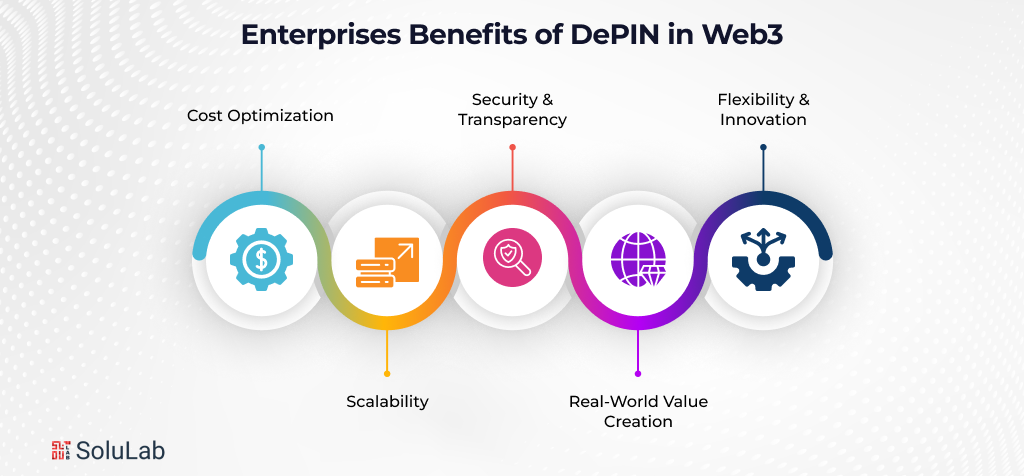
Top 10 Chatbot Development Companies in 2025

[fusion_builder_container hundred_percent=”no” hundred_percent_height=”no” hundred_percent_height_scroll=”no” hundred_percent_height_center_content=”yes” equal_height_columns=”no” menu_anchor=”” hide_on_mobile=”small-visibility,medium-visibility,large-visibility” status=”published” publish_date=”” class=”” id=”” border_size=”” border_color=”” border_style=”solid” margin_top=”” margin_bottom=”” padding_top=”” padding_right=”” padding_bottom=”” padding_left=”” gradient_start_color=”” gradient_end_color=”” gradient_start_position=”0″ gradient_end_position=”100″ gradient_type=”linear” radial_direction=”center” linear_angle=”180″ background_color=”” background_image=”” background_position=”center center” background_repeat=”no-repeat” fade=”no” background_parallax=”none” enable_mobile=”no” parallax_speed=”0.3″ background_blend_mode=”none” video_mp4=”” video_webm=”” video_ogv=”” video_url=”” video_aspect_ratio=”16:9″ video_loop=”yes” video_mute=”yes” video_preview_image=”” filter_hue=”0″ filter_saturation=”100″ filter_brightness=”100″ filter_contrast=”100″ filter_invert=”0″ filter_sepia=”0″ filter_opacity=”100″ filter_blur=”0″ filter_hue_hover=”0″ filter_saturation_hover=”100″ filter_brightness_hover=”100″ filter_contrast_hover=”100″ filter_invert_hover=”0″ filter_sepia_hover=”0″ filter_opacity_hover=”100″ filter_blur_hover=”0″ admin_toggled=”no”][fusion_builder_row][fusion_builder_column type=”1_1″ layout=”1_1″ spacing=”” center_content=”no” link=”” target=”_self” min_height=”” hide_on_mobile=”small-visibility,medium-visibility,large-visibility” class=”” id=”” hover_type=”none” border_size=”0″ border_color=”” border_style=”solid” border_position=”all” border_radius=”” box_shadow=”no” dimension_box_shadow=”” box_shadow_blur=”0″ box_shadow_spread=”0″ box_shadow_color=”” box_shadow_style=”” padding_top=”” padding_right=”” padding_bottom=”” padding_left=”” margin_top=”” margin_bottom=”” background_type=”single” gradient_start_color=”” gradient_end_color=”” gradient_start_position=”0″ gradient_end_position=”100″ gradient_type=”linear” radial_direction=”center” linear_angle=”180″ background_color=”” background_image=”” background_image_id=”” background_position=”left top” background_repeat=”no-repeat” background_blend_mode=”none” animation_type=”” animation_direction=”left” animation_speed=”0.3″ animation_offset=”” filter_type=”regular” filter_hue=”0″ filter_saturation=”100″ filter_brightness=”100″ filter_contrast=”100″ filter_invert=”0″ filter_sepia=”0″ filter_opacity=”100″ filter_blur=”0″ filter_hue_hover=”0″ filter_saturation_hover=”100″ filter_brightness_hover=”100″ filter_contrast_hover=”100″ filter_invert_hover=”0″ filter_sepia_hover=”0″ filter_opacity_hover=”100″ filter_blur_hover=”0″ last=”true” first=”true”][fusion_text columns=”” column_min_width=”” column_spacing=”” rule_style=”default” rule_size=”” rule_color=”” hide_on_mobile=”small-visibility,medium-visibility,large-visibility” class=”” id=”” animation_type=”” animation_direction=”left” animation_speed=”0.3″ animation_offset=””]

In 2022, the global chatbot market was valued at approximately USD 5,132.8 million. From 2023 to 2030, this market is anticipated to experience significant growth, with a robust compound annual growth rate (CAGR) of 23.3%. In a recently published report by Grand View Research, Inc., the global chatbot market is anticipated to attain a value of USD 27,297.2 million by the year 2030. This remarkable growth will be driven by a robust compound annual growth rate (CAGR) of 23.3% over the period from 2023 to 2030.

Nowadays, businesses increasingly seek Enterprise AI Chatbot Development Services to upgrade customer interactions, optimize operations, and deliver immediate support. Voice Activated Chatbot solutions are also gaining traction for their hands-free, intuitive user experience. These services are vital for companies aiming for growth. To assist you in selecting the best options, we have compiled a list of renowned AI Chatbot Development companies recognized for their expertise, pioneering spirit, and impactful solutions.

Selection Criteria

We implemented a rigorous four-step screening process to identify the top chatbot vendors in India. We leveraged publicly available data demonstrating a strong correlation with business success to make informed decisions. The screening process evaluated vendors based on the following essential criteria:

1. Employee Count: The number of employees is a valuable indicator of a company’s financial standing, as it correlates with revenue and success. Companies specializing in enterprise chatbot solutions often have larger teams to handle the complex needs of large organizations. To ensure accuracy, we excluded companies with fewer than 100 employees on LinkedIn during our screening process.

2. B2B Reviews and Ratings: The popularity of a company can be gauged by the number of user reviews on reputable B2B review platforms such as G2, Capterra, and Trustradius. Companies offering virtual assistant services that enhance business efficiency were included if they had a minimum of 50 total reviews and an average rating of 8.5 or higher in our selection.

3. Presence in India: To assess a company’s commitment to the Indian market, we considered its physical presence in the region. Companies without an office in India were excluded from our screening process.

4. Case Studies and References: Case studies and references offer insights into a company’s market standing and the quality of its solutions, such as enterprise chatbot deployments. We prioritized companies with at least two case studies involving Indian companies during our screening

Why Choose Chatbot Development Companies to Build Your Chatbot?

Chatbots have become a crucial tool for modern businesses, offering users seamless interactions on websites and platforms. However, creating an effective chatbot requires more than just coding. Each chatbot acts like a unique character, capable of handling both simple queries and complex actions involving rich content like images. To ensure these chatbots function efficiently and offer engaging user experiences, a combination of technical expertise, creative design, and specialized writing is essential.

Many companies, faced with this skill gap, opt for off-the-shelf chatbot templates or attempt to design conversation flows independently. Unfortunately, this often leads to subpar performance and poor conversion rates. Here’s why hiring a professional chatbot development company is the smarter choice.

  • Expertise Beyond Programming

Chatbot development isn’t just about writing code; it involves crafting a conversational experience. A chatbot development company brings together skilled writers, designers, and tech experts to create a bot that feels natural, intuitive, and engaging. These professionals ensure the chatbot’s responses are well-crafted and aligned with the brand’s tone while incorporating advanced features for seamless functionality.

  • Quality Processes and Timely Delivery

While freelancers can offer chatbot services, working with a company provides a more structured and disciplined approach. Chatbot development companies operate with defined processes and established workflows, ensuring high-quality results are delivered on time. This systematic approach minimizes errors and ensures the chatbot meets your business needs effectively.

  • Capitalizing on a Growing Market

The global interest in chatbots has skyrocketed, fueled in part by the immense popularity of AI tools like ChatGPT. The chatbot industry is projected to grow to a market size of $1.25 billion by 2025, according to Statista. By hiring a chatbot development company, you position your business to capitalize on this booming trend with a cutting-edge solution tailored to your audience.

  • Leverage Expert Guidance

Developing a chatbot, especially in an unfamiliar field, can feel overwhelming. Partnering with an experienced chatbot development company provides you with expert guidance, much like having a mentor who refines and elevates your ideas. Their insights and experience ensure your chatbot aligns with your business objectives and delivers maximum ROI.

What Services Do Chatbot Development Companies Offer?

Chatbot development companies specialize in helping businesses streamline and improve their customer service operations through advanced chatbot solutions. These chatbots are designed to simulate human-like interactions, enabling customers to ask questions and receive prompt, accurate responses via a user-friendly interface.

Many chatbot companies provide no-code platforms that allow businesses to create chatbots without requiring technical expertise. These platforms empower users to design and deploy functional chatbots quickly, making automation accessible to a wider range of businesses.

For businesses with unique requirements, chatbot development companies offer personalized bot development services. These tailored solutions are built to align with specific business needs, ensuring a customized chatbot experience that resonates with the brand’s goals and enhances customer engagement.

What To Look For In An Enterprise AI Chatbot Development Company?

For a successful enterprise chatbot project, selecting the appropriate AI chatbot development company is vital. Consider these critical factors:

1. AI and NLP Expertise: A leading company should possess a deep understanding of artificial intelligence and natural language processing technologies to develop advanced, intelligent chatbots that provide exceptional user experiences.

2. Customization and Integration: The ability to adapt the chatbot to unique business requirements and seamlessly integrate with existing systems is crucial for a successful implementation. Keeping up with chatbot development trends ensures that the solutions remain cutting-edge and relevant.

3. Scalability and Growth: The company should offer scalable solutions that can accommodate increasing interaction volumes as your business grows, ensuring uninterrupted performance and reliability, which is especially important for a chatbot in healthcare that handles sensitive patient data.

4. Security and Compliance Adherence: Recognizing the sensitivity of data processed by chatbots, robust security measures and adherence to industry standards are essential to safeguard information and maintain trust.

5. Dedicated Customer Support: Ongoing support and regular updates are vital to keep the chatbot functioning effectively and up-to-date, ensuring continuous enhancement and optimization.

Most Powerful Chatbot Development Platforms To Build A Chatbot For Your Business

In the vast view of chatbot platforms, we have curated a comprehensive list of the top chatbot-building platforms available. This list provides an in-depth analysis of their features, advantages, disadvantages, pricing structures, and the technical knowledge required to create and build an AI-powered chatbot for your business, including specialized solutions like HR chatbot systems designed to streamline human resources processes.

[/fusion_text][/fusion_builder_column][/fusion_builder_row][/fusion_builder_container][fusion_builder_container hundred_percent=”no” hundred_percent_height=”no” hundred_percent_height_scroll=”no” hundred_percent_height_center_content=”yes” equal_height_columns=”no” menu_anchor=”” hide_on_mobile=”small-visibility,medium-visibility,large-visibility” status=”published” publish_date=”” class=”” id=”” border_size=”” border_color=”” border_style=”solid” margin_top=”” margin_bottom=”” padding_top=”” padding_right=”0px” padding_bottom=”” padding_left=”0px” gradient_start_color=”” gradient_end_color=”” gradient_start_position=”0″ gradient_end_position=”100″ gradient_type=”linear” radial_direction=”center” linear_angle=”180″ background_color=”” background_image=”” background_position=”center center” background_repeat=”no-repeat” fade=”no” background_parallax=”none” enable_mobile=”no” parallax_speed=”0.3″ background_blend_mode=”none” video_mp4=”” video_webm=”” video_ogv=”” video_url=”” video_aspect_ratio=”16:9″ video_loop=”yes” video_mute=”yes” video_preview_image=”” filter_hue=”0″ filter_saturation=”100″ filter_brightness=”100″ filter_contrast=”100″ filter_invert=”0″ filter_sepia=”0″ filter_opacity=”100″ filter_blur=”0″ filter_hue_hover=”0″ filter_saturation_hover=”100″ filter_brightness_hover=”100″ filter_contrast_hover=”100″ filter_invert_hover=”0″ filter_sepia_hover=”0″ filter_opacity_hover=”100″ filter_blur_hover=”0″ admin_toggled=”no”][fusion_builder_row][fusion_builder_column type=”1_1″ layout=”1_1″ spacing=”” center_content=”no” link=”” target=”_self” min_height=”” hide_on_mobile=”small-visibility,medium-visibility,large-visibility” class=”” id=”” hover_type=”none” border_size=”0″ border_color=”” border_style=”solid” border_position=”all” box_shadow=”no” box_shadow_blur=”0″ box_shadow_spread=”0″ box_shadow_color=”” box_shadow_style=”” background_type=”single” gradient_start_position=”0″ gradient_end_position=”100″ gradient_type=”linear” radial_direction=”center” linear_angle=”180″ background_color=”” background_image=”” background_image_id=”” background_position=”left top” background_repeat=”no-repeat” background_blend_mode=”none” animation_type=”” animation_direction=”left” animation_speed=”0.3″ animation_offset=”” filter_type=”regular” filter_hue=”0″ filter_saturation=”100″ filter_brightness=”100″ filter_contrast=”100″ filter_invert=”0″ filter_sepia=”0″ filter_opacity=”100″ filter_blur=”0″ filter_hue_hover=”0″ filter_saturation_hover=”100″ filter_brightness_hover=”100″ filter_contrast_hover=”100″ filter_invert_hover=”0″ filter_sepia_hover=”0″ filter_opacity_hover=”100″ filter_blur_hover=”0″ first=”true” last=”true” padding_right=”30px” padding_left=”30px”][fusion_code]PHN0eWxlPgogIC5ib3gtc2VjdGlvbiB7CiAgICBwYWRkaW5nOiAyNXB4IDBweCAhaW1wb3J0YW50OwogIH0KCiAgLmJveC1zZWN0aW9uLWNvbnRhaW5lciB7CiAgICBtYXgtd2lkdGg6IDEwMjBweDsKICAgIG1hcmdpbjogYXV0bzsKICB9CgogIC5maXJzdC1yb3csCiAgLnNlY29uZC1yb3cgewogICAgYm9yZGVyOiAxcHggc29saWQgI2UyZTJlMjsKICB9CgogIC5ib3gtc2VjdGlvbiAuY29sLTEgewogICAgd2lkdGg6IDcwLjYyNSU7CiAgICBwYWRkaW5nOiAwcHggMHB4IDBweCAyMHB4OwogIH0KCiAgLmJveC1zZWN0aW9uIC5jb2wtMiB7CiAgICB3aWR0aDogMjguODc1JTsKICAgIGRpc3BsYXk6IGZsZXg7CiAgICBhbGlnbi1pdGVtczogY2VudGVyOwogICAganVzdGlmeS1jb250ZW50OiBjZW50ZXI7CiAgfQoKICAuYm94LXNlY3Rpb24gLnJvdyB7CiAgICBkaXNwbGF5OiBmbGV4OwogIH0KCiAgLmJveC1zZWN0aW9uIC5oZWFkaW5nLWJveCB7CiAgICBkaXNwbGF5OiBmbGV4OwogIH0KCiAgLmJveC1zZWN0aW9uIC5oZWFkaW5nLWJveCBpbWcgewogICAgd2lkdGg6IDU5cHg7CiAgICBoZWlnaHQ6IGZpdC1jb250ZW50OwogIH0KCiAgLmhlYWRpbmctYm94IGg0IHsKICAgIHBhZGRpbmctbGVmdDogMTVweCAhaW1wb3J0YW50OwogICAgZm9udC1zaXplOiAyNHB4ICFpbXBvcnRhbnQ7CiAgICBmb250LWZhbWlseTogIkhlbHZldGljYSBOZXVlIiwgSGVsdmV0aWNhLCBBcmlhbCwgc2Fucy1zZXJpZiAhaW1wb3J0YW50OwogICAgZm9udC13ZWlnaHQ6IDcwMCAhaW1wb3J0YW50OwogICAgY29sb3I6ICMwMDAgIWltcG9ydGFudDsKICB9CgogIC5oZWFkaW5nLWJveCB7CiAgICBkaXNwbGF5OiBmbGV4ICFpbXBvcnRhbnQ7CiAgICBhbGlnbi1pdGVtczogY2VudGVyICFpbXBvcnRhbnQ7CiAgfQoKICAuZmlyc3Qtcm93IC5oZWFkaW5nLWJ0biBhIHsKICAgIGNvbG9yOiAjZmZmOwogICAgYm9yZGVyLXJhZGl1czogNHB4OwogICAgZm9udC1zaXplOiAxN3B4OwogICAgcGFkZGluZzogMTBweCAyMHB4OwogICAgYmFja2dyb3VuZC1jb2xvcjogI2UwMzQzNCAhaW1wb3J0YW50OwogICAgdGV4dC1kZWNvcmF0aW9uOiBub25lOwogICAgZm9udC1mYW1pbHk6ICJIZWx2ZXRpY2EgTmV1ZSIsIEhlbHZldGljYSwgQXJpYWwsIHNhbnMtc2VyaWYgIWltcG9ydGFudDsKICB9CgogIC5wYXJhZ3JhcGgtY29udGVudCBwIHsKICAgIGZvbnQtd2VpZ2h0OiA0MDAgIWltcG9ydGFudDsKICAgIGZvbnQtZmFtaWx5OiAiSGVsdmV0aWNhIE5ldWUiLCBIZWx2ZXRpY2EsIEFyaWFsLCBzYW5zLXNlcmlmICFpbXBvcnRhbnQ7CiAgICBjb2xvcjogIzAwMCAhaW1wb3J0YW50OwogICAgcGFkZGluZy1sZWZ0OiAxNXB4ICFpbXBvcnRhbnQ7CiAgICBmb250LXNpemU6IDE4cHggIWltcG9ydGFudDsKICB9CgogIC5wYXJhZ3JhcGgtY29udGVudCB7CiAgICBwYWRkaW5nOiAyMHB4IDMwcHggMHB4IDBweCAhaW1wb3J0YW50OwogICB0ZXh0LWFsaWduIDogbGVmdCAhaW1wb3J0YW50OwogIH0KCiAgLmJveC1zZWN0aW9uIC5pY29uLWxpc3QgewogICAgcGFkZGluZzogMTdweCAxMHB4IDBweCAxMHB4OwogICAgYm9yZGVyLWxlZnQ6IDFweCBzb2xpZCAjZTJlMmUyOwogIH0KCiAgLmljb24tbGlzdCBwIHsKICAgIGRpc3BsYXk6IGZsZXggIWltcG9ydGFudDsKICAgIHBhZGRpbmctYm90dG9tOiAxZW0gIWltcG9ydGFudDsKICAgIG1hcmdpbjogOHB4IDBweCAhaW1wb3J0YW50OwogICAgYWxpZ24taXRlbXM6IGZsZXgtc3RhcnQ7CiAgfQoKICAuaWNvbi1saXN0IHAgc3BhbiB7CiAgICBwYWRkaW5nLWxlZnQ6IDEwcHggIWltcG9ydGFudDsKICAgIGZvbnQtc2l6ZTogMThweCAhaW1wb3J0YW50OwogIH0KCiAgLnNlY29uZC1yb3cgLmNvbC0yIHsKICAgIGp1c3RpZnktY29udGVudDogbGVmdCAhaW1wb3J0YW50OwogICAgYWxpZ24taXRlbXM6IHN0YXJ0ICFpbXBvcnRhbnQ7CiAgfQoKICAuaWNvbi1saXN0IGltZyB7CiAgICB3aWR0aDogMjVweCAhaW1wb3J0YW50OwogIH0KCiAgLmZpcnN0LXJvdyAucm93IHsKICAgIHBhZGRpbmc6IDEwcHggIWltcG9ydGFudDsKICB9CgogIC5oZWFkaW5nLWJveCBpbWcgewogICAgbWFyZ2luOiAwcHggIWltcG9ydGFudDsKICB9CgogIC5wYXJhZ3JhcGgtY29udGVudC1saXN0IHsKICAgIG1hcmdpbjogMTBweCAyMHB4ICFpbXBvcnRhbnQ7CiAgfQoKICAucGFyYWdyYXBoLWNvbnRlbnQtbGlzdCBsaSB7CiAgICBmb250LXNpemU6IDE4cHggIWltcG9ydGFudDsKICB9CgogIEBtZWRpYSBzY3JlZW4gYW5kIChtYXgtd2lkdGg6IDc2OHB4KSBhbmQgKG1pbi13aWR0aDogNDI1cHgpIHsKICAgIC5ib3gtc2VjdGlvbiAucm93IHsKICAgICAgZGlzcGxheTogZmxleCAhaW1wb3J0YW50OwogICAgfQoKICAgIC5ib3gtc2VjdGlvbiAuY29sLTEsCiAgICAuYm94LXNlY3Rpb24gLmNvbC0yIHsKICAgICAgd2lkdGg6IDEwMCUgIWltcG9ydGFudDsKICAgIH0KCiAgICAuYm94LXNlY3Rpb24gLmljb24tbGlzdCB7CiAgICAgIGJvcmRlci1sZWZ0OiAwcHggc29saWQgI2UyZTJlMiAhaW1wb3J0YW50OwogICAgICBtYXJnaW4tbGVmdDogMjBweCAhaW1wb3J0YW50OwogICAgfQogIH0KCiBAbWVkaWEgKG1heC13aWR0aDogOTkxcHgpCi5zZWN0aW9uIHsKICAgIHRleHQtYWxpZ246IGxlZnQgIWltcG9ydGFudDsKfQoKICBAbWVkaWEgc2NyZWVuIGFuZCAobWF4LXdpZHRoOiA0MjRweCkgYW5kIChtaW4td2lkdGg6IDMyMHB4KSB7CiAgICAuYm94LXNlY3Rpb24gLnJvdyB7CiAgICAgIGRpc3BsYXk6IGJsb2NrICFpbXBvcnRhbnQ7CiAgICB9CgogICAgLmJveC1zZWN0aW9uIC5jb2wtMSwKICAgIC5ib3gtc2VjdGlvbiAuY29sLTIgewogICAgICB3aWR0aDogMTAwJSAhaW1wb3J0YW50OwogICAgfQoKICAgIC5ib3gtc2VjdGlvbiAuaWNvbi1saXN0IHsKICAgICAgYm9yZGVyLWxlZnQ6IDBweCBzb2xpZCAjZTJlMmUyICFpbXBvcnRhbnQ7CiAgICAgIG1hcmdpbi1sZWZ0OiAyMHB4ICFpbXBvcnRhbnQ7CiAgICB9CgogICAgLmhlYWRpbmctYm94IGg0IHsKICAgICAgZm9udC1zaXplOiAyMHB4ICFpbXBvcnRhbnQ7CiAgICB9CgogICAgLmhlYWRpbmctYm94IGltZyB7CiAgICAgIHdpZHRoOiA0MHB4ICFpbXBvcnRhbnQ7CiAgICB9CgogICAgLmhlYWRpbmctYnRuIHsKICAgICAgbWFyZ2luOiAxNXB4IDBweCAhaW1wb3J0YW50OwogICAgfQoKICAgIC5ib3gtc2VjdGlvbiAuY29sLTEgewogICAgICBwYWRkaW5nOiAwcHggIWltcG9ydGFudDsKICAgIH0KCiAgICAuaGVhZGluZy1ib3ggewogICAgICBqdXN0aWZ5LWNvbnRlbnQ6IGNlbnRlciAhaW1wb3J0YW50OwogICAgfQoKICAgIC5wYXJhZ3JhcGgtY29udGVudCB7CiAgICAgIHBhZGRpbmc6IDIwcHggMzBweCAwcHggMjBweCAhaW1wb3J0YW50OwogICAgICB0ZXh0LWFsaWduOiBsZWZ0OwogICAgfQogIH0KPC9zdHlsZT4KCjxzZWN0aW9uIGNsYXNzPSJib3gtc2VjdGlvbiI+CiAgPGRpdiBjbGFzcz0iYm94LXNlY3Rpb24tY29udGFpbmVyIj4KICAgIDxkaXYgY2xhc3M9Im1haW4tYm94Ij4KICAgICAgPGRpdiBjbGFzcz0iZmlyc3Qtcm93Ij4KICAgICAgICA8ZGl2IGNsYXNzPSJyb3ciPgogICAgICAgICAgPGRpdiBjbGFzcz0iY29sIGNvbC0xIj4KICAgICAgICAgICAgPGRpdiBjbGFzcz0iaGVhZGluZy1ib3giPgogICAgICAgICAgICAgIDxpbWcgc3JjPSJodHRwczovL3d3dy5zb2x1bGFiLmNvbS93cC1jb250ZW50L3VwbG9hZHMvMjAyMy8wNS9Hcm91cC0xMTE2NjAwMTQ3LW5ldy5wbmciIGFsdD0iIj4KICAgICAgICAgICAgICA8aDQ+PHNwYW4+MS4gU29sdUxhYjwvc3Bhbj48L2g0PgogICAgICAgICAgICA8L2Rpdj4KICAgICAgICAgIDwvZGl2PgogICAgICAgICAgPGRpdiBjbGFzcz0iY29sIGNvbC0yIj4KICAgICAgICAgICAgPGRpdiBjbGFzcz0iaGVhZGluZy1idG4iPgogICAgICAgICAgICAgIDxhIGhyZWY9Imh0dHBzOi8vd3d3LnNvbHVsYWIuY29tL2NoYXRib3QtZGV2ZWxvcG1lbnQtY29tcGFueS8iIHRhcmdldCA9ICJfYmxhbmsiPlZpc2l0CiAgICAgICAgICAgICAgICBXZWJzaXRlPC9hPgogICAgICAgICAgICA8L2Rpdj4KICAgICAgICAgIDwvZGl2PgogICAgICAgIDwvZGl2PgogICAgICA8L2Rpdj4KICAgICAgPGRpdiBjbGFzcz0ic2Vjb25kLXJvdyI+CiAgICAgICAgPGRpdiBjbGFzcz0icm93Ij4KICAgICAgICAgIDxkaXYgY2xhc3M9ImNvbCBjb2wtMSI+CiAgICAgICAgICAgIDxkaXYgY2xhc3M9InBhcmFncmFwaC1jb250ZW50Ij4KICAgICAgICAgICAgIDxwPlNvbHVMYWIgc3RhbmRzIG91dCBhcyBvbmUgb2YgdGhlIHRvcCBjaGF0Ym90IGRldmVsb3BtZW50IGNvbXBhbmllcyBpbiB0aGUgbWFya2V0LCBvZmZlcmluZyB0YWlsb3ItbWFkZSBBSS1wb3dlcmVkIGNoYXRib3Qgc29sdXRpb25zIGZvciBidXNpbmVzc2VzIG9mIGFsbCBzaXplcy4gV2l0aCBhIHN0cm9uZyBmb2N1cyBvbiBlbmhhbmNpbmcgY3VzdG9tZXIgZXhwZXJpZW5jZSBhbmQgb3BlcmF0aW9uYWwgZWZmaWNpZW5jeSwgU29sdUxhYiBkZXZlbG9wcyBpbnRlbGxpZ2VudCBjaGF0Ym90cyB0aGF0IGNhbiBoYW5kbGUgZXZlcnl0aGluZyBmcm9tIHNpbXBsZSBjdXN0b21lciBpbnF1aXJpZXMgdG8gY29tcGxleCBjb252ZXJzYXRpb25hbCB0YXNrcy48L3A+Cgo8cD5XaGF0IHNldHMgU29sdUxhYiBhcGFydCBpcyBpdHMgZXhwZXJ0aXNlIGluIGludGVncmF0aW5nIGNoYXRib3RzIHdpdGggYWR2YW5jZWQgQUkgdGVjaG5vbG9naWVzIHRvIGVuc3VyZSBzZWFtbGVzcyBhdXRvbWF0aW9uIGFuZCBwZXJzb25hbGl6ZWQgY3VzdG9tZXIgZW5nYWdlbWVudC4gV2l0aCBhIHRyYWNrIHJlY29yZCBvZiBkZWxpdmVyaW5nIGhpZ2gtcXVhbGl0eSBzb2x1dGlvbnMsIFNvbHVMYWIgaGFzIGVhcm5lZCBpdHMgcGxhY2UgYW1vbmcgdGhlIGJlc3QgY2hhdGJvdCBkZXZlbG9wbWVudCBjb21wYW5pZXMgaW4gdGhlIGluZHVzdHJ5LiBXaGV0aGVyIHlvdSBuZWVkIGEgY2hhdGJvdCBmb3IgY3VzdG9tZXIgc2VydmljZSwgZS1jb21tZXJjZSwgb3IgaW50ZXJuYWwgYnVzaW5lc3Mgb3BlcmF0aW9ucywgU29sdUxhYiBwcm92aWRlcyBpbm5vdmF0aXZlLCBzY2FsYWJsZSwgYW5kIGVmZmljaWVudCBzb2x1dGlvbnMgdGFpbG9yZWQgdG8geW91ciB1bmlxdWUgYnVzaW5lc3MgbmVlZHMuPC9wPgogICAgICAgICAgICA8L2Rpdj4KICAgICAgICAgIDwvZGl2PgogICAgICAgICAgPGRpdiBjbGFzcz0iY29sIGNvbC0yIj4KICAgICAgICAgICAgPGRpdiBjbGFzcz0iaWNvbi1saXN0Ij4KCiAgICAgICAgICAgICAgPHA+CiAgICAgICAgICAgICAgICA8aW1nIHNyYz0iaHR0cHM6Ly93d3cuc29sdWxhYi5jb20vd3AtY29udGVudC91cGxvYWRzLzIwMjMvMDUvdGFibGVyLWljb24tY29pbi5zdmciIHdpZHRoPSIyNXB4IgogICAgICAgICAgICAgICAgICBoZWlnaHQ9IjI1cHgiPgogICAgICAgICAgICAgICAgPHNwYW4+JDI1IC0gJDQ5IC8gaHI8L3NwYW4+CiAgICAgICAgICAgICAgPC9wPgoKICAgICAgICAgICAgICA8cD4KICAgICAgICAgICAgICAgIDxpbWcgc3JjPSJodHRwczovL3d3dy5zb2x1bGFiLmNvbS93cC1jb250ZW50L3VwbG9hZHMvMjAyMy8wNS90YWJsZXItaWNvbi11c2Vycy0xLnN2ZyIgd2lkdGg9IjI1cHgiCiAgICAgICAgICAgICAgICAgIGhlaWdodD0iMjVweCI+CiAgICAgICAgICAgICAgICA8c3Bhbj4gNTAgLSAyNDk8L3NwYW4+CiAgICAgICAgICAgICAgPC9wPgoKICAgICAgICAgICAgICA8cD4KICAgICAgICAgICAgICAgIDxpbWcgc3JjPSJodHRwczovL3d3dy5zb2x1bGFiLmNvbS93cC1jb250ZW50L3VwbG9hZHMvMjAyMy8wNS90YWJsZXItaWNvbi1jYWxlbmRhci1kdWUtMS5zdmciCiAgICAgICAgICAgICAgICAgIHdpZHRoPSIyNXB4IiBoZWlnaHQ9IjI1cHgiPgogICAgICAgICAgICAgICAgPHNwYW4+MjAxNAogICAgICAgICAgICAgICAgPC9zcGFuPgogICAgICAgICAgICAgIDwvcD4KCiAgICAgICAgICAgICAgPHA+CiAgICAgICAgICAgICAgICA8aW1nIHNyYz0iaHR0cHM6Ly93d3cuc29sdWxhYi5jb20vd3AtY29udGVudC91cGxvYWRzLzIwMjMvMDUvdGFibGVyLWljb24tbWFwLXBpbi5zdmciIHdpZHRoPSIyNXB4IgogICAgICAgICAgICAgICAgICBoZWlnaHQ9IjI1cHgiPgogICAgICAgICAgICAgICAgPHNwYW4+TG9zIEFuZ2VsZXMsIENBLCBVU0E8L3NwYW4+CiAgICAgICAgICAgICAgPC9wPgoKICAgICAgICAgICAgICA8cD4KICAgICAgICAgICAgICAgIDxpbWcgc3JjPSJodHRwczovL3d3dy5zb2x1bGFiLmNvbS93cC1jb250ZW50L3VwbG9hZHMvMjAyMy8wNS90YWJsZXItaWNvbi1icmllZmNhc2UtMi5zdmciIHdpZHRoPSIyNXB4IgogICAgICAgICAgICAgICAgICBoZWlnaHQ9IjI1cHgiPgogICAgICAgICAgICAgICAgPHNwYW4+PGEgaHJlZiA9ICJodHRwczovL3d3dy5zb2x1bGFiLmNvbS9jYXNlLXN0dWRpZXMvZGlnaXRhbC1xdWVzdC8iPkRpZ2l0YWwgUXVlc3Q8L2E+ICAgICAgICAgICAgICAgIDwvc3Bhbj4KICAgICAgICAgICAgICA8L3A+CgogICAgICAgICAgICA8L2Rpdj4KICAgICAgICAgIDwvZGl2PgogICAgICAgIDwvZGl2PgogICAgICA8L2Rpdj4KICAgIDwvZGl2PgogIDwvZGl2Pgo8L3NlY3Rpb24+[/fusion_code][fusion_code]PHNlY3Rpb24gY2xhc3M9ImJveC1zZWN0aW9uIj4KICA8ZGl2IGNsYXNzPSJib3gtc2VjdGlvbi1jb250YWluZXIiPgogICAgPGRpdiBjbGFzcz0ibWFpbi1ib3giPgogICAgICA8ZGl2IGNsYXNzPSJmaXJzdC1yb3ciPgogICAgICAgIDxkaXYgY2xhc3M9InJvdyI+CiAgICAgICAgICA8ZGl2IGNsYXNzPSJjb2wgY29sLTEiPgogICAgICAgICAgICA8ZGl2IGNsYXNzPSJoZWFkaW5nLWJveCI+CiAgICAgICAgICAgICAgPGltZyBzcmM9Imh0dHBzOi8vd3d3LnNvbHVsYWIuY29tL3dwLWNvbnRlbnQvdXBsb2Fkcy8yMDIzLzEwLzYtNC5wbmciIGFsdD0iaW5ub3dpc2UiPgogICAgICAgICAgICAgIDxoND48c3Bhbj4yLiBJbm5vd2lzZSA8L3NwYW4+PC9oND4KICAgICAgICAgICAgPC9kaXY+CiAgICAgICAgICA8L2Rpdj4KICAgICAgICAgIDxkaXYgY2xhc3M9ImNvbCBjb2wtMiI+CiAgICAgICAgICAgIDxkaXYgY2xhc3M9ImhlYWRpbmctYnRuIj4KICAgICAgICAgICAgICA8YSBocmVmPSJodHRwczovL2lubm93aXNlLmNvbS8iIHRhcmdldCA9ICJfYmxhbmsiIHJlbCA9ICJub2ZvbGxvdyBub29wZW5lciIgPlZpc2l0IFdlYnNpdGU8L2E+CiAgICAgICAgICAgIDwvZGl2PgogICAgICAgICAgPC9kaXY+CiAgICAgICAgPC9kaXY+CiAgICAgIDwvZGl2PgogICAgICA8ZGl2IGNsYXNzPSJzZWNvbmQtcm93Ij4KICAgICAgICA8ZGl2IGNsYXNzPSJyb3ciPgogICAgICAgICAgPGRpdiBjbGFzcz0iY29sIGNvbC0xIj4KICAgICAgICAgICAgPGRpdiBjbGFzcz0icGFyYWdyYXBoLWNvbnRlbnQiPgogICAgICAgICAgICAgIDxwPklubm93aXNlIGlzIGEgZ2xvYmFsbHkgcmVjb2duaXplZCBuYW1lIGluIGNoYXRib3QgZGV2ZWxvcG1lbnQgY29tcGFuaWVzLCBwYXJ0aWN1bGFybHkgYW1vbmcgdGhlIGJlc3QgY2hhdGJvdCBkZXZlbG9wbWVudCBjb21wYW5pZXMgZm9yIGVudGVycHJpc2UtZ3JhZGUgc29sdXRpb25zLiBUaGV5IHByb3ZpZGUgQUktcG93ZXJlZCBjaGF0Ym90IHNvbHV0aW9ucyB0aGF0IGNvbWJpbmUgdXNlci1mcmllbmRseSBpbnRlcmZhY2VzIHdpdGggcG93ZXJmdWwgQUkgY2FwYWJpbGl0aWVzIHRvIG1lZXQgdGhlIG5lZWRzIG9mIG1vZGVybiBidXNpbmVzc2VzLiBXaXRoIGEgc3Ryb25nIHByZXNlbmNlIGluIGNoYXRib3QgZGV2ZWxvcG1lbnQgY29tcGFuaWVzIGluIFVTQSwgSW5ub3dpc2Ugb2ZmZXJzIHRhaWxvcmVkIGNoYXRib3Qgc29sdXRpb25zIGZvciBzZWN0b3JzIHN1Y2ggYXMgaGVhbHRoY2FyZSwgZmluYW5jZSwgYW5kIHJldGFpbC4gVGhleSBhcmUga25vd24gZm9yIHRoZWlyIGFiaWxpdHkgdG8gZGV2ZWxvcCBoaWdobHkgaW50ZXJhY3RpdmUgY2hhdGJvdHMgdGhhdCBzdHJlYW1saW5lIHdvcmtmbG93cywgcmVkdWNlIG9wZXJhdGlvbmFsIGNvc3RzLCBhbmQgZW5oYW5jZSBjdXN0b21lciBlbmdhZ2VtZW50LjwvcD4KICAgICAgICAgICAgPC9kaXY+CiAgICAgICAgICA8L2Rpdj4KICAgICAgICAgIDxkaXYgY2xhc3M9ImNvbCBjb2wtMiI+CiAgICAgICAgICAgIDxkaXYgY2xhc3M9Imljb24tbGlzdCI+CiAgICAgICAgICAgICAgICAgICAgICAgICAgICA8cD4KPGltZyBzcmM9Imh0dHBzOi8vd3d3LnNvbHVsYWIuY29tL3dwLWNvbnRlbnQvdXBsb2Fkcy8yMDIzLzA1L3RhYmxlci1pY29uLWNvaW4uc3ZnIiB3aWR0aD0iMjVweCIgaGVpZ2h0PSIyNXB4Ij4KICAgIDxzcGFuPiQ1MCAtIDk5JCAvIGhyPC9zcGFuPgo8L3A+Cgo8cD4KPGltZyBzcmM9Imh0dHBzOi8vd3d3LnNvbHVsYWIuY29tL3dwLWNvbnRlbnQvdXBsb2Fkcy8yMDIzLzA1L3RhYmxlci1pY29uLXVzZXJzLTEuc3ZnIiB3aWR0aD0iMjVweCIgaGVpZ2h0PSIyNXB4Ij4KICAgIDxzcGFuPjUwIC0gMjQ5PC9zcGFuPgo8L3A+Cgo8cD4KPGltZyBzcmM9Imh0dHBzOi8vd3d3LnNvbHVsYWIuY29tL3dwLWNvbnRlbnQvdXBsb2Fkcy8yMDIzLzA1L3RhYmxlci1pY29uLWNhbGVuZGFyLWR1ZS0xLnN2ZyIgd2lkdGg9IjI1cHgiIGhlaWdodD0iMjVweCI+CiAgICA8c3Bhbj4yMDE0PC9zcGFuPgo8L3A+Cgo8cD4KPGltZyBzcmM9Imh0dHBzOi8vd3d3LnNvbHVsYWIuY29tL3dwLWNvbnRlbnQvdXBsb2Fkcy8yMDIzLzA1L3RhYmxlci1pY29uLW1hcC1waW4uc3ZnIiB3aWR0aD0iMjVweCIgaGVpZ2h0PSIyNXB4Ij4KICAgICA8c3Bhbj5Mb3MgQW5nZWxlcywgQ0EsIFVTQTwvc3Bhbj4KPC9wPgoKICAgICAgICAgICAgPC9kaXY+CiAgICAgICAgICA8L2Rpdj4KICAgICAgICA8L2Rpdj4KICAgICAgPC9kaXY+CiAgICA8L2Rpdj4KICA8L2Rpdj4KPC9zZWN0aW9uPg==[/fusion_code][fusion_code]PHNlY3Rpb24gY2xhc3M9ImJveC1zZWN0aW9uIj4KICAgIDxkaXYgY2xhc3M9ImJveC1zZWN0aW9uLWNvbnRhaW5lciI+CiAgICAgIDxkaXYgY2xhc3M9Im1haW4tYm94Ij4KICAgICAgICA8ZGl2IGNsYXNzPSJmaXJzdC1yb3ciPgogICAgICAgICAgPGRpdiBjbGFzcz0icm93Ij4KICAgICAgICAgICAgPGRpdiBjbGFzcz0iY29sIGNvbC0xIj4KICAgICAgICAgICAgICA8ZGl2IGNsYXNzPSJoZWFkaW5nLWJveCI+CiAgICAgICAgICAgICAgICA8aW1nIHNyYz0iaHR0cHM6Ly93d3cuc29sdWxhYi5jb20vd3AtY29udGVudC91cGxvYWRzLzIwMjQvMDkvQnJhaW5odWIucG5nIiBhbHQ9ImJyYWluaHViIj4KICAgICAgICAgICAgICAgIDxoND48c3Bhbj4zLiBCcmFpbmh1YiA8L3NwYW4+PC9oND4KICAgICAgICAgICAgICA8L2Rpdj4KICAgICAgICAgICAgPC9kaXY+CiAgICAgICAgICAgIDxkaXYgY2xhc3M9ImNvbCBjb2wtMiI+CiAgICAgICAgICAgICAgPGRpdiBjbGFzcz0iaGVhZGluZy1idG4iPgogICAgICAgICAgICAgICAgPGEgaHJlZj0iaHR0cHM6Ly9icmFpbmh1Yi5ldS8iIHRhcmdldCA9ICJfYmxhbmsiIHJlbCA9ICJub2ZvbGxvdyI+VmlzaXQgV2Vic2l0ZTwvYT4KICAgICAgICAgICAgICA8L2Rpdj4KICAgICAgICAgICAgPC9kaXY+CiAgICAgICAgICA8L2Rpdj4KICAgICAgICA8L2Rpdj4KICAgICAgICA8ZGl2IGNsYXNzPSJzZWNvbmQtcm93Ij4KICAgICAgICAgIDxkaXYgY2xhc3M9InJvdyI+CiAgICAgICAgICAgIDxkaXYgY2xhc3M9ImNvbCBjb2wtMSI+CiAgICAgICAgICAgICAgPGRpdiBjbGFzcz0icGFyYWdyYXBoLWNvbnRlbnQiPgogICAgICAgICAgICAgICAgPHA+SW4gQWNjZWxlcmF0aW5nIHNvZnR3YXJlIGRldmVsb3BtZW50LCBCcmFpbmh1YiB0cmFuc2NlbmRzIHRoZSByb2xlIG9mIGEgbWVyZSB2ZW5kb3IgdG8gYmVjb21lIGEgc3RyYXRlZ2ljIHBhcnRuZXIgZm9yIHlvdXIgb3JnYW5pemF0aW9uLiBXaXRoIGEgdGVhbSBvZiBoaWdobHkgc2tpbGxlZCBzb2Z0d2FyZSBlbmdpbmVlcnMgZnJvbSBFdXJvcGUsIHByb2ZpY2llbnQgaW4gdGVjaG5vbG9naWVzIHN1Y2ggYXMgUmVhY3RKUywgTm9kZS5qcywgYW5kIC5ORVQsIEJyYWluaHViIGV4Y2VscyBpbiBjcmFmdGluZyBzY2FsYWJsZSBhbmQgYWdpbGUgZGlnaXRhbCBzb2x1dGlvbnMuPC9wPgoKPHA+VGhyb3VnaCBjb2xsYWJvcmF0aW9ucyB3aXRoIGluZHVzdHJ5IGdpYW50cyBsaWtlIFB3QyBhbmQgTmF0aW9uYWwgR2VvZ3JhcGhpYywgQnJhaW5odWIgaGFzIGEgcHJvdmVuIHRyYWNrIHJlY29yZCBvZiBkZWxpdmVyaW5nIHRyYW5zZm9ybWF0aXZlIGJ1c2luZXNzIHNvbHV0aW9ucyBhY3Jvc3MgZGl2ZXJzZSBzZWN0b3JzLCBmcm9tIGZpbnRlY2ggdG8gaGVhbHRoY2FyZS4gVGhlaXIgbWV0aWN1bG91c2x5IHNlbGVjdGVkIHRlYW0sIHdpdGggYW4gaW1wcmVzc2l2ZSAxLjM2JSBhcHBsaWNhbnQtdG8taGlyZSByYXRpbywgZW5hYmxlcyB0aGVtIHRvIG9mZmVyIGEgd2lkZSByYW5nZSBvZiBzZXJ2aWNlcywgaW5jbHVkaW5nIGN1c3RvbSBzb2Z0d2FyZSBkZXZlbG9wbWVudCwgd2ViIGFuZCBtb2JpbGUgZGV2ZWxvcG1lbnQsIGFuZCBhcmVhcyBsaWtlIGdlbmVyYXRpdmUgQUkuCjwvcD4KICAgICAgICAgICAgICA8L2Rpdj4KICAgICAgICAgICAgPC9kaXY+CiAgICAgICAgICAgIDxkaXYgY2xhc3M9ImNvbCBjb2wtMiI+CiAgICAgICAgICAgICAgPGRpdiBjbGFzcz0iaWNvbi1saXN0Ij4KICAgICAgICAgICAgICAgIDxwPgo8aW1nIHNyYz0iaHR0cHM6Ly93d3cuc29sdWxhYi5jb20vd3AtY29udGVudC91cGxvYWRzLzIwMjMvMDUvdGFibGVyLWljb24tY29pbi5zdmciIHdpZHRoPSIyNXB4IiBoZWlnaHQ9IjI1cHgiPgogICAgPHNwYW4+JDUwIC0gJDk5L2hyPC9zcGFuPgo8L3A+Cgo8cD4KPGltZyBzcmM9Imh0dHBzOi8vd3d3LnNvbHVsYWIuY29tL3dwLWNvbnRlbnQvdXBsb2Fkcy8yMDIzLzA1L3RhYmxlci1pY29uLXVzZXJzLTEuc3ZnIiB3aWR0aD0iMjVweCIgaGVpZ2h0PSIyNXB4Ij4KICAgIDxzcGFuPjUwIC0gMjQ5PC9zcGFuPgo8L3A+Cgo8cD4KPGltZyBzcmM9Imh0dHBzOi8vd3d3LnNvbHVsYWIuY29tL3dwLWNvbnRlbnQvdXBsb2Fkcy8yMDIzLzA1L3RhYmxlci1pY29uLWNhbGVuZGFyLWR1ZS0xLnN2ZyIgd2lkdGg9IjI1cHgiIGhlaWdodD0iMjVweCI+CiAgICA8c3Bhbj4yMDE1Cjwvc3Bhbj4KPC9wPgoKPHA+CjxpbWcgc3JjPSJodHRwczovL3d3dy5zb2x1bGFiLmNvbS93cC1jb250ZW50L3VwbG9hZHMvMjAyMy8wNS90YWJsZXItaWNvbi1tYXAtcGluLnN2ZyIgd2lkdGg9IjI1cHgiIGhlaWdodD0iMjVweCI+CiAgICAgPHNwYW4+UG9sYW5kPC9zcGFuPgo8L3A+CgogICAgICAgICAgICAgIDwvZGl2PgogICAgICAgICAgICA8L2Rpdj4KICAgICAgICAgIDwvZGl2PgogICAgICAgIDwvZGl2PgogICAgICA8L2Rpdj4KICAgIDwvZGl2PgogIDwvc2VjdGlvbj4=[/fusion_code][fusion_code]PHNlY3Rpb24gY2xhc3M9ImJveC1zZWN0aW9uIj4KICAgIDxkaXYgY2xhc3M9ImJveC1zZWN0aW9uLWNvbnRhaW5lciI+CiAgICAgIDxkaXYgY2xhc3M9Im1haW4tYm94Ij4KICAgICAgICA8ZGl2IGNsYXNzPSJmaXJzdC1yb3ciPgogICAgICAgICAgPGRpdiBjbGFzcz0icm93Ij4KICAgICAgICAgICAgPGRpdiBjbGFzcz0iY29sIGNvbC0xIj4KICAgICAgICAgICAgICA8ZGl2IGNsYXNzPSJoZWFkaW5nLWJveCI+CiAgICAgICAgICAgICAgICA8aW1nIHNyYz0iaHR0cHM6Ly93d3cuc29sdWxhYi5jb20vd3AtY29udGVudC91cGxvYWRzLzIwMjQvMDkvU3lmbWEucG5nIiBhbHQ9InN5bWZhIj4KICAgICAgICAgICAgICAgIDxoND48c3Bhbj40LiBTeW1mYSA8L3NwYW4+PC9oND4KICAgICAgICAgICAgICA8L2Rpdj4KICAgICAgICAgICAgPC9kaXY+CiAgICAgICAgICAgIDxkaXYgY2xhc3M9ImNvbCBjb2wtMiI+CiAgICAgICAgICAgICAgPGRpdiBjbGFzcz0iaGVhZGluZy1idG4iPgogICAgICAgICAgICAgICAgPGEgaHJlZj0iaHR0cHM6Ly9zeW1mYS5jb20vIiB0YXJnZXQgPSAiX2JsYW5rIiByZWwgPSAibm9mb2xsb3ciPlZpc2l0IFdlYnNpdGU8L2E+CiAgICAgICAgICAgICAgPC9kaXY+CiAgICAgICAgICAgIDwvZGl2PgogICAgICAgICAgPC9kaXY+CiAgICAgICAgPC9kaXY+CiAgICAgICAgPGRpdiBjbGFzcz0ic2Vjb25kLXJvdyI+CiAgICAgICAgICA8ZGl2IGNsYXNzPSJyb3ciPgogICAgICAgICAgICA8ZGl2IGNsYXNzPSJjb2wgY29sLTEiPgogICAgICAgICAgICAgIDxkaXYgY2xhc3M9InBhcmFncmFwaC1jb250ZW50Ij4KICAgICAgICAgICAgICAgIDxwPlN5Zm1hIHN0YW5kcyBvdXQgYW1vbmcgdGhlIFRvcCAxMCBDaGF0Ym90IERldmVsb3BtZW50IENvbXBhbmllcywga25vd24gZm9yIGl0cyBhYmlsaXR5IHRvIGRlbGl2ZXIgQUktcG93ZXJlZCBjaGF0Ym90IHNvbHV0aW9ucyB0aGF0IGNhdGVyIHRvIGEgd2lkZSByYW5nZSBvZiBpbmR1c3RyaWVzLiBBcyBhIHRvcCBjaGF0Ym90IGRldmVsb3BtZW50IGNvbXBhbnksIFN5Zm1hIHNwZWNpYWxpemVzIGluIHByb3ZpZGluZyBzY2FsYWJsZSBhbmQgc2VjdXJlIGNoYXRib3QgYXBwbGljYXRpb25zIGRlc2lnbmVkIHRvIGVuaGFuY2UgdXNlciBlbmdhZ2VtZW50IGFuZCBzdHJlYW1saW5lIGJ1c2luZXNzIHByb2Nlc3Nlcy4gVGhlaXIgYXBwcm9hY2ggbWFrZXMgdGhlbSBhIGxlYWRpbmcgY2hvaWNlIGZvciBjb21wYW5pZXMgbG9va2luZyB0byB1c2UgYXV0b21hdGlvbiBhbmQgY29udmVyc2F0aW9uYWwgQUkgaW4gdGhlaXIgY3VzdG9tZXIgc2VydmljZSBvciBvcGVyYXRpb25hbCB3b3JrZmxvd3MuIFN5Zm1hIGlzIGEgY2hhdGJvdCBkZXZlbG9wbWVudCBjb21wYW55IHRoYXQgaW50ZWdyYXRlcyBtYWNoaW5lIGxlYXJuaW5nIGFuZCBuYXR1cmFsIGxhbmd1YWdlIHByb2Nlc3NpbmcgaW50byBpdHMgc29sdXRpb25zLCBlbnN1cmluZyBhIHNlYW1sZXNzIGFuZCBpbnRlbGxpZ2VudCBpbnRlcmFjdGlvbiBleHBlcmllbmNlIGZvciBlbmQtdXNlcnMuPC9wPgogICAgICAgICAgICAgIDwvZGl2PgogICAgICAgICAgICA8L2Rpdj4KICAgICAgICAgICAgPGRpdiBjbGFzcz0iY29sIGNvbC0yIj4KICAgICAgICAgICAgICA8ZGl2IGNsYXNzPSJpY29uLWxpc3QiPgogICAgICAgICAgICAgICAgPHA+CjxpbWcgc3JjPSJodHRwczovL3d3dy5zb2x1bGFiLmNvbS93cC1jb250ZW50L3VwbG9hZHMvMjAyMy8wNS90YWJsZXItaWNvbi1jb2luLnN2ZyIgd2lkdGg9IjI1cHgiIGhlaWdodD0iMjVweCI+CiAgICA8c3Bhbj4kNTUgLSAkOTkgLyBocjwvc3Bhbj4KPC9wPgoKPHA+CjxpbWcgc3JjPSJodHRwczovL3d3dy5zb2x1bGFiLmNvbS93cC1jb250ZW50L3VwbG9hZHMvMjAyMy8wNS90YWJsZXItaWNvbi11c2Vycy0xLnN2ZyIgd2lkdGg9IjI1cHgiIGhlaWdodD0iMjVweCI+CiAgICA8c3Bhbj4xMDAwIC0gNTAwMDwvc3Bhbj4KPC9wPgoKPHA+CjxpbWcgc3JjPSJodHRwczovL3d3dy5zb2x1bGFiLmNvbS93cC1jb250ZW50L3VwbG9hZHMvMjAyMy8wNS90YWJsZXItaWNvbi1jYWxlbmRhci1kdWUtMS5zdmciIHdpZHRoPSIyNXB4IiBoZWlnaHQ9IjI1cHgiPgogICAgPHNwYW4+MTk5MQo8L3NwYW4+CjwvcD4KCjxwPgo8aW1nIHNyYz0iaHR0cHM6Ly93d3cuc29sdWxhYi5jb20vd3AtY29udGVudC91cGxvYWRzLzIwMjMvMDUvdGFibGVyLWljb24tbWFwLXBpbi5zdmciIHdpZHRoPSIyNXB4IiBoZWlnaHQ9IjI1cHgiPgogICAgIDxzcGFuPlRhbGxpbm4sIEVzdG9uaWE8L3NwYW4+CjwvcD4KICAgICAgCiAgICAgICAgICAgICAgPC9kaXY+CiAgICAgICAgICAgIDwvZGl2PgogICAgICAgICAgPC9kaXY+CiAgICAgICAgPC9kaXY+CiAgICAgIDwvZGl2PgogICAgPC9kaXY+CiAgPC9zZWN0aW9uPg==[/fusion_code][fusion_code]PHNlY3Rpb24gY2xhc3M9ImJveC1zZWN0aW9uIj4KICAgIDxkaXYgY2xhc3M9ImJveC1zZWN0aW9uLWNvbnRhaW5lciI+CiAgICAgIDxkaXYgY2xhc3M9Im1haW4tYm94Ij4KICAgICAgICA8ZGl2IGNsYXNzPSJmaXJzdC1yb3ciPgogICAgICAgICAgPGRpdiBjbGFzcz0icm93Ij4KICAgICAgICAgICAgPGRpdiBjbGFzcz0iY29sIGNvbC0xIj4KICAgICAgICAgICAgICA8ZGl2IGNsYXNzPSJoZWFkaW5nLWJveCI+CiAgICAgICAgICAgICAgICA8aW1nIHNyYz0iaHR0cHM6Ly93d3cuc29sdWxhYi5jb20vd3AtY29udGVudC91cGxvYWRzLzIwMjQvMDkvRGlnaXMucG5nIiBhbHQ9ImRpZ2lzIj4KICAgICAgICAgICAgICAgIDxoND48c3Bhbj41LiBEaWdpcyA8L3NwYW4+PC9oND4KICAgICAgICAgICAgICA8L2Rpdj4KICAgICAgICAgICAgPC9kaXY+CiAgICAgICAgICAgIDxkaXYgY2xhc3M9ImNvbCBjb2wtMiI+CiAgICAgICAgICAgICAgPGRpdiBjbGFzcz0iaGVhZGluZy1idG4iPgogICAgICAgICAgICAgICAgPGEgaHJlZj0iaHR0cHM6Ly9kaWdpc2NvcnAuY29tLyIgdGFyZ2V0ID0gIl9ibGFuayIgcmVsID0gIm5vZm9sbG93Ij5WaXNpdCBXZWJzaXRlPC9hPgogICAgICAgICAgICAgIDwvZGl2PgogICAgICAgICAgICA8L2Rpdj4KICAgICAgICAgIDwvZGl2PgogICAgICAgIDwvZGl2PgogICAgICAgIDxkaXYgY2xhc3M9InNlY29uZC1yb3ciPgogICAgICAgICAgPGRpdiBjbGFzcz0icm93Ij4KICAgICAgICAgICAgPGRpdiBjbGFzcz0iY29sIGNvbC0xIj4KICAgICAgICAgICAgICA8ZGl2IGNsYXNzPSJwYXJhZ3JhcGgtY29udGVudCI+CiAgICAgICAgICAgICAgICA8cD5FbWVyZ2luZyBmcm9tIGh1bWJsZSBiZWdpbm5pbmdzIGFzIGEgYm9vdHN0cmFwcGVkIHN0YXJ0dXAgaW4gMjAxNSwgRGlnaXMgaGFzIHRyYW5zZm9ybWVkIGludG8gYSBnbG9iYWwgZm9yY2Ugd2l0aCBhIGRpdmVyc2UgdGVhbSBvZiAyMDAgcHJvZmVzc2lvbmFscy4gU3BlY2lhbGl6aW5nIGluIHdlYiBhbmQgbW9iaWxlIGRldmVsb3BtZW50LCB0aGV5IHVzZSB0ZWNobm9sb2dpZXMgc3VjaCBhcyBOb2RlLmpzLCBBbmd1bGFyLCBhbmQgUEhQIHRvIGNhdGVyIHRvIGEgd2lkZSByYW5nZSBvZiBpbmR1c3RyaWVzLCBpbmNsdWRpbmcgRWR1Y2F0aW9uLCBIZWFsdGhjYXJlLCBGaW50ZWNoLCBhbmQgQXV0b21vdGl2ZS4gVGhlaXIgcmVzaWxpZW5jZSBhbmQgYWdpbGl0eSB3ZXJlIGV2aWRlbnQgd2hlbiB0aGV5IHN1Y2Nlc3NmdWxseSB0cmFuc2l0aW9uZWQgODAlIG9mIHRoZWlyIHdvcmtmb3JjZSB0byByZW1vdGUgc2V0dGluZ3MgZHVyaW5nIHRoZSBwYW5kZW1pYy4gV2hhdCB0cnVseSBzZXRzIERpZ2lzIGFwYXJ0IGlzIGl0cyBwYXRlbnRlZCBTbWFydCBPdXRzb3VyY2luZyBBdXRvbWF0aW9uIFBhcmFkaWdtLCB3aGljaCBnb2VzIGJleW9uZCB0cmFkaXRpb25hbCBjb2RpbmcgdG8gcHJvdmlkZSBjb21wcmVoZW5zaXZlIGJ1c2luZXNzIGludGVncmF0aW9uIHNvbHV0aW9ucy4gQXMgdGhlIGVjb25vbWljIGNhbWUgaW50byB0aGUgcGljdHVyZSBpbiAyMDIzLCBEaWdpcyBzaGlmdGVkIGl0cyBmb2N1cyB0byBhc3Npc3QgSVQgcHJvZHVjdHMgaW4gb3B0aW1pemluZyBwcm9jZXNzZXMgYW5kIHNjYWxpbmcgZWZmaWNpZW50bHksIHNvbGlkaWZ5aW5nIGl0cyBwb3NpdGlvbiBhcyBhIHN0cmF0ZWdpYyBwYXJ0bmVyIGluIGRpZ2l0YWwgdHJhbnNmb3JtYXRpb24uPC9wPgogICAgICAgICAgICAgIDwvZGl2PgogICAgICAgICAgICA8L2Rpdj4KICAgICAgICAgICAgPGRpdiBjbGFzcz0iY29sIGNvbC0yIj4KICAgICAgICAgICAgICA8ZGl2IGNsYXNzPSJpY29uLWxpc3QiPgogICAgICAgICAgICAgICA8cD4KPGltZyBzcmM9Imh0dHBzOi8vd3d3LnNvbHVsYWIuY29tL3dwLWNvbnRlbnQvdXBsb2Fkcy8yMDIzLzA1L3RhYmxlci1pY29uLWNvaW4uc3ZnIiB3aWR0aD0iMjVweCIgaGVpZ2h0PSIyNXB4Ij4KICAgIDxzcGFuPiQyMCAtICQ3MCAvIGhyPC9zcGFuPgo8L3A+Cgo8cD4KPGltZyBzcmM9Imh0dHBzOi8vd3d3LnNvbHVsYWIuY29tL3dwLWNvbnRlbnQvdXBsb2Fkcy8yMDIzLzA1L3RhYmxlci1pY29uLXVzZXJzLTEuc3ZnIiB3aWR0aD0iMjVweCIgaGVpZ2h0PSIyNXB4Ij4KICAgIDxzcGFuPjUwIC0gMjQ5PC9zcGFuPgo8L3A+Cgo8cD4KPGltZyBzcmM9Imh0dHBzOi8vd3d3LnNvbHVsYWIuY29tL3dwLWNvbnRlbnQvdXBsb2Fkcy8yMDIzLzA1L3RhYmxlci1pY29uLWNhbGVuZGFyLWR1ZS0xLnN2ZyIgd2lkdGg9IjI1cHgiIGhlaWdodD0iMjVweCI+CiAgICA8c3Bhbj4yMDE1Cjwvc3Bhbj4KPC9wPgoKPHA+CjxpbWcgc3JjPSJodHRwczovL3d3dy5zb2x1bGFiLmNvbS93cC1jb250ZW50L3VwbG9hZHMvMjAyMy8wNS90YWJsZXItaWNvbi1tYXAtcGluLnN2ZyIgd2lkdGg9IjI1cHgiIGhlaWdodD0iMjVweCI+CiAgICAgPHNwYW4+VVNBPC9zcGFuPgo8L3A+CgogICAgICAgICAgICAgIDwvZGl2PgogICAgICAgICAgICA8L2Rpdj4KICAgICAgICAgIDwvZGl2PgogICAgICAgIDwvZGl2PgogICAgICA8L2Rpdj4KICAgIDwvZGl2PgogIDwvc2VjdGlvbj4=[/fusion_code][fusion_code]PHNlY3Rpb24gY2xhc3M9ImJveC1zZWN0aW9uIj4KICAgIDxkaXYgY2xhc3M9ImJveC1zZWN0aW9uLWNvbnRhaW5lciI+CiAgICAgIDxkaXYgY2xhc3M9Im1haW4tYm94Ij4KICAgICAgICA8ZGl2IGNsYXNzPSJmaXJzdC1yb3ciPgogICAgICAgICAgPGRpdiBjbGFzcz0icm93Ij4KICAgICAgICAgICAgPGRpdiBjbGFzcz0iY29sIGNvbC0xIj4KICAgICAgICAgICAgICA8ZGl2IGNsYXNzPSJoZWFkaW5nLWJveCI+CiAgICAgICAgICAgICAgICA8aW1nIHNyYz0iaHR0cHM6Ly93d3cuc29sdWxhYi5jb20vd3AtY29udGVudC91cGxvYWRzLzIwMjQvMDkvQml6NEdyb3VwLnBuZyIgYWx0PSJCaXo0R3JvdXAiPgogICAgICAgICAgICAgICAgPGg0PjxzcGFuPjYuIEJpejRHcm91cCA8L3NwYW4+PC9oND4KICAgICAgICAgICAgICA8L2Rpdj4KICAgICAgICAgICAgPC9kaXY+CiAgICAgICAgICAgIDxkaXYgY2xhc3M9ImNvbCBjb2wtMiI+CiAgICAgICAgICAgICAgPGRpdiBjbGFzcz0iaGVhZGluZy1idG4iPgogICAgICAgICAgICAgICAgPGEgaHJlZj0iaHR0cHM6Ly93d3cuYml6NGdyb3VwLmNvbS8iIHRhcmdldCA9ICJfYmxhbmsiIHJlbCA9ICJub2ZvbGxvdyI+VmlzaXQgV2Vic2l0ZTwvYT4KICAgICAgICAgICAgICA8L2Rpdj4KICAgICAgICAgICAgPC9kaXY+CiAgICAgICAgICA8L2Rpdj4KICAgICAgICA8L2Rpdj4KICAgICAgICA8ZGl2IGNsYXNzPSJzZWNvbmQtcm93Ij4KICAgICAgICAgIDxkaXYgY2xhc3M9InJvdyI+CiAgICAgICAgICAgIDxkaXYgY2xhc3M9ImNvbCBjb2wtMSI+CiAgICAgICAgICAgICAgPGRpdiBjbGFzcz0icGFyYWdyYXBoLWNvbnRlbnQiPgogICAgICAgICAgICAgICAgPHA+Qml6NEdyb3VwIGhhcyBlYXJuZWQgaXRzIHBsYWNlIGFtb25nIHRoZSB0b3AgY2hhdGJvdCBkZXZlbG9wbWVudCBjb21wYW5pZXMgZm9yIGl0cyByZWxpYWJsZSBBSS1wb3dlcmVkIGNoYXRib3Qgc29sdXRpb25zLiBLbm93biBhcyBhIGxlYWRpbmcgY2hhdGJvdCBkZXZlbG9wbWVudCBjb21wYW55LCBCaXo0R3JvdXAgb2ZmZXJzIHBlcnNvbmFsaXplZCBjaGF0Ym90IHN5c3RlbXMgdGhhdCBlbmhhbmNlIGJ1c2luZXNzLWN1c3RvbWVyIGludGVyYWN0aW9uIHdoaWxlIGJvb3N0aW5nIG9wZXJhdGlvbmFsIGVmZmljaWVuY3kuIFRoZWlyIHRhaWxvcmVkIGFwcHJvYWNoIGVuc3VyZXMgdGhhdCBjaGF0Ym90cyBtZWV0IHRoZSB1bmlxdWUgbmVlZHMgb2YgZWFjaCBjbGllbnQsIG1ha2luZyB0aGVtIGEgc291Z2h0LWFmdGVyIGNob2ljZSBpbiBjaGF0Ym90IGRldmVsb3BtZW50IGNvbXBhbmllcyBpbiBVU0EuIEJ5IHVzaW5nIEFJIHRlY2hub2xvZ3ksIEJpejRHcm91cCBjb250aW51ZXMgdG8gZGVsaXZlciBzb21lIG9mIHRoZSBiZXN0IGNoYXRib3QgZGV2ZWxvcG1lbnQgY29tcGFueSBzZXJ2aWNlcywgaGVscGluZyBidXNpbmVzc2VzIGF1dG9tYXRlIHByb2Nlc3NlcyBhbmQgaW1wcm92ZSB1c2VyIHNhdGlzZmFjdGlvbi48L3A+CiAgICAgICAgICAgICAgPC9kaXY+CiAgICAgICAgICAgIDwvZGl2PgogICAgICAgICAgICA8ZGl2IGNsYXNzPSJjb2wgY29sLTIiPgogICAgICAgICAgICAgIDxkaXYgY2xhc3M9Imljb24tbGlzdCI+CiAgICAgICAgICAgICAgICA8cD4KPGltZyBzcmM9Imh0dHBzOi8vd3d3LnNvbHVsYWIuY29tL3dwLWNvbnRlbnQvdXBsb2Fkcy8yMDIzLzA1L3RhYmxlci1pY29uLWNvaW4uc3ZnIiB3aWR0aD0iMjVweCIgaGVpZ2h0PSIyNXB4Ij4KICAgIDxzcGFuPiQ1MCAtICQ5OSAvIGhyPC9zcGFuPgo8L3A+Cgo8cD4KPGltZyBzcmM9Imh0dHBzOi8vd3d3LnNvbHVsYWIuY29tL3dwLWNvbnRlbnQvdXBsb2Fkcy8yMDIzLzA1L3RhYmxlci1pY29uLXVzZXJzLTEuc3ZnIiB3aWR0aD0iMjVweCIgaGVpZ2h0PSIyNXB4Ij4KICAgIDxzcGFuPjI1MCAtIDUwMDwvc3Bhbj4KPC9wPgoKPHA+CjxpbWcgc3JjPSJodHRwczovL3d3dy5zb2x1bGFiLmNvbS93cC1jb250ZW50L3VwbG9hZHMvMjAyMy8wNS90YWJsZXItaWNvbi1jYWxlbmRhci1kdWUtMS5zdmciIHdpZHRoPSIyNXB4IiBoZWlnaHQ9IjI1cHgiPgogICAgPHNwYW4+MTk4OQo8L3NwYW4+CjwvcD4KCjxwPgo8aW1nIHNyYz0iaHR0cHM6Ly93d3cuc29sdWxhYi5jb20vd3AtY29udGVudC91cGxvYWRzLzIwMjMvMDUvdGFibGVyLWljb24tbWFwLXBpbi5zdmciIHdpZHRoPSIyNXB4IiBoZWlnaHQ9IjI1cHgiPgogICAgIDxzcGFuPlRleGFzLCBVU0E8L3NwYW4+CjwvcD4KCiAgICAgICAgICAgICAgPC9kaXY+CiAgICAgICAgICAgIDwvZGl2PgogICAgICAgICAgPC9kaXY+CiAgICAgICAgPC9kaXY+CiAgICAgIDwvZGl2PgogICAgPC9kaXY+CiAgPC9zZWN0aW9uPg==[/fusion_code][fusion_code]PHNlY3Rpb24gY2xhc3M9ImJveC1zZWN0aW9uIj4KICAgIDxkaXYgY2xhc3M9ImJveC1zZWN0aW9uLWNvbnRhaW5lciI+CiAgICAgIDxkaXYgY2xhc3M9Im1haW4tYm94Ij4KICAgICAgICA8ZGl2IGNsYXNzPSJmaXJzdC1yb3ciPgogICAgICAgICAgPGRpdiBjbGFzcz0icm93Ij4KICAgICAgICAgICAgPGRpdiBjbGFzcz0iY29sIGNvbC0xIj4KICAgICAgICAgICAgICA8ZGl2IGNsYXNzPSJoZWFkaW5nLWJveCI+CiAgICAgICAgICAgICAgICA8aW1nIHNyYz0iaHR0cHM6Ly93d3cuc29sdWxhYi5jb20vd3AtY29udGVudC91cGxvYWRzLzIwMjQvMDkvbVRyYWN0aW9uLUVudGVycHJpc2UucG5nIiBhbHQ9Im1UcmFjdGlvbiBFbnRlcnByaXNlIj4KICAgICAgICAgICAgICAgIDxoND48c3Bhbj43LiBtVHJhY3Rpb24gRW50ZXJwcmlzZSAgPC9zcGFuPjwvaDQ+CiAgICAgICAgICAgICAgPC9kaXY+CiAgICAgICAgICAgIDwvZGl2PgogICAgICAgICAgICA8ZGl2IGNsYXNzPSJjb2wgY29sLTIiPgogICAgICAgICAgICAgIDxkaXYgY2xhc3M9ImhlYWRpbmctYnRuIj4KICAgICAgICAgICAgICAgIDxhIGhyZWY9Imh0dHBzOi8vd3d3Lm10cmFjdGlvbmVudGVycHJpc2UuY29tLyIgdGFyZ2V0ID0gIl9ibGFuayIgcmVsID0gIm5vZm9sbG93Ij5WaXNpdCBXZWJzaXRlPC9hPgogICAgICAgICAgICAgIDwvZGl2PgogICAgICAgICAgICA8L2Rpdj4KICAgICAgICAgIDwvZGl2PgogICAgICAgIDwvZGl2PgogICAgICAgIDxkaXYgY2xhc3M9InNlY29uZC1yb3ciPgogICAgICAgICAgPGRpdiBjbGFzcz0icm93Ij4KICAgICAgICAgICAgPGRpdiBjbGFzcz0iY29sIGNvbC0xIj4KICAgICAgICAgICAgICA8ZGl2IGNsYXNzPSJwYXJhZ3JhcGgtY29udGVudCI+CiAgICAgICAgICAgICAgICA8cD5Gb3Igb3ZlciAxNyB5ZWFycywgQWZmbGUncyBtVHJhY3Rpb24gRW50ZXJwcmlzZSBoYXMgZXN0YWJsaXNoZWQgaXRzZWxmIGFzIGEgd29ybGQgbGVhZGVyIGluIG1vYmlsZSBhcHAgZGV2ZWxvcG1lbnQgYW5kIGRpZ2l0YWwgdHJhbnNmb3JtYXRpb24uIFdpdGggYSB0ZWFtIG9mIG1vcmUgdGhhbiAzMDAgdGVjaCBleHBlcnRzLCB0aGV5IGhhdmUgY3JhZnRlZCBvdmVyIDEwMDAgY3VzdG9tIGFwcHMgZm9yIGluZHVzdHJ5IGdpYW50cyBzdWNoIGFzIE1jS2luc2V5LCBDb2NhLUNvbGEsIGFuZCBNYXggQnVwYS4gQWZmbGUgc3RhbmRzIG91dCB3aXRoIGl0cyBleHRlbnNpdmUgZXhwZXJpZW5jZSBhbmQgY3JlZGVudGlhbHMsIGluY2x1ZGluZyBEYXRhIFByb3RlY3Rpb24gVHJ1c3RtYXJrIGNlcnRpZmljYXRpb24gYW5kIDIwIHRlY2hub2xvZ3kgcGF0ZW50cywgb25lIG9mIHdoaWNoIGlzIGluIGZyYXVkIGRldGVjdGlvbi48L3A+Cgo8cD5UaGVpciBzZXJ2aWNlcyBnbyBiZXlvbmQgdHJhZGl0aW9uYWwgYm91bmRhcmllcywgc3Bhbm5pbmcgZnJvbSBtb2JpbGUgYW5kIHdlYiBkZXZlbG9wbWVudCB1c2luZyBtb2Rlcm4gdGVjaG5vbG9naWVzIGxpa2UgUmVhY3QgTmF0aXZlIGFuZCBNRUFOLCB0byBBSS9NTCBhbmQgVUkvVVggc29sdXRpb25zLiBUaGV5IGFyZSBjb21taXR0ZWQgdG8gZGVsaXZlcmluZyBxdWFsaXR5LCBldmlkZW50IGluIHRoZWlyIHJpZ29yb3VzIFFBIHRlc3RpbmcgYW5kIGNsb3VkIHNvbHV0aW9ucyBwb3dlcmVkIGJ5IEFXUyBhbmQgR0NQLiBBZmZsZSBzZXJ2ZXMgZGl2ZXJzZSBzZWN0b3JzLCByYW5naW5nIGZyb20gdGVsZWNvbSBhbmQgZmludGVjaCB0byBoZWFsdGhjYXJlIGFuZCBlZHVjYXRpb24sIGFwcGx5aW5nIGFnaWxlIG1ldGhvZG9sb2d5LCBtZXRpY3Vsb3VzIGFkaGVyZW5jZSB0byBTTEFzLCBhbmQgYSBmb2N1cyBvbiBhZGRyZXNzaW5nIHRoZSBjb3JlIGNoYWxsZW5nZXMgb2YgZWFjaCBwcm9qZWN0Lgo8L3A+CiAgICAgICAgICAgICAgPC9kaXY+CiAgICAgICAgICAgIDwvZGl2PgogICAgICAgICAgICA8ZGl2IGNsYXNzPSJjb2wgY29sLTIiPgogICAgICAgICAgICAgIDxkaXYgY2xhc3M9Imljb24tbGlzdCI+CiAgICAgICAgICAgICAgICA8cD4KPGltZyBzcmM9Imh0dHBzOi8vd3d3LnNvbHVsYWIuY29tL3dwLWNvbnRlbnQvdXBsb2Fkcy8yMDIzLzA1L3RhYmxlci1pY29uLWNvaW4uc3ZnIiB3aWR0aD0iMjVweCIgaGVpZ2h0PSIyNXB4Ij4KICAgIDxzcGFuPiQyNSAtICQ1MCAvIGhyPC9zcGFuPgo8L3A+Cgo8cD4KPGltZyBzcmM9Imh0dHBzOi8vd3d3LnNvbHVsYWIuY29tL3dwLWNvbnRlbnQvdXBsb2Fkcy8yMDIzLzA1L3RhYmxlci1pY29uLXVzZXJzLTEuc3ZnIiB3aWR0aD0iMjVweCIgaGVpZ2h0PSIyNXB4Ij4KICAgIDxzcGFuPjUwIC0gMjQ5PC9zcGFuPgo8L3A+Cgo8cD4KPGltZyBzcmM9Imh0dHBzOi8vd3d3LnNvbHVsYWIuY29tL3dwLWNvbnRlbnQvdXBsb2Fkcy8yMDIzLzA1L3RhYmxlci1pY29uLWNhbGVuZGFyLWR1ZS0xLnN2ZyIgd2lkdGg9IjI1cHgiIGhlaWdodD0iMjVweCI+CiAgICA8c3Bhbj4yMDA1PC9zcGFuPgo8L3A+Cgo8cD4KPGltZyBzcmM9Imh0dHBzOi8vd3d3LnNvbHVsYWIuY29tL3dwLWNvbnRlbnQvdXBsb2Fkcy8yMDIzLzA1L3RhYmxlci1pY29uLW1hcC1waW4uc3ZnIiB3aWR0aD0iMjVweCIgaGVpZ2h0PSIyNXB4Ij4KICAgICA8c3Bhbj5TaW5nYXBvcmU8L3NwYW4+CjwvcD4KCiAgICAgICAgICAgICAgPC9kaXY+CiAgICAgICAgICAgIDwvZGl2PgogICAgICAgICAgPC9kaXY+CiAgICAgICAgPC9kaXY+CiAgICAgIDwvZGl2PgogICAgPC9kaXY+CiAgPC9zZWN0aW9uPg==[/fusion_code][fusion_code]PHNlY3Rpb24gY2xhc3M9ImJveC1zZWN0aW9uIj4KICAgIDxkaXYgY2xhc3M9ImJveC1zZWN0aW9uLWNvbnRhaW5lciI+CiAgICAgIDxkaXYgY2xhc3M9Im1haW4tYm94Ij4KICAgICAgICA8ZGl2IGNsYXNzPSJmaXJzdC1yb3ciPgogICAgICAgICAgPGRpdiBjbGFzcz0icm93Ij4KICAgICAgICAgICAgPGRpdiBjbGFzcz0iY29sIGNvbC0xIj4KICAgICAgICAgICAgICA8ZGl2IGNsYXNzPSJoZWFkaW5nLWJveCI+CiAgICAgICAgICAgICAgICA8aW1nIHNyYz0iaHR0cHM6Ly93d3cuc29sdWxhYi5jb20vd3AtY29udGVudC91cGxvYWRzLzIwMjQvMDkvRXhvbWV0cmljcy5wbmciIGFsdD0iRXhvbWV0cmljcyI+CiAgICAgICAgICAgICAgICA8aDQ+PHNwYW4+OC4gRXhvbWV0cmljcyAgPC9zcGFuPjwvaDQ+CiAgICAgICAgICAgICAgPC9kaXY+CiAgICAgICAgICAgIDwvZGl2PgogICAgICAgICAgICA8ZGl2IGNsYXNzPSJjb2wgY29sLTIiPgogICAgICAgICAgICAgIDxkaXYgY2xhc3M9ImhlYWRpbmctYnRuIj4KICAgICAgICAgICAgICAgIDxhIGhyZWY9Imh0dHBzOi8vZXhvLW1ldHJpY3MuY29tLyIgdGFyZ2V0ID0gIl9ibGFuayIgcmVsID0gIm5vZm9sbG93Ij5WaXNpdCBXZWJzaXRlPC9hPgogICAgICAgICAgICAgIDwvZGl2PgogICAgICAgICAgICA8L2Rpdj4KICAgICAgICAgIDwvZGl2PgogICAgICAgIDwvZGl2PgogICAgICAgIDxkaXYgY2xhc3M9InNlY29uZC1yb3ciPgogICAgICAgICAgPGRpdiBjbGFzcz0icm93Ij4KICAgICAgICAgICAgPGRpdiBjbGFzcz0iY29sIGNvbC0xIj4KICAgICAgICAgICAgICA8ZGl2IGNsYXNzPSJwYXJhZ3JhcGgtY29udGVudCI+CiAgICAgICAgICAgICAgICA8cD5FeG9tZXRyaWNzIGlzIG9uZSBvZiB0aGUgdG9wIGNoYXRib3QgZGV2ZWxvcG1lbnQgY29tcGFuaWVzIHRoYXQgc3BlY2lhbGl6ZXMgaW4gY3JlYXRpbmcgQUktcG93ZXJlZCBjaGF0Ym90IHNvbHV0aW9ucyBmb3IgdmFyaW91cyBpbmR1c3RyaWVzLiBUaGVpciBzb2x1dGlvbnMgYXJlIGRlc2lnbmVkIHRvIGhlbHAgYnVzaW5lc3NlcyBlbmhhbmNlIGN1c3RvbWVyIGNvbW11bmljYXRpb24gYW5kIGF1dG9tYXRlIHJlcGV0aXRpdmUgdGFza3MuIEFzIGEgY2hhdGJvdCBkZXZlbG9wbWVudCBjb21wYW55LCBFeG9tZXRyaWNzIGRlbGl2ZXJzIGhpZ2gtcXVhbGl0eSBzZXJ2aWNlcyB0aGF0IHByaW9yaXRpemUgc2NhbGFiaWxpdHksIGZ1bmN0aW9uYWxpdHksIGFuZCB1c2VyIHNhdGlzZmFjdGlvbi4gS25vd24gZm9yIGJlaW5nIG9uZSBvZiB0aGUgYmVzdCBjaGF0Ym90IGRldmVsb3BtZW50IGNvbXBhbmllcywgdGhleSBwcm92aWRlIGNvbXByZWhlbnNpdmUgY2hhdGJvdCBzZXJ2aWNlcywgZnJvbSBpbml0aWFsIGRlc2lnbiB0byBvbmdvaW5nIG1haW50ZW5hbmNlLiBXaXRoIGEgcHJlc2VuY2UgaW4gdGhlIFVTQSwgRXhvbWV0cmljcyBpcyBoaWdobHkgcmVnYXJkZWQgZm9yIGhlbHBpbmcgYnVzaW5lc3NlcyBlbmhhbmNlIGN1c3RvbWVyIHNlcnZpY2UgdGhyb3VnaCBBSSB0ZWNobm9sb2d5LjwvcD4KICAgICAgICAgICAgICA8L2Rpdj4KICAgICAgICAgICAgPC9kaXY+CiAgICAgICAgICAgIDxkaXYgY2xhc3M9ImNvbCBjb2wtMiI+CiAgICAgICAgICAgICAgPGRpdiBjbGFzcz0iaWNvbi1saXN0Ij4KICAgICAgICAgICAgICAgIDxwPgo8aW1nIHNyYz0iaHR0cHM6Ly93d3cuc29sdWxhYi5jb20vd3AtY29udGVudC91cGxvYWRzLzIwMjMvMDUvdGFibGVyLWljb24tY29pbi5zdmciIHdpZHRoPSIyNXB4IiBoZWlnaHQ9IjI1cHgiPgogICAgPHNwYW4+JDI1IC0gJDUwIC8gaHI8L3NwYW4+CjwvcD4KCjxwPgo8aW1nIHNyYz0iaHR0cHM6Ly93d3cuc29sdWxhYi5jb20vd3AtY29udGVudC91cGxvYWRzLzIwMjMvMDUvdGFibGVyLWljb24tdXNlcnMtMS5zdmciIHdpZHRoPSIyNXB4IiBoZWlnaHQ9IjI1cHgiPgogICAgPHNwYW4+NTEgLSAxMDA8L3NwYW4+CjwvcD4KCjxwPgo8aW1nIHNyYz0iaHR0cHM6Ly93d3cuc29sdWxhYi5jb20vd3AtY29udGVudC91cGxvYWRzLzIwMjMvMDUvdGFibGVyLWljb24tY2FsZW5kYXItZHVlLTEuc3ZnIiB3aWR0aD0iMjVweCIgaGVpZ2h0PSIyNXB4Ij4KICAgIDxzcGFuPjIwMTYKPC9zcGFuPgo8L3A+Cgo8cD4KPGltZyBzcmM9Imh0dHBzOi8vd3d3LnNvbHVsYWIuY29tL3dwLWNvbnRlbnQvdXBsb2Fkcy8yMDIzLzA1L3RhYmxlci1pY29uLW1hcC1waW4uc3ZnIiB3aWR0aD0iMjVweCIgaGVpZ2h0PSIyNXB4Ij4KICAgICA8c3Bhbj5Vbml0ZWQgS2luZ2RvbTwvc3Bhbj4KPC9wPgogICAgICAgICAgICAgIDwvZGl2PgogICAgICAgICAgICA8L2Rpdj4KICAgICAgICAgIDwvZGl2PgogICAgICAgIDwvZGl2PgogICAgICA8L2Rpdj4KICAgIDwvZGl2PgogIDwvc2VjdGlvbj4=[/fusion_code][fusion_code]PHNlY3Rpb24gY2xhc3M9ImJveC1zZWN0aW9uIj4KICAgIDxkaXYgY2xhc3M9ImJveC1zZWN0aW9uLWNvbnRhaW5lciI+CiAgICAgIDxkaXYgY2xhc3M9Im1haW4tYm94Ij4KICAgICAgICA8ZGl2IGNsYXNzPSJmaXJzdC1yb3ciPgogICAgICAgICAgPGRpdiBjbGFzcz0icm93Ij4KICAgICAgICAgICAgPGRpdiBjbGFzcz0iY29sIGNvbC0xIj4KICAgICAgICAgICAgICA8ZGl2IGNsYXNzPSJoZWFkaW5nLWJveCI+CiAgICAgICAgICAgICAgICA8aW1nIHNyYz0iaHR0cHM6Ly93d3cuc29sdWxhYi5jb20vd3AtY29udGVudC91cGxvYWRzLzIwMjQvMDkvUXVhbGlmaWVkLnBuZyIgYWx0PSJRdWFsaWZpZWQiPgogICAgICAgICAgICAgICAgPGg0PjxzcGFuPjkuIFF1YWxpZmllZCA8L3NwYW4+PC9oND4KICAgICAgICAgICAgICA8L2Rpdj4KICAgICAgICAgICAgPC9kaXY+CiAgICAgICAgICAgIDxkaXYgY2xhc3M9ImNvbCBjb2wtMiI+CiAgICAgICAgICAgICAgPGRpdiBjbGFzcz0iaGVhZGluZy1idG4iPgogICAgICAgICAgICAgICAgPGEgaHJlZj0iaHR0cHM6Ly93d3cucXVhbGlmaWVkLmNvbS8iIHRhcmdldCA9ICJfYmxhbmsiIHJlbCA9ICJub2ZvbGxvdyI+VmlzaXQgV2Vic2l0ZTwvYT4KICAgICAgICAgICAgICA8L2Rpdj4KICAgICAgICAgICAgPC9kaXY+CiAgICAgICAgICA8L2Rpdj4KICAgICAgICA8L2Rpdj4KICAgICAgICA8ZGl2IGNsYXNzPSJzZWNvbmQtcm93Ij4KICAgICAgICAgIDxkaXYgY2xhc3M9InJvdyI+CiAgICAgICAgICAgIDxkaXYgY2xhc3M9ImNvbCBjb2wtMSI+CiAgICAgICAgICAgICAgPGRpdiBjbGFzcz0icGFyYWdyYXBoLWNvbnRlbnQiPgogICAgICAgICAgICAgICAgPHA+UXVhbGlmaWVkLCBhIHByb21pbmVudCBjaGF0Ym90IGRldmVsb3BtZW50IGNvbXBhbnksIGVtcG93ZXJzIHJldmVudWUgdGVhbXMgdXNpbmcgU2FsZXNmb3JjZSB0byBlbmhhbmNlIHRoZWlyIHNhbGVzIHBpcGVsaW5lcy4gSXQgZXhjZWxzIGluIGlkZW50aWZ5aW5nIHZhbHVhYmxlIGJ1eWVycywgdW5jb3ZlcmluZyBidXllciBpbnRlbnQgc2lnbmFscywgYW5kIGluaXRpYXRpbmcgaW1tZWRpYXRlIHNhbGVzIGNvbnZlcnNhdGlvbnMgYnkgbGV2ZXJhZ2luZyBjb3Jwb3JhdGUgd2Vic2l0ZXMuIEhvd2V2ZXIsIGRlc3BpdGUgaXRzIHJvYnVzdCBmZWF0dXJlcywgUXVhbGlmaWVkIGlzIGEgcmVsYXRpdmVseSBleHBlbnNpdmUgcGxhdGZvcm0uIFdoaWxlIGl0IGV4Y2VscyBpbiBsZWFkIGdlbmVyYXRpb24sIGl0IG1pZ2h0IG5vdCBiZSB0aGUgaWRlYWwgY2hvaWNlIGZvciBjdXN0b21lciBzdXBwb3J0LXJlbGF0ZWQgdXNlIGNhc2VzLjwvcD4KICAgICAgICAgICAgICA8L2Rpdj4KICAgICAgICAgICAgPC9kaXY+CiAgICAgICAgICAgIDxkaXYgY2xhc3M9ImNvbCBjb2wtMiI+CiAgICAgICAgICAgICAgPGRpdiBjbGFzcz0iaWNvbi1saXN0Ij4KICAgICAgICAgICAgICAgIDxwPgo8aW1nIHNyYz0iaHR0cHM6Ly93d3cuc29sdWxhYi5jb20vd3AtY29udGVudC91cGxvYWRzLzIwMjMvMDUvdGFibGVyLWljb24tY29pbi5zdmciIHdpZHRoPSIyNXB4IiBoZWlnaHQ9IjI1cHgiPgogICAgPHNwYW4+ICQyNSAtICQ1MCAvaHI8L3NwYW4+CjwvcD4KCjxwPgo8aW1nIHNyYz0iaHR0cHM6Ly93d3cuc29sdWxhYi5jb20vd3AtY29udGVudC91cGxvYWRzLzIwMjMvMDUvdGFibGVyLWljb24tdXNlcnMtMS5zdmciIHdpZHRoPSIyNXB4IiBoZWlnaHQ9IjI1cHgiPgogICAgPHNwYW4+MTAxIC0gMTk5PC9zcGFuPgo8L3A+Cgo8cD4KPGltZyBzcmM9Imh0dHBzOi8vd3d3LnNvbHVsYWIuY29tL3dwLWNvbnRlbnQvdXBsb2Fkcy8yMDIzLzA1L3RhYmxlci1pY29uLWNhbGVuZGFyLWR1ZS0xLnN2ZyIgd2lkdGg9IjI1cHgiIGhlaWdodD0iMjVweCI+CiAgICA8c3Bhbj4yMDE2PC9zcGFuPgo8L3A+Cgo8cD4KPGltZyBzcmM9Imh0dHBzOi8vd3d3LnNvbHVsYWIuY29tL3dwLWNvbnRlbnQvdXBsb2Fkcy8yMDIzLzA1L3RhYmxlci1pY29uLW1hcC1waW4uc3ZnIiB3aWR0aD0iMjVweCIgaGVpZ2h0PSIyNXB4Ij4KICAgICA8c3Bhbj5TYW4gRnJhbmNpc2NvLCBDQTwvc3Bhbj4KPC9wPgoKICAgICAgICAgICAgICA8L2Rpdj4KICAgICAgICAgICAgPC9kaXY+CiAgICAgICAgICA8L2Rpdj4KICAgICAgICA8L2Rpdj4KICAgICAgPC9kaXY+CiAgICA8L2Rpdj4KICA8L3NlY3Rpb24+[/fusion_code][fusion_code]PHNlY3Rpb24gY2xhc3M9ImJveC1zZWN0aW9uIj4KICAgIDxkaXYgY2xhc3M9ImJveC1zZWN0aW9uLWNvbnRhaW5lciI+CiAgICAgIDxkaXYgY2xhc3M9Im1haW4tYm94Ij4KICAgICAgICA8ZGl2IGNsYXNzPSJmaXJzdC1yb3ciPgogICAgICAgICAgPGRpdiBjbGFzcz0icm93Ij4KICAgICAgICAgICAgPGRpdiBjbGFzcz0iY29sIGNvbC0xIj4KICAgICAgICAgICAgICA8ZGl2IGNsYXNzPSJoZWFkaW5nLWJveCI+CiAgICAgICAgICAgICAgICA8aW1nIHNyYz0iaHR0cHM6Ly93d3cuc29sdWxhYi5jb20vd3AtY29udGVudC91cGxvYWRzLzIwMjQvMDkvSW5jZXB0ZW8ucG5nIiBhbHQ9IkluY2VwdGVvIj4KICAgICAgICAgICAgICAgIDxoND48c3Bhbj4xMC4gSW5jZXB0ZW8gPC9zcGFuPjwvaDQ+CiAgICAgICAgICAgICAgPC9kaXY+CiAgICAgICAgICAgIDwvZGl2PgogICAgICAgICAgICA8ZGl2IGNsYXNzPSJjb2wgY29sLTIiPgogICAgICAgICAgICAgIDxkaXYgY2xhc3M9ImhlYWRpbmctYnRuIj4KICAgICAgICAgICAgICAgIDxhIGhyZWY9Imh0dHBzOi8vd3d3LmluY2VwdGVvLmNvbS8iIHRhcmdldCA9ICJfYmxhbmsiIHJlbCA9ICJub2ZvbGxvdyI+VmlzaXQgV2Vic2l0ZTwvYT4KICAgICAgICAgICAgICA8L2Rpdj4KICAgICAgICAgICAgPC9kaXY+CiAgICAgICAgICA8L2Rpdj4KICAgICAgICA8L2Rpdj4KICAgICAgICA8ZGl2IGNsYXNzPSJzZWNvbmQtcm93Ij4KICAgICAgICAgIDxkaXYgY2xhc3M9InJvdyI+CiAgICAgICAgICAgIDxkaXYgY2xhc3M9ImNvbCBjb2wtMSI+CiAgICAgICAgICAgICAgPGRpdiBjbGFzcz0icGFyYWdyYXBoLWNvbnRlbnQiPgogICAgICAgICAgICAgICAgPHA+SW5jZXB0ZW8gaXMgYSBub3RhYmxlIHBsYXllciBpbiB0aGUgVG9wIDEwIENoYXRib3QgRGV2ZWxvcG1lbnQgQ29tcGFuaWVzIGxpc3QsIHNwZWNpYWxpemluZyBpbiBkZWxpdmVyaW5nIEFJLXBvd2VyZWQgY2hhdGJvdCBzb2x1dGlvbnMgdGhhdCBvZmZlciBleGNlbGxlbnQgdXNlciBlbmdhZ2VtZW50IGFuZCBlZmZpY2llbmN5LiBBcyBhIHRvcCBjaGF0Ym90IGRldmVsb3BtZW50IGNvbXBhbnksIHRoZXkgZm9jdXMgb24gY3JlYXRpbmcgZmxleGlibGUgYW5kIHNjYWxhYmxlIGNoYXRib3Qgc3lzdGVtcyB0YWlsb3JlZCB0byBtZWV0IHRoZSB1bmlxdWUgcmVxdWlyZW1lbnRzIG9mIGJ1c2luZXNzZXMgYWNyb3NzIHZhcmlvdXMgc2VjdG9ycy4gVGhlaXIgQUkgc29sdXRpb25zIGhhdmUgZWFybmVkIHRoZW0gYSBwbGFjZSBhbW9uZyB0aGUgYmVzdCBjaGF0Ym90IGRldmVsb3BtZW50IGNvbXBhbmllcyBnbG9iYWxseS4gSW5jZXB0ZW8gaXMgYWxzbyByZWNvZ25pemVkIGFzIGEga2V5IHBsYXllciBpbiBjaGF0Ym90IGRldmVsb3BtZW50IGNvbXBhbmllcyBpbiBVU0EsIG9mZmVyaW5nIHJvYnVzdCBzb2x1dGlvbnMgdGhhdCBoZWxwIGJ1c2luZXNzZXMgaW1wcm92ZSBwcm9kdWN0aXZpdHkgYW5kIGN1c3RvbWVyIHNhdGlzZmFjdGlvbi48L3A+CiAgICAgICAgICAgICAgPC9kaXY+CiAgICAgICAgICAgIDwvZGl2PgogICAgICAgICAgICA8ZGl2IGNsYXNzPSJjb2wgY29sLTIiPgogICAgICAgICAgICAgIDxkaXYgY2xhc3M9Imljb24tbGlzdCI+CiAgICAgICAgICAgICAgICA8cD4KPGltZyBzcmM9Imh0dHBzOi8vd3d3LnNvbHVsYWIuY29tL3dwLWNvbnRlbnQvdXBsb2Fkcy8yMDIzLzA1L3RhYmxlci1pY29uLWNvaW4uc3ZnIiB3aWR0aD0iMjVweCIgaGVpZ2h0PSIyNXB4Ij4KICAgIDxzcGFuPiQ1MCAtICQ5OSAvaHI8L3NwYW4+CjwvcD4KCjxwPgo8aW1nIHNyYz0iaHR0cHM6Ly93d3cuc29sdWxhYi5jb20vd3AtY29udGVudC91cGxvYWRzLzIwMjMvMDUvdGFibGVyLWljb24tdXNlcnMtMS5zdmciIHdpZHRoPSIyNXB4IiBoZWlnaHQ9IjI1cHgiPgogICAgPHNwYW4+MjUgLSA1MDwvc3Bhbj4KPC9wPgoKPHA+CjxpbWcgc3JjPSJodHRwczovL3d3dy5zb2x1bGFiLmNvbS93cC1jb250ZW50L3VwbG9hZHMvMjAyMy8wNS90YWJsZXItaWNvbi1jYWxlbmRhci1kdWUtMS5zdmciIHdpZHRoPSIyNXB4IiBoZWlnaHQ9IjI1cHgiPgogICAgPHNwYW4+MjAxNDwvc3Bhbj4KPC9wPgoKPHA+CjxpbWcgc3JjPSJodHRwczovL3d3dy5zb2x1bGFiLmNvbS93cC1jb250ZW50L3VwbG9hZHMvMjAyMy8wNS90YWJsZXItaWNvbi1tYXAtcGluLnN2ZyIgd2lkdGg9IjI1cHgiIGhlaWdodD0iMjVweCI+CiAgICAgPHNwYW4+TG9uZG9uLCBVSzwvc3Bhbj4KPC9wPgogICAgICAgICAgICAgIDwvZGl2PgogICAgICAgICAgICA8L2Rpdj4KICAgICAgICAgIDwvZGl2PgogICAgICAgIDwvZGl2PgogICAgICA8L2Rpdj4KICAgIDwvZGl2PgogIDwvc2VjdGlvbj4=[/fusion_code][/fusion_builder_column][/fusion_builder_row][/fusion_builder_container][fusion_builder_container hundred_percent=”no” hundred_percent_height=”no” hundred_percent_height_scroll=”no” hundred_percent_height_center_content=”yes” equal_height_columns=”no” menu_anchor=”” hide_on_mobile=”small-visibility,medium-visibility,large-visibility” status=”published” publish_date=”” class=”” id=”” border_size=”” border_color=”” border_style=”solid” margin_top=”” margin_bottom=”” padding_top=”” padding_right=”” padding_bottom=”” padding_left=”” gradient_start_color=”” gradient_end_color=”” gradient_start_position=”0″ gradient_end_position=”100″ gradient_type=”linear” radial_direction=”center” linear_angle=”180″ background_color=”” background_image=”” background_position=”center center” background_repeat=”no-repeat” fade=”no” background_parallax=”none” enable_mobile=”no” parallax_speed=”0.3″ background_blend_mode=”none” video_mp4=”” video_webm=”” video_ogv=”” video_url=”” video_aspect_ratio=”16:9″ video_loop=”yes” video_mute=”yes” video_preview_image=”” filter_hue=”0″ filter_saturation=”100″ filter_brightness=”100″ filter_contrast=”100″ filter_invert=”0″ filter_sepia=”0″ filter_opacity=”100″ filter_blur=”0″ filter_hue_hover=”0″ filter_saturation_hover=”100″ filter_brightness_hover=”100″ filter_contrast_hover=”100″ filter_invert_hover=”0″ filter_sepia_hover=”0″ filter_opacity_hover=”100″ filter_blur_hover=”0″ admin_toggled=”no”][fusion_builder_row][fusion_builder_column type=”1_1″ layout=”1_1″ spacing=”” center_content=”no” link=”” target=”_self” min_height=”” hide_on_mobile=”small-visibility,medium-visibility,large-visibility” class=”” id=”” hover_type=”none” border_size=”0″ border_color=”” border_style=”solid” border_position=”all” border_radius=”” box_shadow=”no” dimension_box_shadow=”” box_shadow_blur=”0″ box_shadow_spread=”0″ box_shadow_color=”” box_shadow_style=”” padding_top=”” padding_right=”” padding_bottom=”” padding_left=”” margin_top=”” margin_bottom=”” background_type=”single” gradient_start_color=”” gradient_end_color=”” gradient_start_position=”0″ gradient_end_position=”100″ gradient_type=”linear” radial_direction=”center” linear_angle=”180″ background_color=”” background_image=”” background_image_id=”” background_position=”left top” background_repeat=”no-repeat” background_blend_mode=”none” animation_type=”” animation_direction=”left” animation_speed=”0.3″ animation_offset=”” filter_type=”regular” filter_hue=”0″ filter_saturation=”100″ filter_brightness=”100″ filter_contrast=”100″ filter_invert=”0″ filter_sepia=”0″ filter_opacity=”100″ filter_blur=”0″ filter_hue_hover=”0″ filter_saturation_hover=”100″ filter_brightness_hover=”100″ filter_contrast_hover=”100″ filter_invert_hover=”0″ filter_sepia_hover=”0″ filter_opacity_hover=”100″ filter_blur_hover=”0″ last=”true” first=”true”][fusion_text columns=”” column_min_width=”” column_spacing=”” rule_style=”default” rule_size=”” rule_color=”” hide_on_mobile=”small-visibility,medium-visibility,large-visibility” class=”” id=”” animation_type=”” animation_direction=”left” animation_speed=”0.3″ animation_offset=””]

Concluding Remarks

Businesses interact with customers by delivering smarter, faster, and more personalized experiences. Integrating advanced technologies like AI, NLP, and machine learning will be more demanding in the future as most businesses will automate their repetitive tasks. 

Whether for customer support, sales, or automation, partnering with an experienced AI chatbot development firm can give businesses a competitive advantage. 

SoluLab, a chatbot development company, can help you build intelligent AI-powered chatbots that enhance customer engagement and streamline business operations. Contact us today!

[/fusion_text][fusion_imageframe image_id=”101732|full” max_width=”” style_type=”” blur=”” stylecolor=”” hover_type=”none” bordersize=”” bordercolor=”” borderradius=”” align=”none” lightbox=”no” gallery_id=”” lightbox_image=”” lightbox_image_id=”” alt=”Chatbot Development Company” link=”https://staging.solulab.com/chatbot-development-company/?utm_source=SoluLabBlogs&utm_medium=ChatbotDevelopmentCompanines_CTA” linktarget=”_self” hide_on_mobile=”small-visibility,medium-visibility,large-visibility” class=”” id=”” animation_type=”” animation_direction=”left” animation_speed=”0.3″ animation_offset=””]https://staging.solulab.com/wp-content/uploads/2024/09/Chatbot-development-company.png[/fusion_imageframe][/fusion_builder_column][/fusion_builder_row][/fusion_builder_container][fusion_builder_container hundred_percent=”no” hundred_percent_height=”no” hundred_percent_height_scroll=”no” hundred_percent_height_center_content=”yes” equal_height_columns=”no” menu_anchor=”” hide_on_mobile=”small-visibility,medium-visibility,large-visibility” status=”published” publish_date=”” class=”” id=”” border_size=”” border_color=”” border_style=”solid” margin_top=”” margin_bottom=”” padding_top=”” padding_right=”” padding_bottom=”” padding_left=”” gradient_start_color=”” gradient_end_color=”” gradient_start_position=”0″ gradient_end_position=”100″ gradient_type=”linear” radial_direction=”center” linear_angle=”180″ background_color=”” background_image=”” background_position=”center center” background_repeat=”no-repeat” fade=”no” background_parallax=”none” enable_mobile=”no” parallax_speed=”0.3″ background_blend_mode=”none” video_mp4=”” video_webm=”” video_ogv=”” video_url=”” video_aspect_ratio=”16:9″ video_loop=”yes” video_mute=”yes” video_preview_image=”” filter_hue=”0″ filter_saturation=”100″ filter_brightness=”100″ filter_contrast=”100″ filter_invert=”0″ filter_sepia=”0″ filter_opacity=”100″ filter_blur=”0″ filter_hue_hover=”0″ filter_saturation_hover=”100″ filter_brightness_hover=”100″ filter_contrast_hover=”100″ filter_invert_hover=”0″ filter_sepia_hover=”0″ filter_opacity_hover=”100″ filter_blur_hover=”0″][fusion_builder_row][fusion_builder_column type=”1_1″ layout=”1_1″ spacing=”” center_content=”no” link=”” target=”_self” min_height=”” hide_on_mobile=”small-visibility,medium-visibility,large-visibility” class=”” id=”” hover_type=”none” border_size=”0″ border_color=”” border_style=”solid” border_position=”all” border_radius=”” box_shadow=”no” dimension_box_shadow=”” box_shadow_blur=”0″ box_shadow_spread=”0″ box_shadow_color=”” box_shadow_style=”” padding_top=”” padding_right=”” padding_bottom=”” padding_left=”” margin_top=”” margin_bottom=”” background_type=”single” gradient_start_color=”” gradient_end_color=”” gradient_start_position=”0″ gradient_end_position=”100″ gradient_type=”linear” radial_direction=”center” linear_angle=”180″ background_color=”” background_image=”” background_image_id=”” background_position=”left top” background_repeat=”no-repeat” background_blend_mode=”none” animation_type=”” animation_direction=”left” animation_speed=”0.3″ animation_offset=”” filter_type=”regular” filter_hue=”0″ filter_saturation=”100″ filter_brightness=”100″ filter_contrast=”100″ filter_invert=”0″ filter_sepia=”0″ filter_opacity=”100″ filter_blur=”0″ filter_hue_hover=”0″ filter_saturation_hover=”100″ filter_brightness_hover=”100″ filter_contrast_hover=”100″ filter_invert_hover=”0″ filter_sepia_hover=”0″ filter_opacity_hover=”100″ filter_blur_hover=”0″ last=”true” first=”true”][fusion_text columns=”” column_min_width=”” column_spacing=”” rule_style=”default” rule_size=”” rule_color=”” hide_on_mobile=”small-visibility,medium-visibility,large-visibility” class=”” id=”” animation_type=”” animation_direction=”left” animation_speed=”0.3″ animation_offset=””]

FAQs

1. What are the benefits of working with the top chatbot development companies?

Working with the top chatbot development companies ensures you receive customized and AI-powered chatbot solutions that enhance customer engagement, streamline processes, and improve overall efficiency.

2. How can I choose the best chatbot development company for my business?

To select the best chatbot development company, consider factors such as the company’s expertise, portfolio, customer reviews, and the scalability of their solutions to ensure they meet your specific business needs.

3. Why are AI-powered chatbot solutions important for businesses?

AI-powered chatbot solutions enable businesses to provide 24/7 customer support, automate tasks, and improve user engagement by delivering quick, personalized responses to customer inquiries.

4. What industries can benefit from chatbot development companies?

Chatbot development companies serve various industries such as e-commerce, healthcare, finance, and retail by automating customer service, improving response times, and delivering personalized experiences.

5. Are the chatbot development companies in the USA better suited for global clients?

Yes, many chatbot development companies in USA have a global reach, offering expertise in building scalable and customized solutions for businesses across the world.

6. What makes AI-powered chatbot solutions different from traditional chatbots?

AI-powered chatbot solutions use advanced machine learning and natural language processing to deliver more intelligent, context-aware interactions, making them more efficient than traditional chatbots.

7. How long does it take to implement a chatbot solution from a top chatbot development company?

The timeline for implementation varies based on the complexity of the project, but top chatbot development companies typically deliver fully functioning solutions within a few weeks to a few months.

[/fusion_text][/fusion_builder_column][/fusion_builder_row][/fusion_builder_container]
What is Robotic Process Automation (RPA)?

Robotic Process Automation

A recent Deloitte survey revealed that 78% of participating companies have implemented or are in the process of implementing Robotic Process Automation (RPA). Additionally, 16% of respondents plan to adopt RPA robotic process automation in the near future. A 2022 survey conducted by Robocorp indicated that 67% of its respondents had invested in RPA technologies during 2021. In terms of market valuation, the global RPA market was estimated to be worth $5.63 billion in 2023 and is anticipated to experience significant growth, reaching $54.57 billion by 2032, representing an impressive yearly growth rate of 28.7%.

RPA’s roots can be traced back to the 1980s and 1990s when macro technologies for automating tasks in applications like Excel were developed. In the 1990s, RPA evolved further with the automation of user interface testing. The term “RPA” was coined in 2012, and its popularity exploded in 2018. RPA is particularly useful for organizations with complex systems that need to interact seamlessly. Traditional automation software would require human intervention to complete tasks, whereas RPA technology can adapt to interact with systems without human assistance.

What is Robotic Process Automation?

Robotic process automation (RPA) is a technology that simulates human interactions with software to perform high-volume, repeatable tasks. It involves creating software programs or bots that can log into applications, input data, complete tasks, and transfer data between applications. RPA automates repetitive business processes in industries such as banking, IT, human resources, and healthcare, making them faster and more efficient.

RPA is gaining popularity because it offers several benefits:

  • Reduced costs: RPA bots can automate tasks that would otherwise require human labor, resulting in significant cost savings.
  • Streamlined processing: RPA bots can process large volumes of data quickly and accurately, improving operational efficiency.
  • Enhanced customer experiences: RPA can help organizations provide better customer service by automating routine tasks and freeing up human employees to focus on more strategic initiatives.

When combined with artificial intelligence (AI) and machine learning, RPA can capture more context from the content it’s working with. This includes reading text or handwriting using optical character recognition (OCR), extracting entities like names, invoice terms, or addresses using natural language processing (NLP), and capturing more context from images, such as automatically estimating accident damage in an insurance claim picture.

Why Do Companies Invest in RPA?

Why do Companies Invest in RPA

Companies invest in Robotic Process Automation (RPA) to enhance efficiency, reduce operational costs, and improve accuracy across various business processes. By automating repetitive and rule-based tasks, RPA allows organizations to free up human resources for more strategic activities, leading to increased productivity. Additionally, RPA ensures consistency in task execution, minimizes errors, and provides scalability, making it easier for businesses to adapt to changing demands. Investing in RPA also accelerates process times, enhances compliance with regulations, and offers a quick return on investment (ROI), making it a strategic choice for companies aiming to stay competitive.

How Does RPA Work?

Robotic Process Automation (RPA) mimics human interaction with software applications. It differs from automation tools like APIs and low-code development by replicating how humans execute computerized processes. Simple RPA bots are created by recording user clicks and keystrokes. These basic recordings serve as templates for more advanced bots that can adapt to changes. More sophisticated RPA tools use machine vision to interpret on-screen elements and adjust accordingly. Hybrid bots record existing processes and dynamically generate workflow automation. RPA tools combine the simplicity of RPA development with the scalability of workflow automation.

Legacy enterprise systems with RPA may require front-end integrations if back-end systems are inaccessible. Process mining and task mining tools can capture business process workflows as templates for RPA automation. RPA tools integrate with other systems and include orchestration and administration tools for configuration, monitoring, and security. RPA tasks can be run attended (responding to employee requests) or unattended (running on a schedule). RPA tools can be enhanced with AI modules like OCR, machine vision, natural language understanding, or decision engines, creating intelligent process automation. These capabilities may be packaged into cognitive automation modules tailored to specific industries or business processes.

RPA and its Industries

In various industries, RPA (Robotic Process Automation) finds extensive application, especially in sectors characterized by repetitive tasks. Key industries leveraging RPA include insurance, banking, finance, healthcare, and telecommunications. These industries benefit from RPA’s ability to automate routine and repetitive processes, enhancing efficiency and accuracy. Some examples include the following:

  • Finance: Robotic automation process automates financial processes like governance, account reconciliation, invoice processing, payment exchange, account opening/closing, audit request management, and insurance claim processing, resulting in improved efficiency and accuracy.
  • Supply Chain Management: Organizations leverage RPA to automate data entry, procurement, predictive maintenance, order processing, and payments for after-sales service support, shipment tracking, and inventory level monitoring, leading to optimized supply chain operations.
  • Telecommunications: Telecommunications companies employ RPA to configure new services and billing systems for new accounts, as well as gather data from multiple sources to troubleshoot equipment outages and anticipate potential issues, enhancing customer satisfaction and network reliability.
  • Banking: Banks utilize robotic process automation RPA to automate customer onboarding, account closing, customer service, credit card processing, and fraud detection, providing faster and more secure banking services.

Related: AI in Banking: Transforming Financial Services

  • IT: Robotic process automation RPA facilitates data collection, regulatory compliance, automated network management, data transformations, and onboarding/offboarding processes in the IT sector, streamlining operations and ensuring data integrity.
  • Human Resources (HR): HR teams leverage RPA for recruiting, employee onboarding/offboarding, training, employee data management, expense management, employee information updates, and timesheet submissions, enhancing HR efficiency and accuracy.
  • Insurance: In the insurance industry, RPA automates claims processing, regulatory compliance, fraud detection, customer service, and policy administration/cancellations, improving the overall customer experience and reducing operational costs.
  • Healthcare: RPA robotic process automation in healthcare automates appointment scheduling, account management, claims administration, billing, regulatory compliance, electronic record management, and data processing, ensuring accurate and efficient patient care.
  • Customer Service: RPA enhances customer service by automating contact center tasks such as e-signature verification, scanned document uploading, and information verification for automatic approvals or rejections, resulting in faster resolution times and improved customer satisfaction.

Read Blog: How AI in Accounting is Changing the Industry?

  • Accounting: Organizations employ robotics process automation for general accounting, operational accounting, transactional reporting, and budgeting, leading to increased accuracy, timeliness, and efficiency in financial operations.

Benefits Of RPA

Benefits of RPA

Robotic process automation technology can help organizations on their digital transformation journeys by doing the following:

1. Enabling Better Customer Service:

RPA can streamline customer service processes, allowing businesses to respond to customer inquiries faster and more efficiently. This can improve customer satisfaction and loyalty. For example, RPA bots can be used to automate tasks such as answering FAQs, processing customer orders, and tracking shipments. This can free up customer service representatives to focus on more complex and value-added tasks, such as building relationships with customers and resolving complex issues.

2. Ensuring Compliance:

RPA can help businesses stay compliant with regulations and compliance standards by automating tasks such as data entry, document processing, and reporting. This can reduce the risk of fines and penalties. For example, robotic process automation services bots can be used to automate the process of collecting and reporting customer data, such as names, addresses, and phone numbers. This can help businesses comply with data protection regulations, such as the General Data Protection Regulation (GDPR).

Check Out Our Blog: Generative AI for Compliance

3. Speeding Up Processing Time:

RPA can dramatically speed up processing time for tasks such as invoice processing, order fulfillment, and claims processing. This can improve operational efficiency and customer satisfaction. For example, RPA bots can be used to automate the process of extracting data from invoices and purchase orders. This can help businesses process invoices faster and get paid sooner.

4. Increasing Efficiency:

RPA can increase efficiency by automating repetitive and time-consuming tasks. This can free up employees to focus on more strategic and value-added activities. For example, RPA bots can be used to automate tasks such as data entry, data processing, and reporting. This can free up employees to focus on more creative and innovative tasks, such as developing new products and services.

5. Improving Accuracy:

RPA can improve accuracy by eliminating the risk of human error. This is especially important for tasks that require precision and attention to detail. For example, robotic automation process bots can be used to automate the process of calculating taxes and discounts. This can help businesses avoid errors that could result in lost revenue or fines.

6. Reducing Costs:

RPA can reduce costs by decreasing manual and repetitive tasks. This can free up resources that can be invested in other areas of the business. For example, robotics process automation bots can be used to automate the process of collecting and processing expense reports. This can help businesses reduce the cost of processing expenses and free up employees to focus on more productive tasks.

7. Improving Employee Productivity:

RPA can improve employee productivity by focusing on more important or complicated tasks. This can boost morale and job satisfaction. For example, RPA bots can be used to automate tasks such as scheduling appointments and sending reminders. This can free up employees to focus on more challenging and rewarding tasks, such as providing customer service and developing new products.

8. Simplifying Development:

RPA can simplify development by using low-code tools to make RPA scripts. This makes it easier for businesses to automate processes without having to invest in extensive coding resources. For example, robotic process automation services bots can be developed using drag-and-drop interfaces and pre-built templates. This can help businesses quickly and easily automate processes, without the need for specialized coding skills.

9. Operating on the Presentation Layer:

RPA operates on the presentation layer of apps, which doesn’t disturb inner systems. This makes it a safe and non-invasive way to automate processes. For example, RPA bots can be used to automate tasks such as filling out forms and clicking buttons. This can help businesses automate processes without having to make changes to their underlying systems.

AI Services

Challenges Of RPA

There are also several challenges related to RPA that have limited its use:

  • Scalability

Enterprises have faced challenges in scaling their RPA automation initiatives due to several factors. While RPA robotic process automation software bots are relatively straightforward to implement, governing and managing them can be challenging, particularly when scaling up operations. This complexity arises from the need to ensure that RPA bots are operating in a consistent and efficient manner, adhering to organizational policies and regulations, and integrating seamlessly with existing IT infrastructure.

  • Limited Abilities

Critics have pointed out that while RPA tools automate tasks, they often fall short of automating complete processes. This is because RPA bots are typically designed to handle specific, repetitive tasks within a process. However, when multiple tasks need to be stitched together to form a cohesive process, additional work is required. Furthermore, there are inherent limitations to RPA bots’ capabilities. For instance, they may struggle when required to make more than five decisions, manipulate more than five applications, or perform more than 500 clicks. These limitations can hinder the automation of complex processes.

  • Security

Robotic process automation RPA bots often require access to sensitive information to complete their tasks. This poses an additional security risk for organizations if the bots are compromised. RPA bots may become vulnerable to unauthorized access, manipulation, or data theft if not properly secured. Organizations must implement robust security measures, such as access control, encryption, and regular security audits, to mitigate these risks.

Read Blog: The Role of AI in Modern Cybersecurity

  • Limited Resiliency

RPA failures can occur when applications change in ways that aren’t anticipated by the software developers. This is because RPA bots rely on the stability and consistency of the applications they interact with. When applications undergo updates, modifications, or redesigns, RPA bots may no longer function correctly. This lack of resilience can lead to disruptions in automated processes and impact operational efficiency.

  • New Quality Assurance (QA) Issues

Bots introduce a new set of QA challenges that need to be addressed to ensure they continue to work as intended. Traditional QA practices may not be sufficient for robotics process automation bots, as they require specialized testing methodologies and tools. organizations need to establish robust QA processes to validate the accuracy, reliability, and performance of RPA bots throughout their lifecycle.

  • Privacy

RPA bots often work with personally identifiable information (PII) governed by privacy requirements. Organizations need to ensure that this data is processed in compliance with local data protection laws, such as the General Data Protection Regulation (GDPR). Failure to do so could result in legal and reputational risks. For example, moving data outside of a specific country without encryption would constitute a GDPR violation. To address these concerns, RPA vendors are seeking ISO 27701 certification from the International Organization of Standardization (ISO) as a foundation for managing sensitive information.

  • Efficiency

RPA bots often manually navigate through applications in a similar manner to humans. This approach may not be as efficient as automating applications through application programming interfaces (APIs) or integrating workflow automations directly into the applications themselves. APIs can provide faster and more direct access to application data and functionality, enabling more efficient automation.

RPA Vendors

RPA Vendors

The following are examples of RPA vendors:

ABBYY:

  • Develop OCR tools to enhance back-office applications.
  • Recently expanded to offer automation capabilities for diverse use cases.

Automation Anywhere:

  • Provides a digital workforce platform for various back-office processes, including procure-to-pay, quote-to-cash, HR, and claims processing.

Blue Prism:

  • Focuses on assisting regulated industries to automate processes.
  • Offers desktop-aligned and AI-powered bots managed centrally.

NICE:

  • Traditionally focused on improving customer interactions in call centers.
  • Expanded automation capabilities to support RPA with an emphasis on enhancing customer experience across multiple channels.

Nintex:

  • Provides comprehensive automation capabilities, including process mining, governance, and AI modules to extend RPA functionalities.

Pegasystems:

  • Initially known for business process management tools.
  • Expanded into robotic process automation services by acquiring OpenSpan in 2016, offering Pega Robotic Automation.

UiPath:

  • Provides an open platform to assist organizations in automating business processes efficiently.

The Future Of the RPA

Robotic process automation (RPA) is experiencing significant market growth due to its ability to enhance organizational capabilities, boost performance, and drive cost savings. The integration of artificial intelligence (AI) and machine learning (ML) capabilities into RPA products has contributed to this growth, enabling RPA bots to learn from data, automate complex tasks, and extend their usability. Future growth of RPA is further anticipated due to trends such as cloud-based RPA, RPA as a service model, no-code RPA for efficient development, and the use of process and task mining to uncover automation opportunities.

RPA’s growth is anticipated to be accelerated by hyper automation. Hyperautomation combines RPA with various automation tools, such as low-code and no-code development platforms, BPM tools, and decision engines. IPA and cognitive automation modules further enhance the integration of AI capabilities into this automation. Organizations should adopt a strategic approach to identify and generate automation opportunities and manage processes across the enterprise as hyper-automation gains traction. Some have established an automation center of excellence to effectively coordinate and scale automation projects.

Contact Us

Conclusion

In conclusion, robotic process automation (RPA) is transforming business operations by automating repetitive tasks, enhancing efficiency, and reducing costs. Understanding what is robotic process automation and its potential allows organizations to optimize their processes and stay competitive. The benefits of robotic process automation are substantial, from increased accuracy to better compliance, making it a critical tool in today’s fast-paced environment.

Exploring robotic process automation use cases helps identify opportunities for RPA to drive significant improvements. However, addressing robotic process automation challenges like implementation costs and ongoing management is essential for maximizing its potential. Integrating artificial intelligence services and robotic process automation can further enhance decision-making and process automation.

For businesses looking to fully leverage RPA, partnering with an experienced provider like SoluLab can be invaluable. SoluLab offers comprehensive robotic process automation services, guiding companies through every step of the automation journey. Whether you’re starting out or expanding your RPA initiatives, SoluLab’s expertise ensures that your process automation RPA efforts are successful and sustainable, paving the way for future growth and innovation.

FAQs

1. What is robotic process automation (RPA)?

Robotic process automation (RPA) refers to the technology that automates repetitive, rule-based tasks typically performed by humans. RPA robots, or “bots,” can mimic human interactions with digital systems, such as data entry, form filling, and processing transactions.

2. What are the benefits of robotic process automation?

The benefits of robotic process automation include increased efficiency, reduced errors, cost savings, and enhanced compliance. By automating repetitive tasks, organizations can free up human resources to focus on more strategic initiatives.

3. What are some common robotic process automation use cases?

Common robotic process automation use cases include invoice processing, customer service automation, HR onboarding, and data migration. These tasks, which are repetitive and time-consuming, are ideal for automation through RPA.

4. What are the challenges of implementing RPA robotic process automation?

Implementing RPA robotic process automation can present challenges such as initial setup costs, resistance to change from employees, and the need for ongoing maintenance. It’s important to address these challenges to maximize the benefits of RPA.

5. How does artificial intelligence enhance robotic process automation?

Artificial intelligence and robotic process automation can be integrated to create more intelligent robotic process automation systems. This combination allows RPA to handle more complex tasks, such as decision-making, data analysis, and pattern recognition, enhancing the overall capabilities of RPA bots.


Understanding Wrapped Tokens: Everything You Need to Know

Wrapped Tokens

In recent years, the market for wrapped tokens has experienced a surge in growth, with Wrapped Bitcoin (wBTC) leading the way with a remarkable value of $10.58 billion. This figure surpasses the combined budgets of three small African countries.

At the time of writing, wBTC has seen a significant price increase of 1.7% in a single day, hovering around $68,443.00. This surge reflects the growing interest in wrapping digital assets to unlock new possibilities within the DeFi space. Collectively, the market cap for wrapped tokens has reached an impressive $12.1 billion.

The increasing market cap suggests that wrapped tokens like wBTC are gaining significant traction. Crypto thought leaders have expressed enthusiasm for the potential of wrapped tokens to change the DeFi world. 

What are Wrapped Tokens?

Wrapped tokens, like Wrapped Bitcoin (WBTC), function as assets that facilitate the transfer of value from one blockchain to another. Wrap crypto mechanisms ensure that WBTC, in particular, maintains a 1:1 peg to the price of Bitcoin (BTC), guaranteeing that one WBTC always corresponds to one BTC. Unlike BTC, WBTC’s availability as ERC-20 and TRC-20 tokens enables its use and trading on the Ethereum and Tron blockchains.

In comparison to stablecoins like USDT, which mirror the value of the U.S. dollar, wrapped tokens share similarities. Just as one WBTC is tied to the price of one BTC, one USDT is pegged to $1. However, the defining aspect of a wrap token extends beyond its 1:1 price peg to another asset. It lies in the underlying technology and the mechanisms used to maintain and back its value.

The Role of Wrapped Tokens

Wrapped tokens serve as a link between different blockchain networks, enabling the utilization of non-native assets within diverse DeFi ecosystems. They fill the gap between blockchains by allowing assets to be seamlessly transferred and employed across various platforms. For instance, let’s consider Bitcoin and Ethereum. Bitcoin, operating on its own blockchain, cannot directly interact with smart contracts or DeFi applications built on Ethereum. However, by wrapping tokens like Bitcoin into an Ethereum-compatible wrapper token such as WBTC, users can access the functionality and liquidity of Bitcoin within the Ethereum DeFi ecosystem.

This wrapping process involves creating a representation of the original asset on a different blockchain. The wrapped token acts as a proxy, backed 1:1 by the underlying asset held in custody. When a user wraps their Bitcoin into WBTC, the wrapped token is minted on the Ethereum blockchain while the equivalent amount of Bitcoin is locked in a secure vault.

Wrapped tokens provide several key benefits for users and DeFi applications alike. They enhance interoperability, allowing for the integration of non-native assets into various blockchain networks. This expanded interoperability fosters innovation and enables the creation of more complex and sophisticated DeFi applications. Wrapped tokens also increase liquidity, as they open up new markets for non-native assets. By tapping into the liquidity of Ethereum’s DeFi ecosystem, Bitcoin holders can earn yield through lending, borrowing, or participating in decentralized exchanges.

Wrapped tokens play a significant role in the DeFi ecosystem by bridging the gap between different blockchains and expanding the functionality and liquidity of cryptocurrencies. They unlock new possibilities for DeFi developers and users, fostering innovation and driving the growth of the industry.

How Wrapped Tokens Are Created?

How Wrapped Tokens Are Created?

The process of creating wrapped tokens, also known as tokenization, involves several crucial steps:

1. Custodian Involvement:

  • A custodian plays a vital role in the process. The custodian can be a centralized entity, a smart contract, or a decentralized autonomous organization (DAO).
  • The custodian’s primary responsibility is to hold the original asset in reserve. For example, if Bitcoin is being wrapped, the custodian will hold the Bitcoin in their custody. This process is crucial to understand in the list of wrapped tokens, as it highlights how wrapped tokens are backed by the original asset. Understanding how do wrapped tokens work involves recognizing the custodian’s role in maintaining the integrity and value of the wrapped token.

2. Minting Wrapped Tokens:

  • Once the original asset is in the custodian’s possession, the custodian initiates the minting process.
  • Minting involves creating an equivalent amount of wrapped tokens on the target blockchain. For instance, if Bitcoin is being wrapped on the Ethereum blockchain, the custodian will mint an equivalent number of wrapped Bitcoin tokens (WBTC) on Ethereum.

3. Pegging Mechanism:

  • To ensure the stability and credibility of wrapped tokens, each wrapped token is pegged 1:1 to the original asset. This means that the value of one wrapped token should always mirror the value of one unit of the original asset.
  • The pegging mechanism plays a crucial role in maintaining the price parity between the wrapped token and the original asset.

4. Redeeming Wrapped Tokens:

  • When users wish to convert their wrapped tokens back to the original asset, they can initiate a redemption process through the custodian.
  • The custodian verifies the user’s request and burns (destroys) the wrapped tokens from circulation.
  • Once the wrapped tokens are burned, the custodian releases the equivalent amount of the original asset to the user. This process ensures that the supply of wrapped tokens is always backed by the original asset held in reserve by the custodian.

The tokenization process allows users to interact with assets from different blockchains seamlessly. It enables cross-chain compatibility, liquidity enhancement, the exploration of new financial opportunities, and real world asset tokenization. However, it’s important to note that the security and reliability of wrapped tokens heavily depend on the trustworthiness of the custodian and the underlying infrastructure.

CTA1

Popular Examples of Wrapped Tokens

Here are some popular examples of wrapped tokens:

  • Wrapped Bitcoin (WBTC): Wrapped Bitcoin (WBTC) is an ERC-20 token on the Ethereum blockchain that is backed 1:1 by Bitcoin. This means that for every WBTC in circulation, there is an equivalent amount of Bitcoin held in reserve by a trusted custodian. WBTC was created by BitGo, a digital asset custody provider, in January 2019. It allows Bitcoin holders to participate in Ethereum’s DeFi ecosystem, which offers a wide range of decentralized financial applications such as lending, borrowing, trading, and more. WBTC has a market capitalization of over $3.5 billion and is the most popular tokenized version of Bitcoin.
  • renBTC: renBTC is another tokenized version of Bitcoin on the Ethereum blockchain. However, unlike WBTC, which is backed by a centralized custodian, renBTC is backed by the Ren protocol. Ren is a decentralized network that allows for the trustless transfer of assets between different blockchains. This means that renBTC holders do not have to rely on a third party to hold their Bitcoin in reserve. RenBTC was created in May 2020 and has a market capitalization of over $400 million. It offers a number of advantages over WBTC, such as lower fees and faster transaction times.
  • Wrapped Ethereum (WETH): Wrapped Ethereum (WETH) is an ERC-20 token that represents Ethereum. It was created in 2017 by the decentralized exchange Uniswap. WETH is created by depositing ETH into a smart contract and receiving an equivalent amount of WETH in return. WETH can then be used in DeFi applications that require ERC-20 tokens, such as decentralized exchanges, lending platforms, and yield farming protocols. WETH has a market capitalization of over $2 billion and is the most popular wrapped token on the Ethereum blockchain. The distinction between layer 1 vs. layer 2 solutions also plays a role here, as WETH operates on Ethereum’s layer 1, but can interact with layer 2 scaling solutions to enhance transaction speed and reduce costs in DeFi applications.
  • Wrapped BNB (WBNB): Wrapped BNB (WBNB) is a tokenized version of Binance Coin (BNB) that can be used on the Ethereum network. It was created by Binance in April 2019. WBNB is created by depositing BNB into a Binance Smart Chain (BSC) smart contract and receiving an equivalent amount of WBNB in return. WBNB can then be used in DeFi applications on Ethereum, such as decentralized exchanges, lending platforms, and yield farming protocols. WBNB has a market capitalization of over $1 billion and is the most popular wrapped token on the BSC. The concept of multi-chain vs. cross-chain becomes relevant here, as WBNB facilitates cross-chain interactions, allowing BNB to be utilized in Ethereum’s DeFi ecosystem.

Benefits of Wrapped Tokens

Wrapped tokens, as a significant innovation in the cryptocurrency industry, offer a range of benefits that enhance the functionality and accessibility of cryptocurrencies. These advantages contribute to the overall growth and adoption of digital assets:

Interoperability:

  • Wrapped tokens act as a bridge between different blockchains, enabling the seamless transfer of assets across various networks. This interoperability is crucial for the development of a connected and inclusive blockchain ecosystem.
  • By allowing assets to be moved between blockchains, wrapped tokens facilitate cross-chain transactions, collaborations, and the exchange of value in a more efficient and cost-effective manner.

Liquidity:

  • Wrapped tokens increase the liquidity of non-native assets by making them available for use in various DeFi protocols and decentralized applications (dApps).
  • This expanded liquidity pool attracts traders, investors, and liquidity providers, resulting in deeper markets and more competitive pricing for wrapped assets.
  • It also enhances the overall efficiency of the DeFi ecosystem by enabling users to seamlessly access a wider range of assets for lending, borrowing, staking, and other financial activities.

Accessibility:

  • Wrapped tokens simplify the process of accessing and using cryptocurrencies across different platforms.
  • By wrapping non-native assets, users can interact with various DeFi protocols, wallets, and exchanges without having to go through complex conversion processes or face limitations imposed by certain platforms.
  • This accessibility opens up new opportunities for individuals and institutions to participate in the cryptocurrency market, regardless of their technical expertise or the specific blockchain network they prefer.

Efficiency:

  • When users wish to convert their wrapped crypto back to the original asset, they can initiate a redemption process through the custodian.
  • The custodian verifies the user’s request and burns (destroys) the wrapped tokens from circulation.
  • Once the wrapped tokens are burned, the custodian releases the equivalent amount of the original asset to the user. This process ensures that the supply of wrapped tokens is always backed by the original asset held in reserve by the custodian. This is a critical part of understanding wrapping crypto and what is wrapping crypto, as it illustrates the mechanism behind the wrapped token process.

Wrapped tokens are upgrading the cryptocurrency by breaking down barriers between blockchains, increasing liquidity, improving accessibility, and enhancing transaction efficiency. These advantages position wrapped tokens as key enablers for the mainstream adoption and growth of the cryptocurrency industry.

Related: Guide to DeFi Yield Farming

Potential Risks and Challenges

Wrapped tokens offer several advantages such as enhanced liquidity, accessibility, and interoperability. However, they also come with certain risks and challenges that investors and users should be aware of:

1. Custodial Risk:

Wrapped tokens depend on custodians, usually centralized entities, to hold the original assets. The security of wrapped tokens is highly reliant on the custodian’s integrity and operational practices. If the custodian is compromised due to a cyber attack, internal fraud, or mismanagement, it could lead to the loss of the underlying assets and the devaluation of wrapped tokens. Understanding what is wrapped crypto and what are wrapped tokens helps illustrate how wrapped crypto functions. What does wrapped mean in crypto in this context refers to the reliance on the custodian to maintain the value and security of the wrapped assets, introducing counterparty risk as investors must trust the custodian’s ability to safeguard their assets.

2. Smart Contract Risk:

The minting and burning mechanisms of wrapped tokens are facilitated through smart contracts. While smart contracts offer transparency and automation, they can also introduce vulnerabilities if not developed and audited thoroughly. Bugs, exploits, or vulnerabilities in the code could allow unauthorized access to funds or manipulation of the token supply. Smart contract risk is particularly concerning for wrapped tokens as they involve complex interactions between multiple blockchains and often rely on third-party protocols. As we look towards The Future of Blockchain?, addressing these risks will be crucial for ensuring the security and reliability of wrapped tokens.

3. Regulatory Risk:

Wrapped tokens may face regulatory scrutiny due to their cross-chain nature and the involvement of custodial services. Regulators may classify wrapped tokens as securities or financial instruments, subjecting them to licensing, registration, and compliance requirements. This regulatory uncertainty could impact the availability and legality of wrapped tokens in certain jurisdictions, potentially affecting their liquidity and value.

CTA2

4. Liquidity Risk:

While wrapped tokens aim to increase liquidity by bridging different blockchains, their liquidity is ultimately tied to the liquidity of the underlying asset and the trust in the custodian. If the underlying asset experiences low trading volume or liquidity issues, wrapped tokens may also suffer from reduced liquidity. Additionally, if the custodian faces liquidity challenges or becomes insolvent, it could impact the ability of investors to redeem their wrapped tokens for the underlying assets. This risk highlights the importance of asset tokenization and the need for reliable custodians to maintain confidence in the market.

Future of Wrapped Tokens

Wrapped tokens, a type of token representing underlying assets, are gaining attention in the cryptocurrency market. Factors like innovations in DeFi, advancements in Blockchain Working, development of new protocols, and regulatory clarity are driving their demand. Wrapped tokens facilitate cross-chain transactions and interoperability, enabling users to access a wider range of markets and opportunities. They are used for cross-chain trading, DeFi lending and borrowing, staking and yield farming, and real-world asset tokenization. As DeFi grows and blockchain technology advances, wrapped tokens will become increasingly important in the future, playing a vital role in the seamless transfer and trading of assets across different blockchains.

Conclusion

In conclusion, wrapped tokens are a pivotal innovation in the blockchain ecosystem, bridging different blockchains and enhancing the liquidity and interoperability of digital assets. They enable users to leverage the unique features of various blockchain networks, such as speed, security, and lower transaction fees, without losing access to their original assets. This interoperability fosters a more integrated and versatile crypto economy, making wrapped tokens a valuable tool for both individual and institutional investors. For businesses and developers looking to explore the potential of wrapped tokens, wrapped tokens development services are essential. These services ensure the seamless creation and integration of wrapped tokens into your blockchain projects, providing robust security and efficiency. Partnering with a wrapped tokens development company like SoluLab can significantly streamline this process. SoluLab offers comprehensive solutions tailored to meet your specific needs, from initial concept to deployment, ensuring that your wrapped token implementation is both effective and secure.

If you’re looking to expand your blockchain capabilities and enhance your platform’s functionality, consider the benefits of wrapped tokens. To achieve the best results, it’s crucial to hire wrapped tokens developers who possess the expertise and experience needed to navigate the complexities of blockchain technology. SoluLab’s team of dedicated developers stands out in this field, offering top-notch development services that can help you achieve your goals efficiently and securely. By leveraging the expertise of professionals and incorporating advanced technological solutions, you can ensure that your venture into the world of wrapped tokens is both successful and sustainable. Embrace the future of blockchain with confidence, knowing that SoluLab and its wrapped tokens development services are here to support you every step of the way.

FAQs

1. What are wrapped tokens?

Wrapped tokens are a type of digital asset designed to represent another cryptocurrency on a different blockchain. The process involves “wrapping” the original asset within a smart contract, which then issues an equivalent token on a different blockchain. This mechanism facilitates interoperability between different blockchain networks. By using wrapped tokens, users can trade and utilize their assets across various platforms while maintaining the value of the original cryptocurrency.

2. How do wrapped tokens work?

The functioning of wrapped tokens involves a process where the original asset is secured in a smart contract, and a corresponding amount of the wrapped version is minted on the target blockchain. For instance, wrapping tokens such as Bitcoin on Ethereum involves locking Bitcoin in a secure smart contract and creating Wrapped Bitcoin (WBTC) on the Ethereum network. This process ensures that the total supply of both the wrapped and original tokens remains balanced, thereby preserving their value equivalence.

3. What is wrapping in crypto?

In the context of cryptocurrencies, wrapping refers to the technique of creating wrapped tokens by locking an asset in a smart contract and generating a corresponding token on another blockchain. This process enhances the interoperability and liquidity of the asset across various blockchain networks. Wrapping in crypto allows users to utilize their assets in different blockchain environments without sacrificing the value or utility of their original holdings.

4. How to create a wrapped token?

Creating a wrapped token involves several key steps. Initially, the original asset is locked in a secure smart contract. Following this, an equivalent amount of the wrapped token is minted on the target blockchain. To ensure the integrity and value of the wrapped token, it must be redeemable for the original asset at any time. Engaging a wrapped tokens development service or a reputable wrapped tokens development company like SoluLab can provide the necessary expertise to ensure a smooth and secure wrapping process.

5. What does wrapped mean in crypto?

In cryptocurrency terms, wrapped signifies the process of converting an asset into a different form that can be used on another blockchain. Wrapped tokens maintain the value of the original cryptocurrency while being functional on different platforms. This method of wrapping crypto enables the asset to be utilized across various blockchain ecosystems, enhancing its utility and integration within the broader crypto space.

6. What are the benefits of wrapped tokens?

The primary benefits of wrapped tokens include increased liquidity and enhanced interoperability between blockchain networks. By allowing assets to be used across different platforms, wrapping crypto enables users to leverage their assets in various decentralized finance (DeFi) applications. Additionally, wrapped tokens preserve the value of the original asset, ensuring it remains redeemable and valuable within the new blockchain context. This flexibility and utility make wrapped tokens a valuable component in the evolving landscape of digital assets.